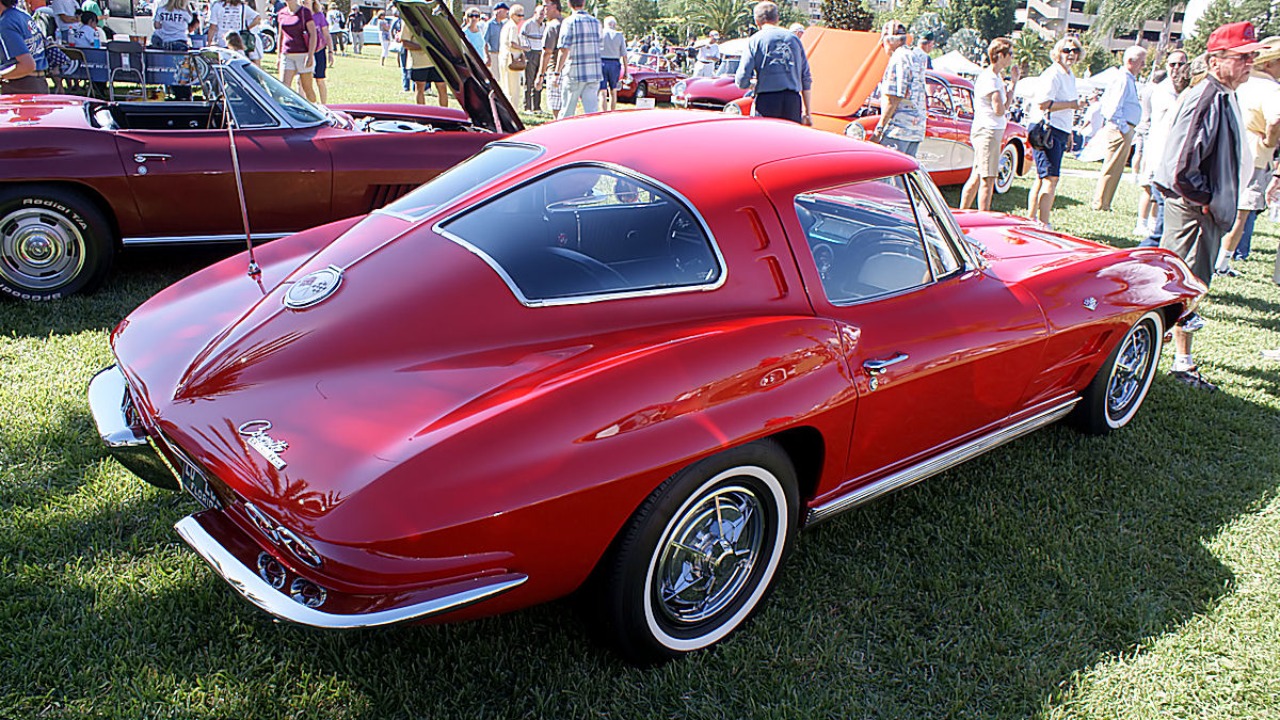
The 1963 Corvette split-window coupe arrived as a rolling piece of sculpture, then vanished from showrooms after a single model year. Buyers saw a beautiful new Sting Ray, not a short-run future collectible, and many never understood why Chevrolet quietly erased its most dramatic styling flourish.
The answer sits at the intersection of design ego, engineering pragmatism, and customer impatience. The split rear glass that defined the 1963 Corvette Sting Ray also divided the people who had to drive, build, and race it, and their complaints eventually outweighed the styling statement.
The one-year wonder that was not planned as one
On paper, the second-generation Corvette was a success from the start. The 1963 car introduced the Sting Ray name, a new chassis, and a coupe body that finally gave Chevrolet a proper hardtop sports car. Sales reflected that momentum. Period figures show that the 1963 Corvette topped 20,000 units, with exactly 10,594 coupes built with the split rear window before the factory switched to a single piece of glass for 1964.
That production run sounds healthy, which is why many casual observers assume the split design must have been a limited edition or a calculated rarity. Contemporary accounts and later histories describe it very differently. The split window was standard on the 1963 coupe, not an option, and the decision to abandon it came only after months of internal friction and external criticism about visibility and safety.
Today, that short run has turned the car into a blue-chip collectible. Auction listings and enthusiast coverage of surviving cars routinely emphasize that the split rear window was a one-year-only feature that collectors chase specifically because it disappeared so quickly. A feature that once pushed some owners to modify their cars has become the single detail that can double the attention a 1963 Corvette receives on a show field.
Bill Mitchell’s statement piece
To understand why the split window existed at all, it helps to look at the personalities behind the 1963 Corvette Stingray Coupe. Chief Designer Bill Mitchell wanted a dramatic, futuristic profile that would stand apart from both European rivals and the outgoing first generation. The spine that runs down the center of the car, culminating in the divided rear glass, came straight out of his sketchbooks and earlier show cars.
Accounts shared by enthusiasts describe how the 1963 Corvette Stingray Coupe sparked a prolonged fight between Chief Designer Bill Mitchell and Chief Engineer Zora Arkus Duntov. One detailed discussion on Corvette Stingray Coupe history notes that Chief Designer Bill Mitchell and Chief Engineer Zora Arkus Duntov clashed repeatedly over that rear window, with Mitchell digging in to preserve the styling and Duntov pushing for better rearward vision and practicality.
For Mitchell, the split was the signature of the entire car. The raised central ridge and twin panes gave the Sting Ray a muscular, almost marine-animal look that tied back to his earlier concept work. In profile and three-quarter views, the effect was stunning. Period photography and later video coverage, including a detailed walkaround of a 1963 Chevrolet Corvette coupe on Jul, highlight how the split glass and tapering roofline made the new car look lower, wider, and more exotic than anything else in Chevrolet showrooms.
From the design studio’s perspective, the split window was not a gimmick that could be tossed aside. It was the visual proof that the Corvette had entered a new era, with a fastback roof and sculpted bodywork that finally matched the performance image Chevrolet wanted.
Zora Arkus Duntov and the engineering revolt
On the engineering side, the split window quickly became a problem. Acting Chief Corvette Engineer Zora Duntov, who had already built a reputation as the performance conscience of the brand, saw the divided glass as a direct threat to the car’s usability. In a detailed recollection shared on a Corvette-focused page, he is described as hating the rear split windows so intensely that he almost lost his job over his opposition.
According to that account, the fiberglass bar that separated the two panes obstructed the driver’s rear view and interfered with race car preparation. For a man obsessed with lap times and high-speed stability, that was not acceptable. The same source recalls that Acting Chief Corvette Engineer Zora Duntov derisively referred to the design as a bat window, a sign of how little he cared for the stylistic flourish.
He was not alone inside General Motors. Later retellings of the internal debate describe a kind of civil war between designers who wanted to protect the Sting Ray’s new identity and engineers who had to answer to safety concerns and customer complaints. A video essay on the controversial rear glass notes that the 1963 Corvette split-window coupe turned heads but also triggered intense debate among Designers and other decision makers within General Motors, who had to weigh aesthetics against function.
Safety concerns, real and perceived
Outside the company, the split window also ran into criticism. A detailed history of the 1963 Sting Ray explains how the car’s engineering, performance, and styling were widely praised, yet the split rear glass generated a steady stream of complaints tied to safety and visibility. The same account, focused on Split Window Corvette Safety Concerns, describes how the design became one of those historical asterisks that enthusiasts now debate.
Drivers reported that the central bar created a blind spot directly behind the car, which made lane changes and backing up more difficult than in the already compromised sports cars of the era. Some owners complained that at night, headlights from following traffic reflected awkwardly off the two panes and the spine between them, which made it harder to judge distance.
Modern coverage of surviving cars reinforces that narrative. A feature on a forgotten 1963 Chevy coupe notes that the two-piece rear window proved troublesome because of safety and visibility issues, which led Chevrolet to replace it with a single, wider piece of glass starting with the 1964 model year. That same report highlights a car whose split rear window is missing entirely, yet collectors still chase it because the underlying 1963 specification remains desirable.
Even enthusiasts who love the look acknowledge the compromise. A social video shared under the caption From the factory it looked unreal, but rear visibility was so poor that Some original owners went so far as to cut out the split and retrofit the later single window, captures how divided the early customer base really was.
Owners who literally cut the car apart
The most dramatic reaction came from owners who decided not to wait for Chevrolet to fix the problem. Period anecdotes and later interviews describe how some 1963 Corvette drivers took their brand-new cars to body shops and requested a conversion to the 1964-style rear glass. That meant cutting out the fiberglass spine, reshaping the opening, and installing a one-piece window that never existed on the assembly line for that model year.
One widely shared video, captioned with the line From the factory it looked unreal, but rear visibility was terrible, shows a 1963 coupe that had its split removed decades ago. The narrator explains that Some owners prioritized daily usability over originality, a choice that seemed reasonable at the time but now horrifies collectors.
That kind of modification helps explain why original split-window cars are so coveted. Not only was the design available for a single model year, a portion of those 10,594 coupes lost their defining feature to aftermarket surgery. In effect, the market thinned its own herd, which has only intensified the mystique around untouched examples.
The press piles on
Enthusiast media of the period did not always side with the stylists either. A detailed retrospective on a 1963 Corvette without a split rear window notes that Duntov was apparently not alone in his dislike for the design. The automotive press blasted the split rear window, criticizing both the obstructed view and what some writers saw as a case of form winning over function.
Such coverage filtered back to potential buyers. For customers who were already wary of fiberglass bodies and sports car quirks, the idea of paying for a new model that reviewers said was harder to see out of made the coupe a tougher sell. The convertible, which never had a split rear window, became the safer choice for anyone who wanted Corvette performance without the visibility controversy.
Inside General Motors, that criticism carried real weight. The company was already facing growing public attention on automotive safety, and management did not want the flagship sports car to become a test case in that debate. The combination of internal engineering pressure, customer complaints, and negative press made the split window harder to defend with each passing month.
How the industry read the split window
Beyond the Corvette program, the 1963 split window became a case study in the tension between styling bravado and everyday usability. A detailed discussion on Corvettes and their influence notes that while the Corvette of 1963 impressed rivals with its aggressive design, the split rear glass also served as a cautionary tale about letting aesthetics override the driver’s needs.
Other manufacturers experimented with bold rear treatments, but few copied the exact split-window concept on a mass-produced sports car. Instead, the lesson many designers took was that dramatic rooflines and glass shapes had to be balanced with clear sightlines. The Corvette team itself applied that thinking almost immediately, keeping the Sting Ray’s fastback silhouette but opening up the rear view with a single large window from 1964 onward.
In that sense, the 1963 coupe influenced the industry twice. First, it showed how far an American manufacturer could push styling on a production sports car. Second, it showed how quickly the market would push back if that styling made the car harder to live with.
From discarded quirk to collector obsession
The irony is that the same qualities that frustrated early owners now fuel intense demand. Modern auction coverage of a 1963 split-window Corvette notes that the split rear window was a one-year-only affair, replaced by a wider single window starting in 1964, and that original cars are in high demand with collectors today.
Specialists point to several reasons. The one-year production run and the number 10,594 give the car a built-in scarcity that is easy to explain to buyers. The design itself has aged well, with the split glass now seen as a piece of rolling midcentury sculpture rather than a practical compromise. The story of the internal battle between Bill Mitchell and Zora Arkus Duntov adds a layer of human drama that collectors love to recount.
Even modified cars that lost their split can attract attention. A recent feature on a forgotten 1963 Chevy describes a coupe whose split rear window is missing, yet enthusiasts still pursue it because the underlying 1963 chassis and styling remain desirable. That example underlines how powerful the one-year association has become. Simply being a 1963 coupe is enough to spark interest, even when the most iconic feature is gone.
More from Fast Lane Only