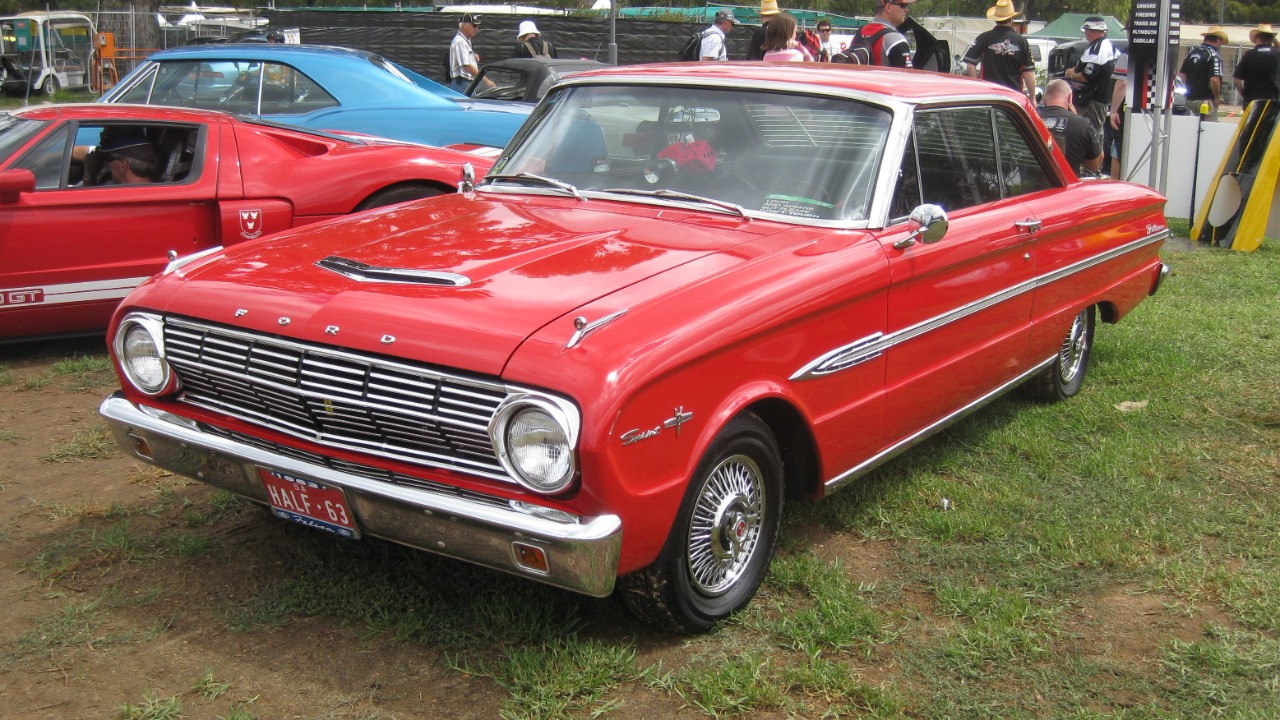
The 1963 Ford Falcon Sprint arrived as a compact coupe with a new sense of purpose, taking a sensible economy car platform and giving it a V8 heart. In doing so, it previewed the formula that would define the Ford Mustang only a year later, from its chassis to its proportions and even its mission. The Falcon Sprint did not just foreshadow a future icon, it tested the idea that American buyers wanted affordable performance in a smaller, stylish package.
From frugal Falcon to sporty Sprint
The story starts with the Ford Falcon itself. The early 1960s Ford Falcon was a compact car that played a significant role in Ford’s lineup, aimed at buyers who valued simplicity and efficiency. Lighter and smaller than the company’s full-size offerings, it quickly became known for straightforward engineering and low running costs, which helped Ford capture customers who were wary of the larger Detroit iron of the time.
By 1963, Ford saw room to stretch the Falcon concept. According to a detailed summary of the period, the Ford Falcon Sprint was a performance oriented variant of Ford’s compact Falcon, designed to add a sporty edge to the economy minded original. That description of the Ford Falcon Sprint captures the shift in thinking inside Ford: the same basic car, now aimed at drivers who cared about style and speed as much as thrift.
The Falcon Sprint package arrived in hardtop and convertible form, and it immediately stood apart from the regular Falcon sedans and wagons. The car sat low and lean, with a clean roofline and a restrained use of brightwork that gave it a more purposeful stance. The basic shape still read as compact and practical, but the intent had changed.
The 260 V8 and a new attitude
Under the hood, the Sprint introduced a feature that would define Ford’s next wave of performance cars. Several period write ups describe the 1963 Ford Falcon Sprint as the lightweight precursor to the Mustang, powered by a 260 cubic inch V8. One enthusiast breakdown of the model lists the engine figure simply as 260, and that number matters because it marked a clear break from the Falcon’s original six cylinder mission.
Another overview of the car’s evolution calls the 1963 Ford Falcon Sprint a game changer, describing it as Ford’s first compact to offer a proper small block V8 in a package that enthusiasts could enjoy. That same account highlights how the Ford Falcon Sprint paired the 260 V8 with a 4 speed manual, presenting it as 260 V8 & 4 Speed Fun in a Compact Package The. That phrasing underlines the combination of powertrain and size that would soon appear again in a different body with a different badge.
Inside, the Sprint received bucket seats, a floor shifter and sportier trim that distinguished it from the more utilitarian Falcon models. The changes were not radical, but they were enough to transform the driving experience. The car still carried the practical DNA of the Falcon, yet it now invited its driver to explore the upper half of the tachometer.
Styling cues that prefigure the Mustang
Visually, the 1963 Ford Falcon Sprint already looked like a prototype for the pony car era. Enthusiast comparisons of the first generation Falcon Sprint and the Mustang note that the Falcon Sprint was the basis for the 1964 Mustang released by Ford one year later. Those same comparisons describe how the Falcon Sprint is nearly identical in key dimensions to the early Mustang, and they emphasize that The Falcon Sprint shared much of its underlying structure with the eventual pony car.
Another retrospective on mid 1960s choices for buyers points out that in 1965, a shopper could choose a Ford Mustang or a Falcon Sprint as they were very similar under the skin. That analysis again stresses that the first generation Falcon Sprint was the basis for the 1964 Mustang released by Ford one year later, and it repeats that The Falcon Sprint is nearly a twin in terms of wheelbase and basic chassis layout. The repeated pairing of Falcon Sprint and Mustang in such accounts shows how closely enthusiasts see the two cars as siblings.
Even in period, observers noticed that the Falcon Sprint’s two door hardtop silhouette, with its long hood and short rear deck, matched the proportions that would soon define the Mustang. The Sprint’s slightly more aggressive grille treatment and trim details hinted at a sportier direction without alienating buyers who still wanted a sensible compact.
The Falcon Futura Sprint on the Mustang trail
One of the clearest links between the compact Falcon and the emerging Mustang idea came through the Falcon Futura Sprint. One detailed historical piece describes how One more important step for the Ford Motor Company on the road to the Mustang was the 1963 Falcon Futura Sprint. In that account, the author explains how the 1960 Falcon had established the basic compact platform, then With the Falcon Futura Sprint Ford tested a more upscale and sporty interpretation of the same hardware.
The Falcon Futura Sprint added trim and equipment that nudged the car closer to what would become the Mustang’s blend of style and performance. The same historical narrative notes that the Falcon Futura Sprint sat directly along the Mustang trail, and it presents the car as a bridge between the plain early Falcons and the more expressive pony car that followed. That bridge role is reinforced by the way later sources describe the 1963.5 Ford Falcon Sprint as a dry run for the Mustang, a phrase that captures how Ford used the Sprint to rehearse the concept of an affordable sporty coupe.
The research behind that history even traces back to specialist commentary such as the material at kitfoster.com, which is cited as Discovered via the work on Along the Mustang Trail and the Falcon Futura Sprint. That citation trail shows how deeply the Falcon Futura Sprint is embedded in discussions of Mustang origins.
Inside Ford: a compact platform with bigger ambitions
From Ford’s perspective, the Falcon family was more than a single model line. It was a flexible architecture that could support several different market niches. One overview of the Falcon’s broader history notes that the 1963 Ford Falcon is a compact car that played a significant role in Ford’s lineup during the early 1960s, and it describes how the car was Known for its simplicity and practicality. That same context helps explain why the platform was so attractive as a starting point for something new.
Another historical survey of the brand refers to The Falcon as a key product that went through its first complete makeover when the 64 m models bowed in late 1963. In that retelling, More chiseled and square edged styling arrived for the 1964 and 1965 cars, and the Second Generation Ford Falcon (1964 to 1965) is described as a sharper, more modern interpretation of the original Falcon. That second generation Falcon is laid out in a guide to the Ford Falcon generations, which also explains how the Falcon platform evolved alongside the Mustang rather than simply disappearing when the pony car arrived.
Another enthusiast source on the Falcon’s legacy adds that the 1963 Falcon served as the Foundation for the Mustang, explaining that the Falcon’s chassis underpinned the Ford Mustang when it debuted in 1964. That same summary emphasizes that The Falcon provided the fundamental hard points for the Mustang’s suspension and drivetrain layout, which helps explain why so many parts interchange between the two cars.
Hardtop hero: the Sprint as milestone
Within the 1963 lineup, the Ford Falcon Sprint Hardtop occupied a special place. One club level overview describes the 1963 Ford Falcon Sprint Hardtop as a sporty variant of the compact Falcon lineup, marking Ford’s move into a more performance oriented compact. In that description, the writer refers to the model as Ford Falcon Sprint Hardtop The and then repeats the full name Ford Falcon Sprint Hardtop while emphasizing that it still sat within the broader Falcon family.
A separate enthusiast summary calls the 1963 Ford Falcon Sprint Hardtop a milestone in the compact’s evolution and explains that The Sprint package brought sporty styling cues and, most importantly, V8 power to the lightweight Falcon body. That same account notes that Under the hood, it carried the 260 V8 that transformed the car’s character. The repetition of The Sprint, Falcon and Under the hood in such coverage shows how central the engine swap was to the car’s identity.
Collectors have since gravitated to these hardtops, and some of the most detailed modern walkarounds, such as the commentary by Jay Leno in his Garage on a Ford Falcon a 63, treat the Sprint as a kind of hidden muscle car in miniature. Leno’s remarks about the Ford Falcon and the way he repeats the number 63 underline how enthusiasts see that model year as a turning point.
Convertible charisma and the enthusiast eye
The Sprint was not just a hardtop. Convertible versions have also drawn attention from historians and collectors. In one video overview, Steve Manti walks through a 1963 Ford Falcon Sprint Convertible in Bogart Georgia at the Tony Townley collection, which was being prepared for auction. As Steve Manti points out details like the bucket seats, floor shifter and V8 engine, the car comes across as a fully formed sporty compact rather than a simple trim package.
That same walkaround highlights how the convertible Sprint combined open air motoring with the more muscular drivetrain, something that would later become a staple of Mustang offerings. The continuity from Falcon Sprint Convertible to Mustang Convertible is hard to miss when viewed through that lens.
How closely did it match the Mustang?
Side by side comparisons of the early Mustang and the Falcon Sprint show just how much the two cars shared. Several enthusiast discussions stress that the first generation Falcon Sprint was the basis for the 1964 Mustang released by Ford one year later, and they repeat that The Falcon Sprint is nearly the same in wheelbase and track as the early Mustang. Another community that focuses on Ford history echoes that point, again stating that the first generation Falcon Sprint was the basis for the 1964 Mustang released by Ford one year later and that The Falcon Sprint is nearly indistinguishable from the Mustang in some underbody views.
One detailed feature on mid sixties choices for buyers even notes that in 1965, a shopper could pick a Falcon Sprint or a Mustang and find that they were very similar in structure and mechanical layout. That piece again names the Falcon Sprint and Mustang together, and it underscores that Ford marketed both under the same corporate umbrella, Ford, even as the Mustang took on a more glamorous image.
More from Fast Lane Only