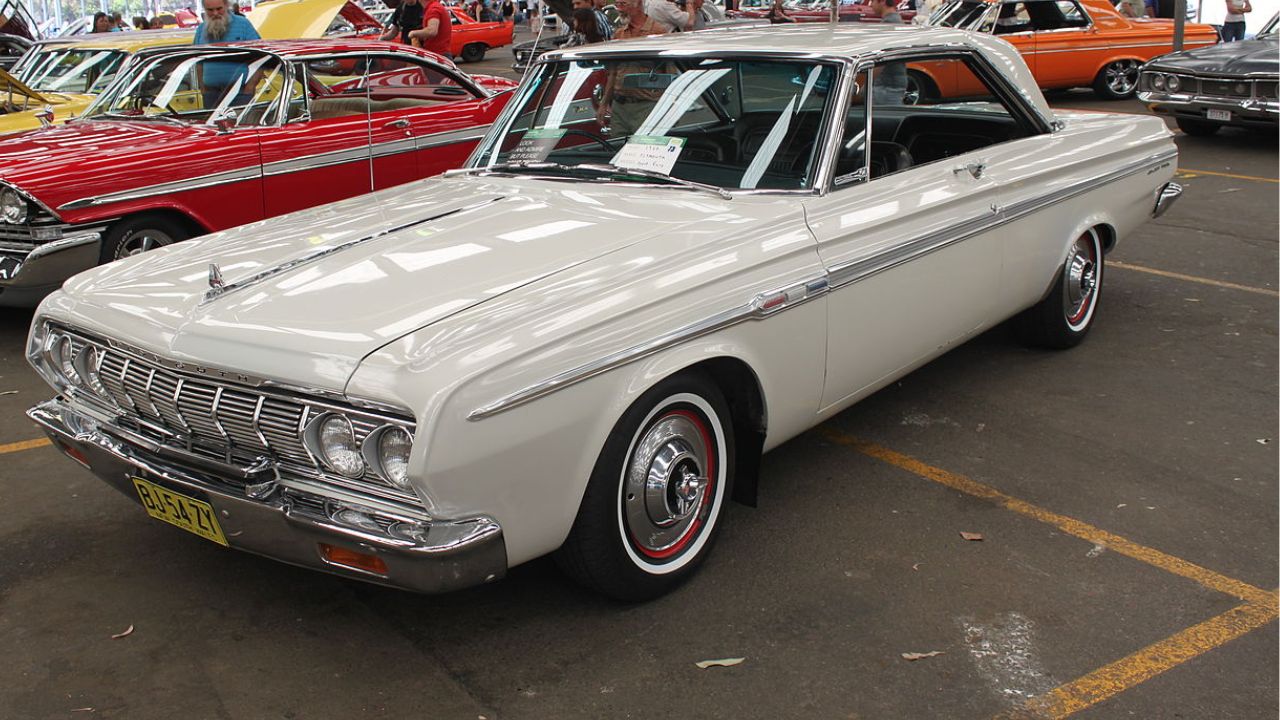
The 1964 Plymouth Sport Fury arrived at the height of Detroit’s horsepower contest, dressed in crisp lines and bright trim yet engineered with a seriousness that went beyond boulevard posing. It was sold as the flashiest member of the Plymouth full-size family, but its chassis, engine choices, and racing pedigree gave it a depth that still resonates with enthusiasts six decades later.
The top of the Plymouth full-size heap
Within the Plymouth hierarchy, the Sport Fury sat at the peak of the full-size range. Full-size Plymouths in the early sixties adopted revised styling, and the Sport Fury remained the top-line trim level for buyers who wanted the sharpest combination of appearance and performance. The Sport Fury name itself signaled that this was not simply another family sedan, but a halo model designed to pull buyers into showrooms.
Outside, the new twosome of Sport Fury hardtop and convertible stood apart from lesser Furys with black grille accents, special wheel covers, and belt molding extension that visually stretched the car and emphasized its length. These touches reinforced the Sport Fury as a more dramatic interpretation of the basic Plymouth Fury package, aimed at drivers who wanted to stand out.
Styling that squared its shoulders
By 1964, Plymouth styling had moved away from the exaggerated curves of the late fifties into a cleaner, squared-off look. Contemporary descriptions of the Plymouth Fury highlight bold, clean design and powerful engine options, and the Sport Fury shared that same basic body with added brightwork and trim. The car delivered crisp, squared surfaces that aligned with mid-sixties tastes, avoiding the excess chrome of earlier years in favor of a more disciplined shape.
On the hardtops, an extra-large wraparound backlight created a dramatic roofline that flooded the cabin with light. According to period fact sheets, this glass was paired with roof pillars that were much wider at the top than the bottom, a design that gave the car a planted, almost formal appearance while still reading as sporty. That mix of visual mass and glass area helped the Sport Fury look serious from some angles and almost airy from others.
Inside, flash with function
Inside the Sport Fury, Plymouth leaned into the idea of a personal performance car. Bucket seats and a center console were common features in these top-level models, separating driver and passenger and giving the cabin a cockpit feel. Materials were upgraded over base Furys, with bright trim and textured surfaces that matched the exterior’s upscale message.
The interior was not only about shine, though. Instrumentation was oriented toward the driver, and the layout left enough room for real-world use, from daily commuting to long highway trips. The Sport Fury had to serve as a family car as much as a weekend toy, and the cabin reflected that double life with generous space and practical controls that did not get lost in decorative gimmicks.
Under the skin: simplified, serious power
Under the hood, Plymouth simplified the engine lineup for its mid-size and full-size offerings, focusing on combinations that would satisfy both mainstream buyers and performance customers. Contemporary technical summaries of the Plymouth Mid range show that the company concentrated on a smaller number of engines, including big-block V-8s that delivered strong acceleration in street trim.
From 1962 through 64, Max Wedge 413 and 426-cu.in. V-8s were famously tearing up America’s drag strips, setting speed records and cementing Plymouth’s reputation among racers. Those Max Wedge 413 and 426-cu engines were not everyday Sport Fury fare, but their presence in the broader Plymouth catalog influenced how buyers saw the entire line. Magazine coverage of a later Sport Fury build notes that a 426-cu engine could be rated at a strong 365 horsepower, a figure that placed Plymouth squarely in the performance conversation.
Factory horsepower wars and racing credibility
The 1964 model year landed right in the peak of the factory horsepower wars, and Plymouth used the Sport Fury as a showcase for what its engineers could do. A period account of Plymouth’s racing involvement describes how the brand set the automotive world on fire when it released the newly designed 64 model, which shared much of the chassis with earlier cars but came with more refined bodywork and suspension tuning. In that environment, the Sport Fury became a natural platform for drag racing and stock car efforts.
From 1962 through 64, Max Wedge 413 and 426-cu engines were at the center of these efforts, and the Sport Fury body style frequently appeared at the strip. A later feature on a restored car recounts how those Max Wedge packages were aimed squarely at America’s quarter-mile tracks, where they set speed records and intimidated rivals. The Sport Fury’s role in that story gave it credibility that went far beyond chrome and badges.
Real-world structure: more than a pretty shell
Surviving examples reveal how solidly these cars were built. One detailed inspection of a 1964 Plymouth Sport Fury hardtop describes a car that is all business and all original, with the frame, rockers, body hangers, and floor pans looking straight and secure with no rot. That particular All original structure suggests that Plymouth’s unibody construction and rust protection were better than some rivals, at least when owners kept the cars out of the worst conditions.
The same account notes that the car spent its life on the streets of Myerstown, Pennsylvania, a real-world test for any chassis exposed to winter weather and road salt. The fact that the frame rails and floor pans remained intact decades later gives weight to the idea that the Sport Fury combined style with genuine structural integrity. It was not a flimsy shell wrapped around a powerful engine, but a complete package designed to handle the stress of both daily use and aggressive driving.
How it drove: balance over bravado
Contemporary and modern impressions of the 1964 Plymouth Fury family suggest a car that favored balance over pure straight-line bravado. The suspension tuning, combined with the relatively clean aerodynamics of the squared-off body, produced a stable highway cruiser. Enthusiasts who have driven restored Sport Furys describe steering that feels heavier than modern cars but communicates what the front tires are doing, and brakes that, while not up to present standards, were competitive for the era.
In period form, a Sport Fury equipped with a big-block V-8 and proper gearing could run hard on the highway and still manage city traffic without constant drama. That dual character was central to its appeal. Buyers could enjoy the sound and surge of a large engine on open roads, then settle into a comfortable ride for the commute home.
Design details that signaled intent
Several exterior details helped the Sport Fury broadcast its intent. Black grille accents framed the headlights and gave the front end a more aggressive expression than base models. Special wheel covers, often with turbine or multi-spoke patterns, filled the wheel openings and visually lowered the car. Belt molding extension along the sides tied the front and rear together and emphasized the car’s length.
These touches were subtle compared with the stripes and spoilers that would define later muscle cars, but they were enough to separate the Sport Fury from ordinary Furys at a glance. Enthusiast commentary on social platforms describes the 1964 Plymouth Sport Fury as a striking example of mid-sixties American performance and style, with long, sleek body lines that capture the era’s taste for speed and sophistication. One such post highlights the Plymouth Sport Fury as a standout in American car culture, underscoring how its design has aged gracefully.
On-screen and online, a continued presence
The Sport Fury’s mix of flash and depth has helped it remain visible in modern media. A detailed video walkaround of a 1964 Plymouth Savoy, Belvedere, Fury and Sport Fury on the series If This Car Could Talk brings viewers close to the design and engineering choices that defined the model. In that episode, available on Car Could Talk, the host frames the Sport Fury as part of a broader Plymouth story that includes both family transportation and high-performance experimentation.
Another modern reference point comes from a segment focused specifically on the 1964 Plymouth Sport Fury, shared by a restoration and muscle car program. In that video, introduced with the line Back in the peak of the factory horsepower wars, the Sport Fury is presented as proof that Plymouth could build a full-size car that looked classy and still ran hard. The clip, hosted on Back, emphasizes that this was an era before the muscle-car boom fully exploded, which makes the Sport Fury feel like a bridge between the restrained early sixties and the wild late decade.
Engineering support that still exists
The continued interest in these cars has created a small but steady ecosystem of replacement parts and technical knowledge. Suspension specialists, for example, catalog springs and related hardware specifically for the 1964 Plymouth Fury and Sport Fury, reflecting ongoing demand from owners who want to keep these cars on the road. One such catalog, linked from the Plymouth Mid Size Cars Fact Sheet, lists dedicated components for the Fury, Sport Fury, Belvedere, and Savoy, showing how closely related these models were under the skin.
The presence of applications for Plymouth Fury, Plymouth Sport Fury, Plymouth Belvedere, and Plymouth Savoy in modern parts databases confirms that the basic chassis and suspension architecture has proven durable enough to support long-term restoration. That structural continuity is another sign that the 1964 Sport Fury was built with more than short-term fashion in mind.
How enthusiasts interpret it now
Modern owners and fans tend to see the 1964 Sport Fury as a kind of missing link between the finned excess of the late fifties and the pure muscle cars that would follow. In online discussions and social posts, the car is often praised for its restraint. It has presence without cartoonish proportions, and its performance credentials are earned rather than implied by decals.
Some enthusiasts focus on the Max Wedge heritage, pointing out that from 1962 through 64, Plymouth used the same basic body shell to house some of the fiercest drag racing engines of the period. Others emphasize the car’s day-to-day livability, citing examples like the all original hardtop that spent decades in Pennsylvania and still retains solid frame rails and floors. Both perspectives feed into the same conclusion: the Sport Fury balanced visual drama with engineering substance.
A car that lived up to its name
In the crowded field of mid-sixties American performance cars, the 1964 Plymouth Sport Fury did not rely solely on chrome or marketing slogans. It backed up its sporty name with real hardware, from big-block engines and Max Wedge relatives to a unibody structure that could survive decades of use. Its styling was flashy enough to turn heads, but its squared-off lines, wraparound backlight, and carefully chosen trim gave it a disciplined look that still appeals to modern eyes.
That combination of flash and something deeper is why the Sport Fury continues to appear in restoration shops, online videos, and enthusiast conversations. It represents a moment when Plymouth found a sweet spot between family duty and factory horsepower wars, and built a car that could handle both with confidence.
More from Fast Lane Only