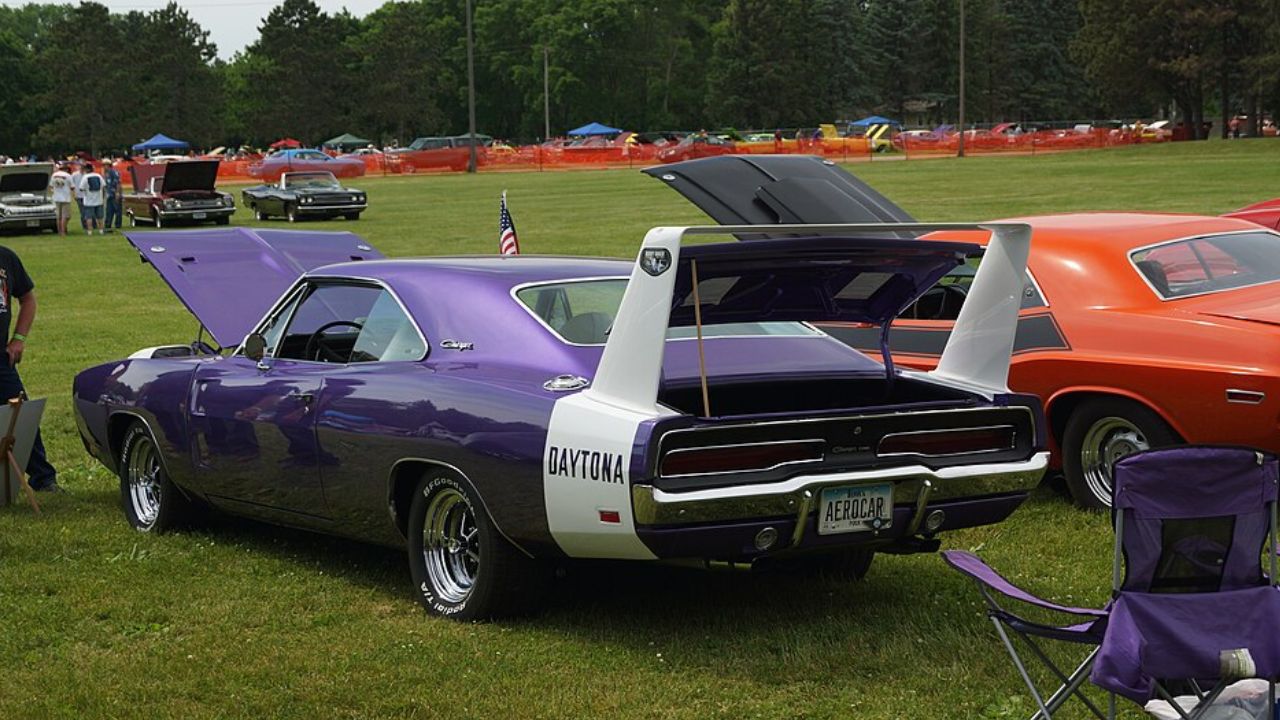
The 1970 Dodge Daytona looked like a science project that escaped a wind tunnel, a wedge of steel and sheetmetal that broke every styling rule of its era. It was not built to win beauty contests or to cruise quietly down Main Street. It existed for a single purpose: to do something no one had ever seen before on an American oval track and to change stock car racing in the process.
That purpose was speed, not in the abstract but as a measurable, frightening number on a timing sheet. The Dodge Charger Daytona was engineered to slice through the air, to topple records, and to force an entire racing series to rethink what “stock” really meant. The fact that it later became a collectible icon was almost an accident.
The moonshot that came from a missile division
The story of the 1970 Dodge Daytona starts long before fans saw that towering rear wing in the grandstands. Inside Chrysler, racing had become a matter of corporate pride. Dodge had been outgunned on the superspeedways, and leadership turned to engineers with backgrounds that sounded more like aerospace than automotive. One key figure moved from the Chrysler missile division into the Chrysler testing grounds, a shift that captured how seriously the company treated the problem of drag and lift on its race cars.
This was not a styling exercise. It was a program rooted in data, wind tunnels, and the kind of thinking that had more in common with rockets than with road cars. As one period account of the project notes, the engineer arrived at the proving grounds with a mandate to fix Dodge’s high-speed stability and to give the brand a car that could dominate the long, banked tracks that defined top-level stock car racing. That effort would eventually crystallize in the Dodge Charger Daytona, a car that looked almost alien in the context of late 1960s muscle.
On paper, the Daytona was still a Dodge Charger. In reality, it was a purpose-built tool for one job: turn more speed on the big ovals than any rival could match, and do it reliably enough to win championships.
From slab-sided Charger to winged warrior
The regular Charger had the power but not the aerodynamics. At high speed, its bluff nose and recessed grille acted like a parachute. Engineers attacked that problem with a pointed nose cone that extended the front of the car and cleaned up the airflow. Period descriptions of the 1970 Dodge Charger Daytona, including one that refers to the car as the Dodge Charger Daytona “Demon” 1970, highlight that iconic nose cone and the massive rear wing as the visual signatures of a machine engineered for aerodynamic efficiency.
That nose cone did more than look dramatic. It reduced drag and helped keep the front tires planted when the car pushed beyond the speeds that had been possible for earlier stock bodies. At the rear, the tall aluminum wing mounted on struts over the trunk lid generated downforce that pressed the back of the car into the track surface. One detailed look at a surviving example notes that the wing only needed to be about half as tall to work effectively, and that its height was chosen in part so the trunk lid could still open under it. Functional engineering and basic practicality met in a single, unforgettable piece of hardware.
Side by side with its corporate cousin, the Plymouth Superbird, the Dodge Daytona formed a pair of so-called winged warriors. Both cars shared the same philosophy: sacrifice conventional styling for outright speed. Enthusiast analysis of the Dodge Daytona vs pairing underlines how radical that approach looked on American streets at the time.
Born to win on the superspeedways
Inside Dodge, the Daytona program was framed as a racing solution, not a marketing gimmick. A detailed video history of the project describes how one engineer, after leaving the Chrysler missile division, went to the Chrysler testing grounds specifically to solve Dodge’s superspeedway problem and to create what internal voices believed could be the fastest stock car ever built. That account traces the way data from test tracks and wind tunnels fed directly into the final shape of the car.
Those early tests involved long days of incremental adjustments. The team experimented with nose angles, wing heights, and even small details like fender openings to manage airflow around the tires. The result, as one enthusiast group later summarized, was a car that looked unlike anything else on the road, built specifically to dominate high-speed superspeedways. A social media discussion of a Bobby Isaac Dodge Daytona from 1970 calls out how the end product stood apart from the rest of the muscle car era, not because of chrome or stripes, but because every major surface had been shaped by aerodynamics.
In that sense, the Daytona was less a muscle car and more a racing prototype that happened to be sold in showrooms. Homologation rules required Dodge to build road-going versions, which is why the public ever saw the nose cone and wing outside a racetrack fence.
The day Buddy Baker broke 200
The clearest proof of the Daytona’s purpose arrived when Buddy Baker climbed into a Dodge Charger Daytona and set out to rewrite the record books. At Alabama International Motor Speedway, later known as Talladega, Baker used the car’s slippery body and immense power to exceed 200 m on the high banks. One historical account of that run states that on that day in 1970, Buddy Baker drove a Dodge Charger Daytona to more than 200 m at Alabama International Motor Speedway, a moment that marked a new frontier for stock cars.
A separate retrospective on the same achievement describes how Baker patiently brought his Dodge Daytona up to speed during a full day of testing. Conditions were not ideal at first, with a damp surface early on, but as the track dried and the team refined the setup, Baker continued to push. Eventually he eclipsed the 200 mph mark with a lap of 200, a figure that turned the Daytona from an experiment into a legend. That account of the 200 mph Dodge captures the mix of patience and audacity behind the record.
Later tributes describe that same event as a World Closed Course Speed Record of more than 200 mph for a stock car. One social media post that revisits the anniversary notes that on that day in automotive history, Buddy Baker drove a Dodge Charger Daytona to a new World Closed Course Speed Record of over 200 mph, cementing both his name and the car’s in racing lore.
The one-year wonder that forced a rulebook rewrite
The Dodge Daytona did not dominate alone. Alongside the Plymouth Superbird, it formed a two-car armada that transformed the 1970 NASCAR season. A video highlight reel of that era points out that the Plymouth Superbird and Dodge Daytona combined to take the checkered flag in 33 of 48 races during the 1970 NASCAR season. That level of success was not a fluke. It was the direct result of the aerodynamic advantage that the nose cones and wings provided on the fastest tracks.
For competitors and officials, the message was clear. If one manufacturer could apply aerospace thinking and missile-division expertise to a stock car, others would follow. The winged cars pushed speeds to a level that made sanctioning bodies uncomfortable. Safety concerns grew as lap times fell, and the rulebook began to change. Limits on engine displacement, restrictions on certain body styles, and tighter homologation rules all followed.
The Daytona and Superbird were effectively victims of their own success. They had been built to dominate, and they did. Once they proved the concept, regulators moved to rein them in. That is why the cars are often described as one-year wonders: they burned bright, then disappeared from top-level competition almost as quickly as they had arrived.
What it was like on the street
Homologation meant ordinary buyers could, in theory, walk into a dealership and buy a Dodge Charger Daytona. A modern enthusiast group post describes the 1970 Dodge Charger Daytona as an iconic and rare muscle car known for its distinctive aerodynamic design and impressive speed capability. The same discussion notes that the 1970 Dodge Charger Daytona was built for speed and performance and that it has become a symbol of performance and innovation, phrases that capture how the car is remembered today.
On public roads, the Daytona’s race-bred hardware created a strange contrast. The nose cone sat low and sharp, a pointed reminder that this was not a typical Charger. The rear wing towered above the trunk, high enough that drivers could see it in the rearview mirror like a fixed spoiler on a race car. Owners quickly learned that the car attracted attention wherever it went, from gas stations to small-town main streets.
Yet the same features that made the Daytona a terror on the track could be awkward in traffic. The long nose made parking more of a challenge. The wing drew the eye of every police officer and curious passerby. Some buyers reportedly removed or modified the aero pieces, not realizing that they were dismantling what would one day become some of the most valuable hardware in American muscle car history.
The “Demon” and the afterlife in pop culture
Decades after its short racing career, the Dodge Charger Daytona has taken on a second life in games, collectibles, and online communities. A social media post focused on a mobile racing title refers to the Dodge Charger Daytona “Demon” 1970 and highlights its iconic nose cone and massive rear wing, describing how it was engineered for aerodynamic performance. That post invites players to experience the car virtually and even asks if they want to see more content about it, a sign of how the Daytona’s legend has migrated into digital culture.
The same thread links out to a dedicated page that further showcases The Dodge Charger Daytona and the Demon branding within that game universe. Another link in the chain leads to a platform where fans of the title share content about The Dodge Charger Daytona and Demon, showing how a car built for a very specific 1970 racing rulebook now entertains a generation that knows it primarily from screens rather than from grandstands.
That digital afterlife has real-world echoes. Collectors chase original Daytonas, while scale model builders trade notes on details such as the correct shape of the nose cone or the placement of the rear wing bracing. A post in a model car hobby group that features a Bobby Isaac Dodge Daytona from 1970 emphasizes how the car’s unusual window net and bodywork set it apart, even in miniature form.
More from Fast Lane Only