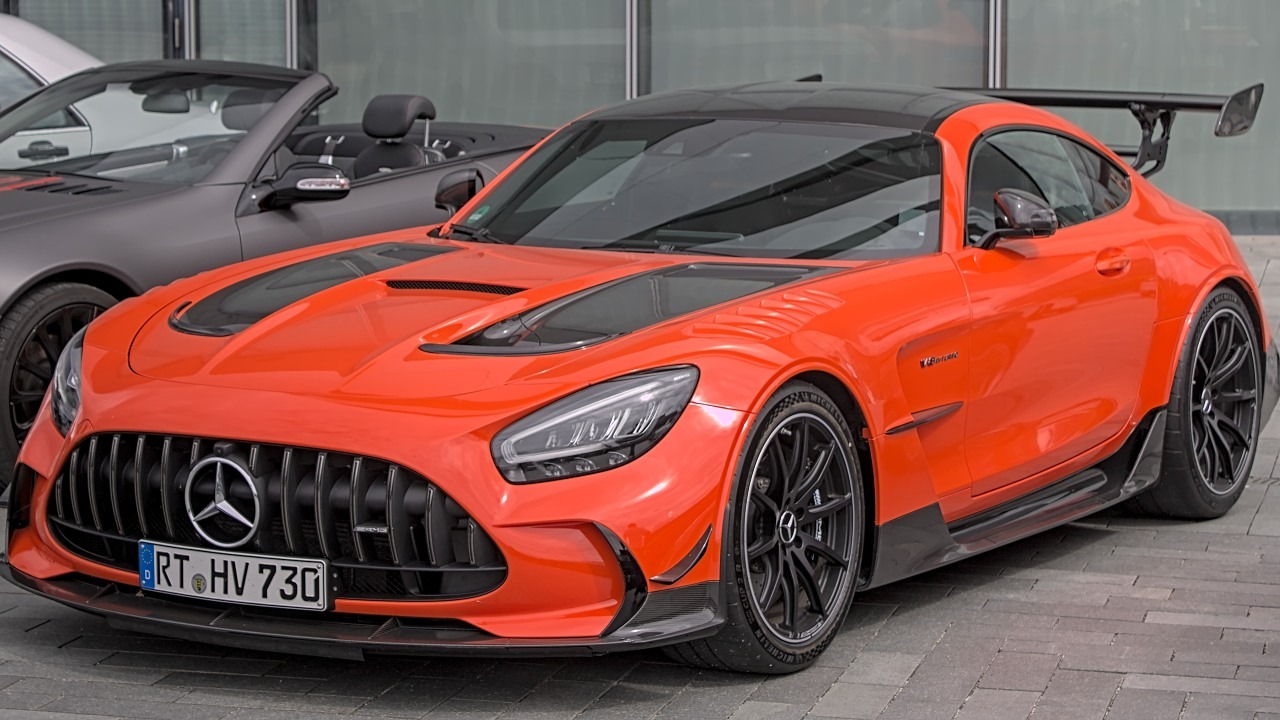
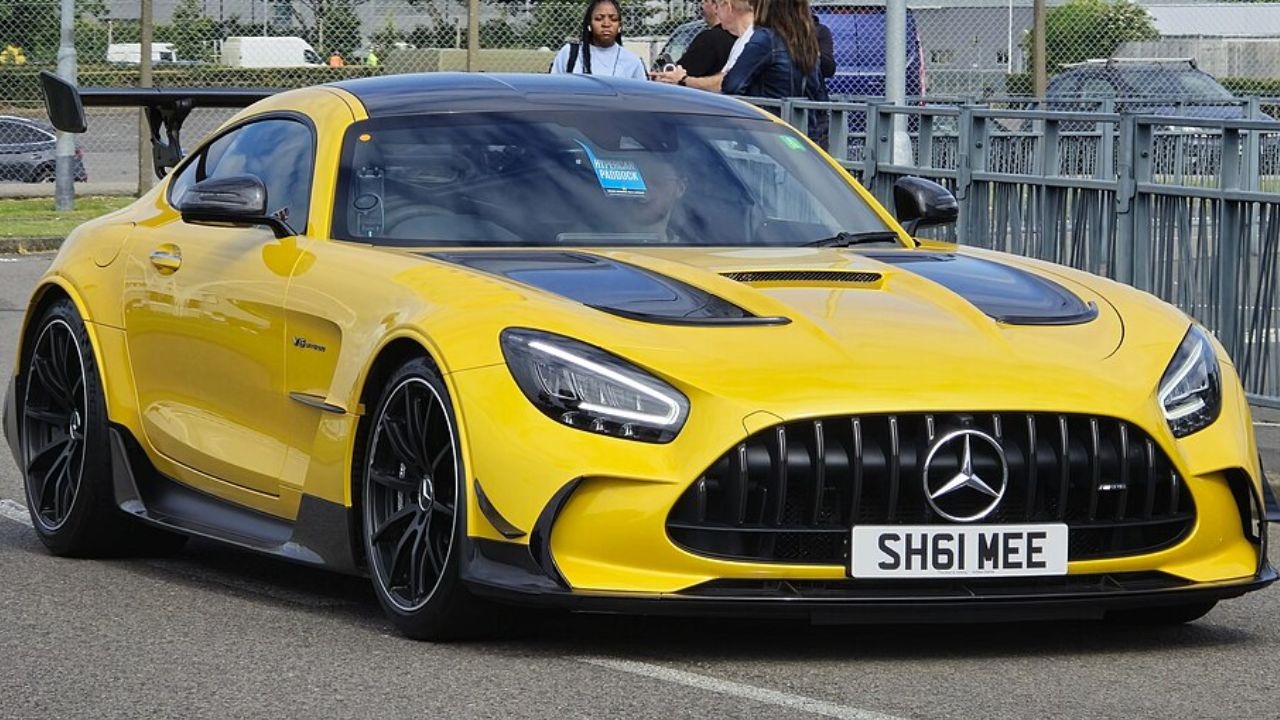
The Mercedes-AMG GT Black Series is not a subtle car. It looks like it has rolled straight out of a GT paddock and onto public tarmac, bristling with vents, wings and hardware that make most supercars seem underdressed. It is a road-legal machine that wears its intent openly, a car that appears ready for battle before the engine has even fired.
From its towering rear wing to its jutting front splitter, every surface signals that this is the most aggressive evolution of the AMG GT formula. I see it less as a special edition and more as a homologation-style statement, a car built to close the gap between customer road cars and the AMG GT3 racers that inspired it.
The most extreme AMG in the family
The GT Black Series sits at the top of the Mercedes performance hierarchy, and its bodywork makes that hierarchy instantly clear. The proportions of the standard GT are still there, but they are buried under a layer of motorsport aggression, with GT-racer influenced looks, vast air inlets and an aerodynamics package focused on downforce rather than boulevard posing, a philosophy that underpins its reputation as the most extreme AMG yet and is detailed in depth in this overview. The result is a silhouette that looks less like a grand tourer and more like a factory race car that happens to wear number plates.
That visual drama is not cosmetic. The huge rear wing, deep front splitter and fender extractors are all working parts of a package that aims to generate serious grip at serious speed. You cannot miss the new two-piece carbon-fibre rear wing, which carries an electric flap in the upper blade to trim drag or add stability, a detail that underlines how far AMG has gone to turn the GT into a track weapon and is highlighted in the official reveal description. When I look at the car in profile, the message is simple: this is not a styling exercise, it is an aero kit that happens to be beautiful.
A twin-turbo V8 reworked for combat
Under the long bonnet, the GT Black Series uses a version of AMG’s familiar 4.0‑litre twin-turbo V8, but the engineering team has treated it as a clean-sheet opportunity rather than a mild tune. The engine is codenamed M178 LS2 and is described as the most powerful turbocharged AMG 4.0‑liter V8, fine-tuned for optimal firing at minimal displacement to deliver race-car urgency from low revs, a configuration laid out in detail in the technical breakdown. That specification matters, because it explains why the Black Series feels so different from the already ferocious GT R and GT Pro siblings.
On track, the character of this V8 is defined by its willingness to rev and its relentless mid-range, traits that testers have linked directly to AMG’s decision to adopt a flat-plane crank layout for this engine. One detailed review lists as a key advantage the “insane mid- and top-end” that comes from that flat-plane crank, describing the car as about as close as you will get to piloting a race car on the road, a verdict that captures the engine’s ferocity and is backed up in a set of track-focused impressions. For me, that combination of engineering detail and subjective violence is what makes the Black Series powertrain feel like it belongs in a pit lane more than a parking garage.
Aero, chassis and the feel of a factory racer
The bodywork is only the most visible part of a chassis package that has been tailored to behave like a GT3 car that tolerates public roads. With its huge rear spoiler, jutting front splitter, fender extractors and triple-level diffuser, the car is designed to generate serious downforce and to keep the front axle keyed into the tarmac even at very high speed, a set of details that are laid out in a comprehensive 2021 review. The same analysis notes how the aero work is paired with a stiffened structure and track-focused suspension, which together give the car a sense of purpose that is obvious even at low speed.
From behind the wheel, that hardware translates into a steering feel and balance that demand commitment but reward precision. One Australian first drive describes the steering as “lantern-jawed,” a vivid phrase that captures how solid and unflinching the front end feels when you lean on it, and goes on to explain how the chassis lets you work the masses around to your advantage, a dynamic character that is unpacked in the Australian first drive. I read that as a sign that AMG has not tried to tame the car for casual drivers; instead, it has built a platform that comes alive when you treat it like the track car it resembles.
Performance that backs up the posture
For a car that looks this aggressive, straight-line numbers matter, and the GT Black Series delivers figures that match its stance. Output has risen significantly over the already potent GT Pro, with power and torque lifted to the point where the car can launch to 100 km/h in a claimed 3.2 seconds and continue on to a top speed that places it firmly in the upper tier of modern supercars, a step-change that is spelled out in a detailed output and acceleration breakdown. Those numbers are not just for bragging rights; they are the foundation for the car’s record-chasing ambitions.
The clearest proof of that ambition came at the Nürburgring Nordschleife, where the GT Black Series set records as the fastest production car around the circuit. What makes that achievement more striking is that driver Maro Engel, who spends his day job in an AMG GT3 race car on slick tyres, described the Black Series as being on another level compared with typical road machinery, a perspective captured in the report on its Nürburgring record. When a professional racer who lives in GT3 machinery talks about a road car in those terms, it confirms that the Black Series is not just theatrics; it is a genuine time-attack tool.
Track focus, price and the reality of living with it
All of this engineering and performance comes at a price, both financial and practical. The GT Black Series is positioned as a track-ready flagship that uses an upgraded version of the GT’s twin-turbocharged 4.0‑litre V8, and its pricing reflects that status, with official figures placing it well above the rest of the AMG GT range and pairing that cost with a claimed 0–100 km/h time of 3.2 seconds that underlines its intent, a combination laid out in the official pricing and specs. For buyers, that means accepting that they are paying for lap time and engineering depth rather than day-to-day convenience.
On circuit, that trade-off makes sense. One detailed track review notes that AMG opted for a flat-plane crank to sharpen the engine’s response and describes the sound as more primal and more stridently mechanical than other AMG V8s, a character that suits the car’s hardcore brief and is unpacked in Glenn Butler’s track review for Drive. For me, that detail captures the essence of the GT Black Series: it is a car that looks ready for battle because it has been engineered for one, a machine that prioritises lap times, feedback and drama over subtlety, and that feels most at home when the pit lane light turns green.