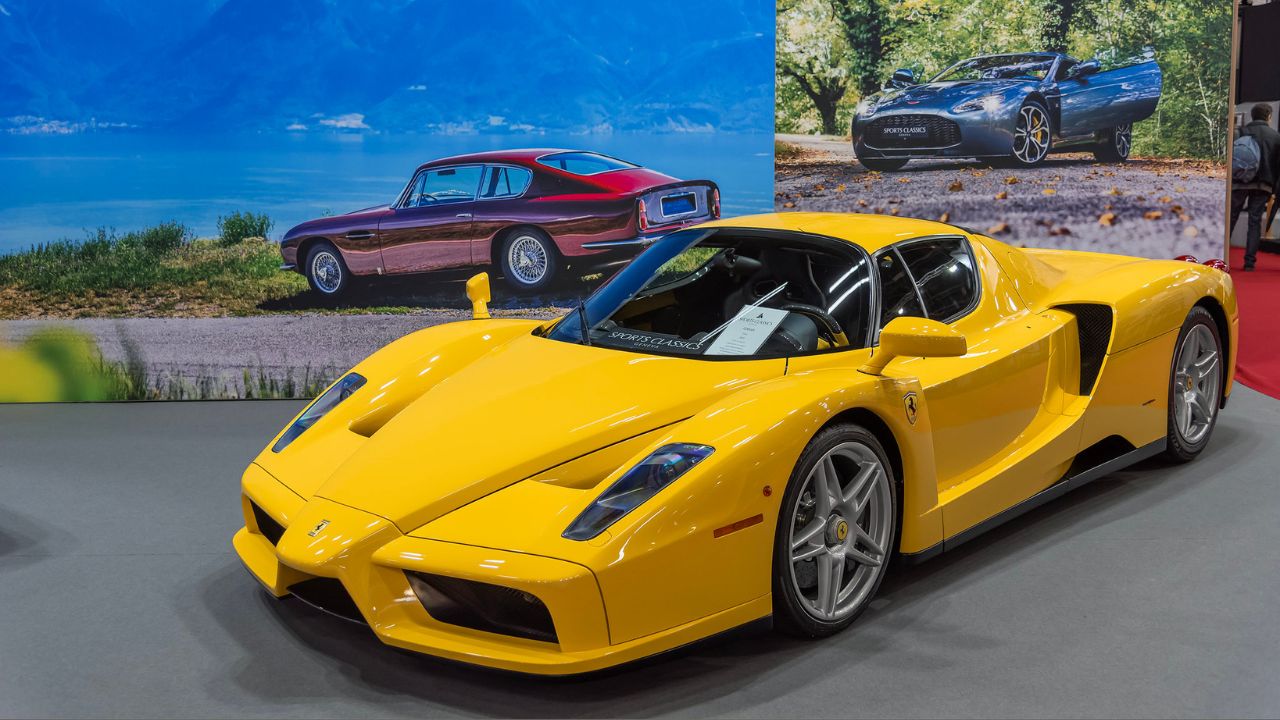
The Ferrari Enzo arrived at a moment when supercar performance was being rewritten by racing technology, and it turned that shift into a new benchmark for the road. By fusing Formula 1 thinking with a purist, naturally aspirated V12, it created an era in which outright speed, control and drama were redefined for a generation of halo cars. Two decades on, its influence still shapes how the industry thinks about the limits of a road‑legal machine.
The Enzo as a turning point in Ferrari’s halo lineage
When I look at the Ferrari Enzo in context, it reads as the decisive bridge between old‑school analog excess and the data‑driven hypercars that followed. Officially marketed as Enzo Ferrari, the car carried the name of the company’s founder and was built in limited numbers as a mid‑engine flagship that sat above the regular range, a role that earlier icons like the F40 and F50 had defined in their own eras. The model, internally known as Type F140, used a carbon fiber structure, a naturally aspirated V12 and a stripped‑back cabin to prioritize performance over comfort, a philosophy that is clear in the technical profile of The Ferrari Enzo.
That positioning was not accidental. The Enzo, launched for the early 2000s, was conceived as a “High‑Tech Halo” project that could showcase the most advanced materials and electronics Ferrari was willing to homologate for the road. It arrived without the emissions and packaging compromises that had constrained some earlier specials, and it leaned on a clean‑sheet carbon chassis, a new F140 V12 and a focus on weight reduction to deliver a step change in performance. The way that High, Tech Halo, Ferrari Enzo, Launched, Enzo is described underlines how deliberately Ferrari used this car to reset expectations for what a road‑going flagship could be.
Race car technology brought to the road

The Enzo era is defined by how aggressively Ferrari transplanted Formula 1 thinking into a street‑legal package. The company itself describes The Enzo as the link between racing know‑how and road use, noting that its carbon fiber tub, ceramic brake discs, human‑machine interface and aerodynamic features were all derived from contemporary single‑seater practice. That philosophy is spelled out in the way The Enzo, on the other hand, went down in history as a direct transfer of F1 technology, and it is the core reason the car still feels like a watershed moment rather than just another limited‑run special.
That motorsport DNA is visible not only in the materials but in the way the car is laid out and presented. The engine is mounted behind the passenger compartment and displayed under glass, a layout that highlights the mechanical centerpiece and echoes the way a single‑seater exposes its power unit as a functional sculpture. Contemporary analysis notes that this V12 is “Also special” because it integrates systems and functionality from an F1 car, a point underscored in coverage that describes how the powertrain and its ancillaries were packaged for both performance and drama, as seen in the detailed look at Aug and Also special is the engine.
Design, aerodynamics and the pursuit of control
From a design standpoint, the Enzo era marked a shift from sculptural beauty toward functional aggression, and that choice has echoed through supercar styling ever since. The bodywork is dominated by sharp edges, deep cutouts and a nose that looks more like a prototype racer than a traditional grand tourer, all in service of downforce and cooling. The official technical description of Type highlights how the car’s shape, underbody and active elements were tuned to keep the chassis stable at very high speeds while managing airflow over the mid‑mounted engine and brakes.
That focus on control rather than just headline power figures is echoed in performance analysis that breaks down how the Ferrari Enzo behaves at the limit. Contemporary testing emphasizes that the car’s aerodynamics and suspension tuning were engineered to deliver stability in high‑speed maneuvers and confidence in hard cornering, not simply straight‑line acceleration. The way one technical guide describes the car “unleashing the beast” in terms of braking, cornering and high‑speed behavior captures how the Enzo’s aero package and chassis electronics worked together to make its performance exploitable, a point reinforced in the detailed breakdown of Unleashing the Beast.
The Enzo’s place in Ferrari history and culture
Within Ferrari’s own narrative, the Enzo is framed as a tribute to il Commendatore and a culmination of decades of racing and road‑car development. It sits in a lineage that stretches from classic sports racers to modern hypercars, and its very name signals that it was meant to embody the brand’s core values of performance, exclusivity and technical daring. Enthusiast histories describe the Ferrari Enzo as one of the most revered and celebrated supercars, a fitting tribute to Commendatore that distilled the company’s racing success into a road‑legal statement, a view that is clear in the comprehensive overview of Ferrari Enzo.
That cultural weight is amplified by the way Enzo Ferrari’s philosophy continues to shape modern supercar design. Analyses of his legacy emphasize his insistence on marrying performance, luxury and aesthetics, a balance that can be seen in the Enzo’s combination of bare‑carbon engineering and dramatic styling. The car’s era sits within a broader story in which Enzo’s emphasis on that three‑way blend still influences contemporary halo models, a connection drawn explicitly in discussions of how Enzo shaped the trajectory from mid‑century racers to modern supercars.
How the Enzo reshaped expectations for future hypercars
The Enzo did not just cap an era, it set the template for what came next. Later hybrid and turbocharged hypercars from multiple brands adopted the idea that a flagship should be a rolling technology demonstrator, a concept that traces directly back to the way Ferrari used its F1 dominance as a springboard for this car. Contemporary market analysis notes that the Enzo drew directly from that period of racing success to celebrate technical leadership while laying the groundwork for the hybrid and turbocharged hypercars that followed, a throughline made explicit in coverage that describes Drawing from Ferrari’s era of F1 success.
Inside the company, that influence is visible in how later limited‑run models continued to borrow from top‑tier motorsport programs, but the Enzo remains the clearest expression of that philosophy in naturally aspirated form. It took lessons from earlier icons and applied them with a more systematic, engineering‑led mindset, a progression that is spelled out in technical retrospectives that describe how The Enzo, launched in 2002, synthesized knowledge from previous halo cars and even informed projects aimed at the FIA GT Championship. That evolution is captured in the detailed discussion of how Ferrari Enzo in detail connects the car to both its predecessors and its competition‑focused derivatives.
From Testa Rossa to Enzo: a changing definition of beauty
To understand how radically the Enzo reshaped supercar performance, I find it useful to look back to earlier legends like the Ferrari 250 Testa Rossa. That car, celebrated as cool, beautiful, desirable and iconic, represents an era when flowing bodywork and mechanical simplicity defined the top tier of performance. Enthusiast writing about the Ferrari 250 Testa Rossa and other Supercars underscores how that generation prioritized elegance and visceral sound over electronic sophistication, a contrast that highlights just how far the brand moved by the time the Enzo arrived, as reflected in the discussion of 250.
By the early 2000s, beauty in the supercar world had become inseparable from aerodynamic function and visible technology, and the Enzo sits right at that inflection point. Its sharp nose, exposed intakes and glass‑covered engine bay were designed to be visually arresting, but they were also the product of wind‑tunnel work and packaging constraints. Broader design commentary that compares manufacturer specifications and aesthetic choices across brands notes how modern exotics increasingly treat every surface as both a styling statement and an aero device, a trend that aligns with the Enzo’s form‑follows‑function approach and is echoed in the analysis that it all adds up to beautiful when engineering and design are tightly integrated.
The Enzo era’s lasting grip on enthusiasts
Two decades after its debut, the Enzo’s reputation as a defining supercar has only solidified among enthusiasts and collectors. It is frequently described as the supercar that defined an era, a phrase that captures how its blend of raw V12 power, F1‑inspired technology and limited production turned it into a touchstone for what a flagship should be. That sentiment is echoed in enthusiast media that frame the Ferrari Enzo as The Supercar That Defined an Era, a view that continues to shape how younger fans discover the car through modern platforms, as seen in the short‑form coverage of Ferrari Enzo, The Supercar That Defined, Era.
On the ground, that reverence translates into intense demand and rising values for the best examples, particularly those with factory certification and clear provenance. Auction listings highlight how Classiche‑certified cars command premiums, and they often foreground the car’s direct link to Ferrari’s F1 era and its role in setting the stage for hybrid hypercars. The language used to market these cars leans heavily on the idea that the Enzo crystallized a unique moment in performance history, a narrative that is reinforced every time a meticulously documented Ferrari, Enzo crosses the block and sets a new benchmark for what collectors are willing to pay.