
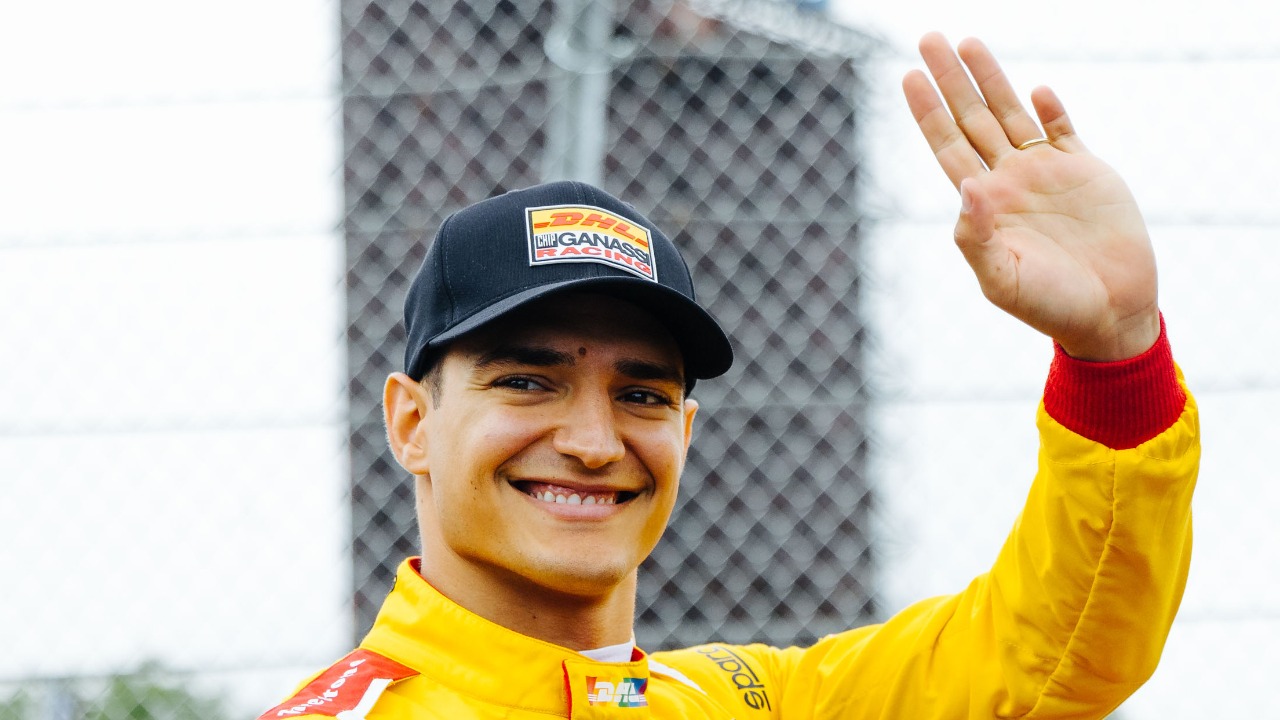
The Indianapolis 500 has a way of shrinking long careers into a few decisive laps, and of stretching a single afternoon into a legacy that lasts decades. For Alex Palou, the 109th running of the race did exactly that, turning a long‑pursued goal into the defining reference point for everything he has done in IndyCar and everything he is likely to chase next.
His victory did more than add another line to an already crowded résumé, it resolved the one lingering question around a champion who had dominated everywhere except the Brickyard, and it did so on a day when the pressure, the history and the expectations all converged on one driver in one car.
The last box Alex Palou had to tick
By the time Alex Palou arrived at Indianapolis this year, he had already built the kind of record that usually belongs to drivers in the twilight of their careers, not the middle of them. Multiple IndyCar titles, relentless consistency and an ability to control races from the front had made him the series’ benchmark, yet the absence of an Indianapolis 500 win hung over his achievements like an asterisk. He had spoken openly about how his face would look on the Borg‑Warner Trophy, but until this spring he had never converted that ambition into a victory at the Speedway, and the gap between his dominance on road and street circuits and his results on ovals had become a recurring storyline.
That context is what made his breakthrough so transformative. Before this season, reports underscored that, But he ( Palou ) has never won the Indianapolis 500, and in fact Alex Palou had never won a race on an oval at all, a statistical quirk that sat awkwardly beside his status as the series’ dominant force. That is why his charge through the final stint this year, when Alex Palou passed Marcus Ericsson with 14 laps remaining and controlled the closing miles, felt like more than another win; it was the moment when Alex Palou passed Marcus Ericsson, erased the oval question mark and finally aligned his results at the Speedway with the rest of his career.
History at the Brickyard and a nation’s first

Palou’s win did not just complete his personal checklist, it also rewrote a chapter of Indianapolis 500 history. In more than a century of racing at the Speedway, no driver from Spain had ever taken the checkered flag first, which meant that every lap he led late in the race carried the weight of national firsts as well as personal milestones. When he finally crossed the yard of bricks, he did so as the first Spanish driver to win the Indianapolis 500, a breakthrough that instantly broadened the race’s global story and gave Spanish motorsport fans a new hero at a venue long dominated by American, Brazilian and British names.
The significance of that moment was captured in the immediate aftermath, as Alex Palou, of Spain, celebrated in front of the main grandstand, his crew flooding the pit lane and his team owner sprinting to grab his star driver in a chaotic embrace that underlined how much this meant to everyone involved. That scene, described in detail as Alex Palou, of Spain, celebrates, was followed by another vivid image when he jumped down from the car and took off in a run down the front stretch, pulling off his gloves and tossing them behind him as he headed toward his Chip Ganassi Racing team in a jubilant celebration that showed how fully he understood the scale of what he had just done, as chronicled when He jumped down and took off in a run.
From dominant champion to complete Indy legend
In the years leading up to this race, Palou’s career had already been trending toward historic territory, but the Speedway remained stubbornly resistant. He had collected championships with a level of control that made his weekends feel almost inevitable, yet the Indianapolis 500 kept slipping away through misfortune, strategy swings or sheer circumstance. That is why some in the paddock framed this year’s event as the last major test of whether he would be remembered as a great IndyCar champion or as a driver whose résumé lacked the one victory that defines so many careers.
His performance this season has answered that question decisively. Reports on his campaign describe how Palou has absolutely dominated IndyCar, and how his late pass for the lead at the Speedway finally aligned his on‑track authority with the sport’s biggest stage. One analysis framed the win as the moment when Palou ticked the final items on his list, noting that his Indy 500 triumph effectively completed his transformation from rising star to all‑time great, a point underscored when Indy 500 triumph Advertisement described how rivals could only watch him slide past and disappear up the road. That sense of inevitability has carried into the broader season as well, where Palou ( Alex Palou ) matched feats not seen in decades, with one retrospective noting that he was the last driver before Palou to win three straight championships and the most recent to win both the series title and the 500 in the same year until Palou ( Alex Palou ) matched both feats in 2025.
How one Indy 500 can define a driver’s story
Palou’s experience fits a familiar pattern at Indianapolis, where one race can overshadow everything that comes before or after. Alexander Rossi is a prime example. When Alexander Rossi stunned the paddock by winning the 100th Running of the Indianapolis 500, coasting on fumes in a fuel‑saving gamble that paid off in front of a packed house, his name instantly shifted from anonymous rookie to permanent part of Speedway lore. That day, chronicled in detail by Jerry Bonkowski with datelines that shouted INDIANAPOLIS and a narrative that opened with the line “When Alexander Rossi leaves Indianapolis, don’t be surprised if h…,” showed how quickly a single afternoon can reframe a career, as captured in the report where Jerry Bonkowski MAY Share INDIANAPOLIS When Alexander Rossi chronicled the shock and the implications.
Rossi himself has acknowledged how the race can make or break reputations. Ahead of a later attempt to add another Borg‑Warner likeness, he spoke about the difficulty of charging from the middle of the pack, arguing that he did not see the person in ninth or 10th just being able to all of a sudden drive their way through, a sober assessment of how narrow the path to glory can be at the Speedway. That perspective, laid out when Rossi previewed another run at the race, mirrors the stakes Palou faced this year: the understanding that even for elite drivers, opportunities to seize a career‑defining Indy 500 do not come often, and that failing to convert them can leave a permanent gap in an otherwise stellar record.
The Borg‑Warner, innovation and the meaning of immortality
Part of what makes Palou’s victory so consequential is the way the Indianapolis 500 sits at the intersection of tradition and innovation. The race has long been a showcase for technical leaps, from the rear‑engine revolution to ground‑effect experiments, and its history is filled with teams that used the 500 as a laboratory. A detailed look at the event’s greatest innovations highlights how The Indy became a proving ground for Lotus, Brabham and Penske, and how the 50‑mile increments of strategy and risk have often turned engineering gambles into legend, as outlined in a retrospective that traced The Indy 500’s greatest innovations back through Home Car News Indycar Racing News The Indy Lotus, Brabham and Penske 500 50. Palou’s win slots into that lineage, not because his car introduced a radical new concept, but because his execution under the most intense scrutiny reaffirmed why the race remains the sport’s ultimate test.
The other pillar of that immortality is the Borg‑Warner Trophy itself, the silver monument that will now carry Palou’s likeness alongside generations of champions. Drivers talk about the moment their face is unveiled as a second victory, a tangible confirmation that their name is etched into the Speedway’s story forever. Will Power captured that feeling when his own likeness was added, reflecting on how he had never given his two cents on the oval track until he learned that a sealant was to be applied to the surface earlier in the season, a detail that underscored how even subtle changes at Indianapolis can shape outcomes and legacies, as recounted when Dec Power described his evolving relationship with the place. For Palou, the long‑imagined moment of seeing his own face on that trophy is no longer hypothetical; it is the visual shorthand that will define how future generations remember his career.
A career forever measured against one perfect Sunday
In the months since his win, the way people talk about Palou has subtly but unmistakably changed. Before, conversations about his greatness often came with qualifiers, with observers noting his titles and consistency but circling back to the missing Indianapolis 500. Now, the race is the starting point, the shorthand that frames every other statistic. When fans and analysts debate where he ranks among IndyCar’s all‑time best, they do so with the understanding that he has conquered the same 500‑mile gauntlet that defined legends before him, and that his achievements in the series are no longer separated from the sport’s most important event.
That shift is evident in how his season has been chronicled. Coverage of his campaign emphasizes that Palou has absolutely dominated IndyCar this year, that he has turned title fights into processions and that his control of the 500 mirrored his command of the championship, a narrative crystallized when Alex Palou makes history as 1st Spanish driver was used as shorthand for his broader dominance. For all the numbers that will accumulate in the years ahead, from additional wins to possible future titles, I suspect that one image will always sit at the center of his story: a Spanish champion sprinting down the front stretch, gloves in hand, having finally claimed the Indianapolis 500 that turned a brilliant career into a complete one.


Leave a Reply