

Ford’s Fairlane GT and GTA arrived right as Detroit’s midsize muscle wars were heating up, and for a brief two-year window they gave the Blue Oval a serious player in that fight. Today, those same 1966 and 1967 performance Fairlanes sit in a sweet spot for collectors, with values that reward originality and condition without yet reaching the stratosphere of the most famous muscle nameplates.
To understand what these cars are worth now, I need to start with when and how Ford built them, then connect that production story to current pricing data and market listings. The result is a clear picture of which Fairlane GT and GTA variants command the strongest money, where driver-quality cars trade, and why rarity and body style matter so much for buyers in 2025.
How the Fairlane GT and GTA fit into Ford’s muscle timeline
Ford did not jump into the midsize performance game as quickly as some rivals, and that delay shaped the short production run of the Fairlane GT and GTA. Reporting on the model’s history notes that it was not until Ford’s 1966 restyling of the midsize Fairlane lineup that it offered a GT model at all, a move that finally aligned the car with the growing appetite for V-8 power and sporty trim in this segment. In the eyes of many buyers, sportiness and the Ford Fairlane had not been synonymous terms before this shift, which is why the GT badge and associated hardware marked such a turning point for the nameplate.
The GTA designation arrived alongside the GT as an automatic-transmission counterpart, giving buyers a way to get the same basic performance package without a clutch pedal. Contemporary and retrospective coverage of the 1966 and 1967 cars treats the GT and GTA as a pair, with the 1966-’67 Ford Fairlane GT/GTA often discussed together as a two-year performance chapter in the Fairlane story. That same reporting, dated Mar 25, 2024, reinforces that the GT and GTA were products of a specific moment in Ford’s lineup strategy, bracketed by the 1966 restyle on one side and later performance directions on the other, which helps explain why collectors today focus so tightly on those two model years.
Production years and what “GT” versus “GTA” really meant
The Fairlane GT and GTA story is concentrated entirely in the 1966 and 1967 model years, which simplifies the timeline but raises the stakes for understanding the differences within that short run. Historical overviews of the 1966-’67 Ford Fairlane GT/GTA make clear that the GT badge signaled a performance-oriented package on the midsize Fairlane, while the GTA label identified cars equipped with an automatic transmission, a distinction that matters both for driving character and for how enthusiasts talk about these cars today. A separate discussion of the 1966–1967 Ford Fairlane GTA highlights how the automatic-equipped version still delivered the same basic muscle-car formula, reinforcing that both badges belong to the same brief but influential performance chapter.
Within that two-year window, 1967 stands out for sheer Fairlane volume, which in turn shapes how rare the GT and GTA variants feel today. A period-focused account of the 1967 Fairlane GT/A notes that in 1967 Ford built 255,952 Fairlanes in thirteen different body styles, and that only 8 percent, or 20,787 cars, were GT/A models, figures that underscore how small a slice of total production these performance versions represented. That same source describes the GT/A as “extremely rare,” and while exact survival numbers are unverified based on available sources, the combination of a short two-year run and a relatively small share of 1967 production helps explain why collectors pay close attention to body style, drivetrain, and originality when they evaluate these cars.
What price guides say a Fairlane GT is worth today
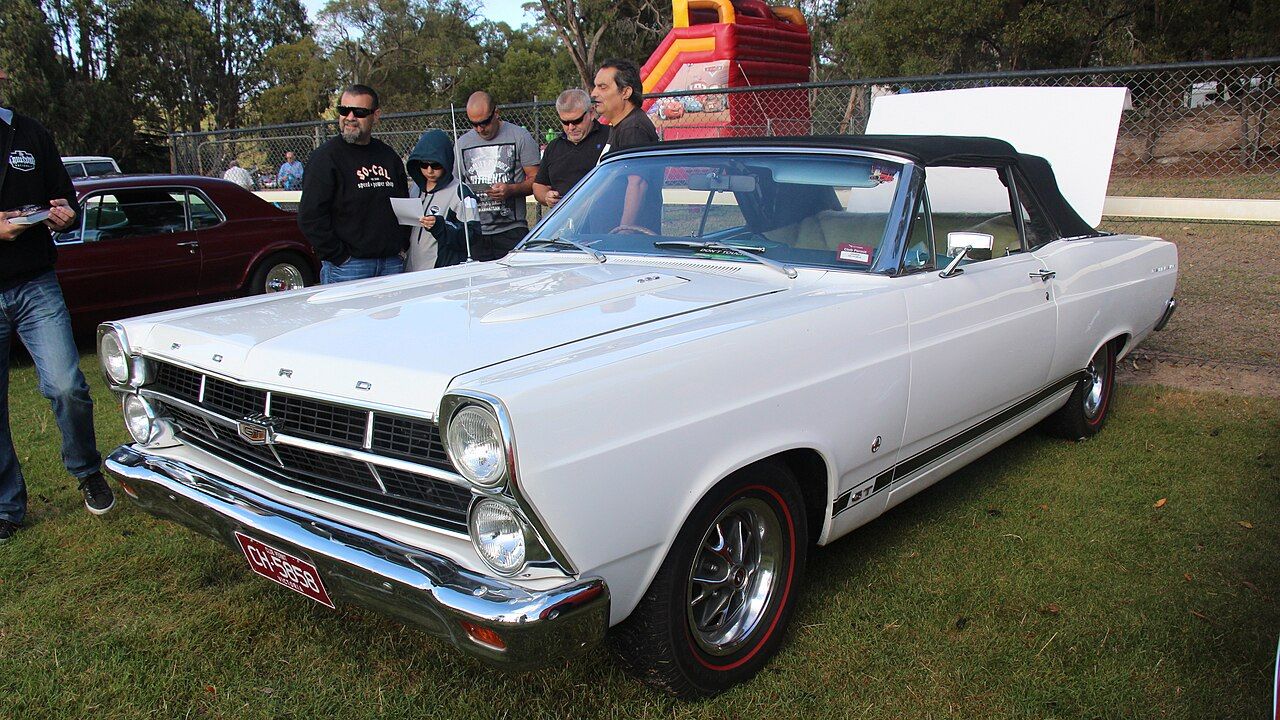
Price guides provide a structured snapshot of what insurers and many collectors consider fair market value for specific configurations of the Fairlane GT. For the 1966 model year, valuation data for a Ford Fairlane GT 2dr Hardtop Coupe with an 8-cyl. 390cid/335hp 4bbl GT engine lists a figure of $34,200, a number that anchors expectations for a solid example of that specification. That same tool invites users to “Calculate the” price and “Please” select adjustments, which signals that the $34,200 figure is a baseline that can move up or down depending on condition, options, and other factors.
For 1967, the same valuation source breaks out multiple reference points that help frame the market for different body styles and conditions. One entry for a 1967 Ford Fairlane GT 2dr Convertible with an 8-cyl. 289cid/200hp 2bbl engine lists $28,000, again with prompts to “Calculate the” price and “Please” select adjustments, which positions that convertible configuration slightly below the 1966 hardtop benchmark in this particular dataset. A separate summary from the same valuation tool states that “Typically, you can expect to pay around $33,050 for a 1967 Ford Fairlane GT in good condition with average spec,” a figure that effectively brackets the 1967 GT market near the mid-$30,000 range for a representative car.
How asking prices in the wild compare to guide values
Real-world listings for classic Fairlanes show how sellers and buyers are actually behaving, and they provide a useful counterpoint to structured guide numbers. For 1966 cars, a marketplace snapshot labeled 1966 Ford Fairlane Classic Cars for Sale reports “1966 Ford Fairlane Pricing: Low $17,900 / Average $36,189 / High $48,197,” a spread that captures everything from driver-quality examples to top-tier cars. Those figures, especially the $36,189 average and $48,197 high, sit in the same general neighborhood as the $34,200 guide value for a 1966 Ford Fairlane GT Hardtop Coupe, suggesting that well-presented GTs can track or slightly exceed the broader Fairlane averages, while exceptional cars push toward the top of that range.
For 1967 Fairlanes, the same marketplace data shows a somewhat different pattern that still aligns with the idea that performance variants and high-spec cars command a premium. The 1967 Ford Fairlane Classic Cars for Sale snapshot lists “1967 Ford Fairlane Pricing: Low $10,995 / Average $41,282 / High $81,998,” a range that stretches from project-level cars to what are likely highly restored or heavily optioned examples. When I compare that $41,282 average to the “Typically” cited $33,050 value for a 1967 Ford Fairlane GT in good condition with average spec, it suggests that the market is willing to pay more for the right 1967 Fairlane, especially when rarity, options, or exceptional restoration quality come into play, while the low entry point of $10,995 underscores how much condition and specification can swing the price.
Why rarity, body style, and documentation drive premiums
Within the already narrow 1966–1967 window, certain Fairlane GT and GTA configurations stand out as especially desirable, and the available reporting helps explain why. The account of the 1967 Fairlane GT/A that cites 255,952 total Fairlanes and only 20,787 GT/A models highlights how limited the automatic-equipped performance cars were relative to the broader lineup, a ratio that naturally feeds into higher interest among collectors who want something more exclusive. At the same time, valuation tools that single out specific body styles, such as the 2dr Hardtop Coupe and Convertible, show that open-top cars and high-horsepower engines can command distinct pricing tiers, as reflected in the separate $34,200 and $28,000 guide figures for those configurations in the 1966 and 1967 Ford Fairlane GT entries.
Documentation and accurate identification also matter, especially when distinguishing between GT and GTA models or between 1966 and 1967 cars that can look similar at a glance. Enthusiast discussions about identifying a 1966 or 1967 Ford Fairlane GTA model year, which describe the 1966–1967 Ford Fairlane GTA as a true American classic and emphasize specific dimensions and styling cues, underline how much value buyers place on getting the details right. When I put that emphasis on correctness alongside the structured pricing from valuation tools and the wide ranges in marketplace listings, a consistent pattern emerges: the best-documented, correctly identified GT and GTA cars, especially those with desirable engines and body styles, tend to sit at or above the upper end of guide values, while less certain or heavily modified examples fall closer to the lower and midrange numbers that broader Fairlane pricing data reflects.
More from Fast Lane Only

Leave a Reply