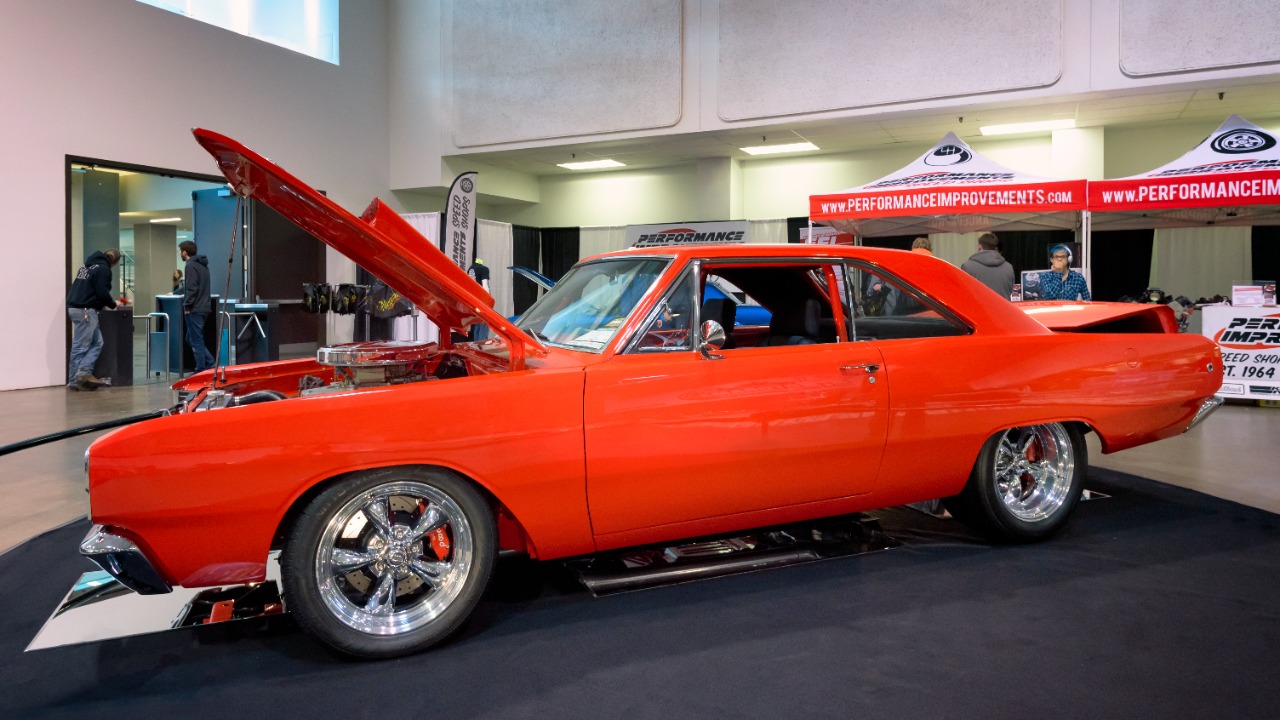
The 1968 Hemi Dart was never supposed to be a polite streetcar. It was a bare‑knuckle factory weapon, built in tiny numbers to dominate a drag‑strip class and then quietly retired. Instead, it became the kind of machine that could embarrass exotic supercars decades later, a compact Dodge that could run 9‑second quarters and leave far pricier machinery staring at its taillights.
Born from a loophole in racing rules and assembled like a skunkworks project, this factory‑built Dart carried race‑car compromises into the showroom. Lightweight panels, a brutal Hemi, and almost no creature comforts made it barely sensible for public roads, yet brutally effective against rivals it was never meant to meet at a stoplight.
From economy compact to quarter‑mile assassin
In stock form, the Dodge Dart was a modest compact, remembered by many as practical transportation with what one video characterizes as objectively mediocre build quality and styling inspired more by necessity than passion. That same analysis of the Dodge Dart sets the baseline that makes the Hemi version so shocking: this was not an obvious foundation for a world‑class drag car.
Dodge engineers, however, saw opportunity in the Dart’s small footprint and relatively light shell. For National Hot Rod Association Super Stock racing, the rules rewarded factory‑built combinations that could be homologated with a limited production run. That is where the LO23 program emerged, turning the humble compact into a purpose‑built Super Stock contender with the 426 Hemi shoehorned between its fenders.
Once Dodge unleashed the Hemi Dart on Class B Super Stock competition, it immediately reset expectations. Coverage of When Dodge pushed the Hemi Dart into that Class explains that the car quickly became a force that shaped the category for years, proving that a compact body with a massive Hemi could out‑muscle larger, more glamorous rivals.
Built in secrecy, signed in waivers
Accounts from enthusiasts describe how Dodge treated the LO23 cars almost like contraband. One retrospective urges readers to witness the 1968 Dodge Hemi Dart as a street‑illegal legend, noting that Dodge required buyers to sign waivers acknowledging the extreme nature of the car. This was not marketing theater. The combination of stripped weight, race‑ready power, and marginal street manners made the Dart a liability in untrained hands.
Another account frames the program as Mopar’s Most Dangerous Secret. A feature on Hemi Dart in 1968 describes how Mopar quietly unleashed the LO23 Hemi Dart as a compact drag monster built to exploit the rulebook. It was never meant to be a comfortable daily driver. It was a factory race weapon that just happened to carry a license plate.
Similar language appears in a piece that calls the 1968 Dodge HEMI Dart LO23 a street‑legal assassin built in secrecy and bred for the dragstrip, with Dodge taking a lightweight Dart shell and turning it into a Dodge HEMI Dart that terrified competitors. The secrecy was less about hiding the car from the public and more about staying one step ahead of sanctioning bodies that were already uneasy with factory drag specials.
Hurst, hand‑built details, and the LO23 recipe
The LO23 Hemi Dart was not simply a Dart with a bigger engine. It was the product of a collaboration with Hurst, which handled extensive modifications to turn a production compact into a dedicated Super Stock machine. A detailed breakdown of the Hurst Performance work explains that Dodge adapted the LO23 Hemi Dart specifically for the quarter mile, with weight reduction, engine placement tweaks, and drag‑oriented hardware that allowed the car to clear the traps in astonishing times.
Transmission choices reflected that single‑minded focus. Factory documentation highlighted in a heritage piece notes that Transmission options matched the aggression of the engine, with Four‑speed cars using a heavy‑duty 10.5-inch clutch and a steel bellhousing intended for high‑rpm launches. Automatic versions used equally tough internals, but the four‑speed setup is often celebrated as the purest expression of the car’s intent.
Production numbers remain a point of fascination. Multiple sources converge around roughly 80 units, with one enthusiast group describing the Dodge Dart Hemi as a Legendary Drag Strip Dominator and noting that only 80 were ever produced. Auction coverage of a surviving Dodge Dart Hemi repeats the figure 80 and ties it directly to the car’s immense rarity and collector appeal today.
Another retrospective on the 1968 Hurst HEMI Dodge Dart LO23 reinforces that only roughly 80 units were produced in collaboration with Hurst, describing the Dodge Dart HEMI as one of the most hardcore factory drag cars of the muscle‑car era. That tiny run, paired with the car’s competition focus, explains why so few survive in original specification.
Power at the center of everything
The heart of the LO23 program was the 426 Hemi, a race‑bred engine that was already feared in stock‑car circles. A feature devoted to the 1968 Power Was At Dodge Hurst Hemi Dart underlines that this engine was the entire point of the car. Official ratings hovered around 425 horsepower, but period racers and modern analysts argue that the real figure was significantly higher, especially in the tune delivered for Super Stock duty.
Some enthusiast groups describe the engine as underrated at 425 horsepower, with the true figure hovering closer to 500 horsepower in factory trim. That aligns with auction commentary that calls the Hemi Dart a machine whose advertised numbers barely hinted at its real output, especially once tuned by experienced drag racers.
Modern tributes keep that spirit alive. A restoration shop highlights a 1968 Hemi Dart tribute that uses a FAST XFI-controlled 426 Crate Hemi, a Passon Chrysler four‑speed and a Dana 60 with 4.10 gears, presenting it as a continuation of a purpose-built machine that was never meant to be average. The recipe remains the same: big Hemi, short wheelbase, and gearing that favors the quarter mile over comfort.
Lightweight, dangerous, and barely “street.”
Period descriptions of the LO23 Hemi Dart emphasize how far Dodge went to shed pounds. Thin glass, acid‑dipped body panels, and a stripped interior helped the car launch harder than heavier muscle rivals. A social‑media feature on Dodge HEMI Dart bluntly states that this was not just fast, it was dangerous, and that in 1968, Dodge built something that barely made sense for the street.
Another retrospective frames the 1968 Dodge Dart HEMI LO23 as a forgotten Mopar that terrified everyone, calling it a street‑legal assassin and a Today favorite among Mopar enthusiasts who now praise the short‑lived program as a final salvo in the factory drag racing wars. The car’s rawness is a large part of that appeal. It feels closer to a sanctioned race car than a showroom model.
A separate piece on the 1968 Dodge Hemi Dart LO23 describes it as a factory‑built drag racing machine designed for NHRA Super Stock competition, and notes that the Dodge Hemi Dart has become a prized collector item among Mopar fans. The same description underscores how little attention was paid to comfort. Everything that did not help the car launch harder or trap faster was expendable.
On paper, “legal,” on track with a problem
One of the more striking modern commentaries on the program points out that the Dodge HEMI Dart Super Stock looked legal on paper yet was effectively a race car with plates. A detailed social‑media narrative about Dodge notes that sanctioning bodies initially accepted the car because it technically met production requirements, only to discover that its performance upset the competitive balance.
Video coverage of the broader factory drag era reinforces that storyline. One piece titled as a look at the muscle car the NHRA regretted banning explains that in 1969, one car hit the strip and shattered every record, leaving the NHRA (as the video’s transcription phrases it) with one answer: ban it. The narrator in that Oct feature adds that the car was so fast, even the NH officials admitted that banning it was the only way to restore parity.
Although that video uses the NHS label, the context clearly points to the sanctioning environment around Super Stock racing and the discomfort officials felt about factory specials that blurred the line between production car and professional dragster. The Hemi Dart sat squarely in that gray zone, which is why its racing life was intense but brief.
Humiliating supercars decades later
If the Hemi Dart’s dominance in 1968 seemed outrageous, its performance looks even more extreme when compared with modern exotics. A widely shared short video describes a particular 1968 Forgotten Hemi Dart as the car that was running 9-second quarters in 1968, then taunts modern owners with the line that anyone who thought a McLaren was fast should meet the 1968 Dodge Hemi Dart that humiliated supercars.
The same clip, also shared directly as a short that invites viewers to meet the Dodge Hemi Dart, underscores how far ahead of its time the LO23 package was. A 9‑second quarter mile remains a serious benchmark for street‑based cars today. That a factory‑built machine on bias‑ply tires could flirt with that number in the late 1960s explains why rivals and officials were so unsettled.
Modern commentary often frames this performance gap as a kind of time‑travel embarrassment. Supercars that rely on electronics, turbos, and advanced aerodynamics can still find themselves struggling to match the raw, mechanical violence of a Hemi Dart on a well‑prepped strip. The car was tuned for one thing and one thing only: to get to the finish line first.
Rarity, mythology and the Mopar halo
The combination of low production, extreme performance, and a short competitive window has turned the LO23 Hemi Dart into a mythic figure in Mopar circles. A feature that calls the 1968 Dodge Dart Hemi a Legendary Drag Strip emphasizes that, with only 80 built, each surviving car carries immense value and a heavy load of stories from the golden age of factory drag racing.
Other retrospectives echo that sentiment. One social‑media essay on the forgotten Mopar that terrified everyone notes that the 1968 Dodge Dart HEMI LO23 has become a hashtagged FactoryRaceWeapon, and that Mopar enthusiasts Today praise the program as a high‑water mark for the brand’s performance image.
More from Fast Lane Only