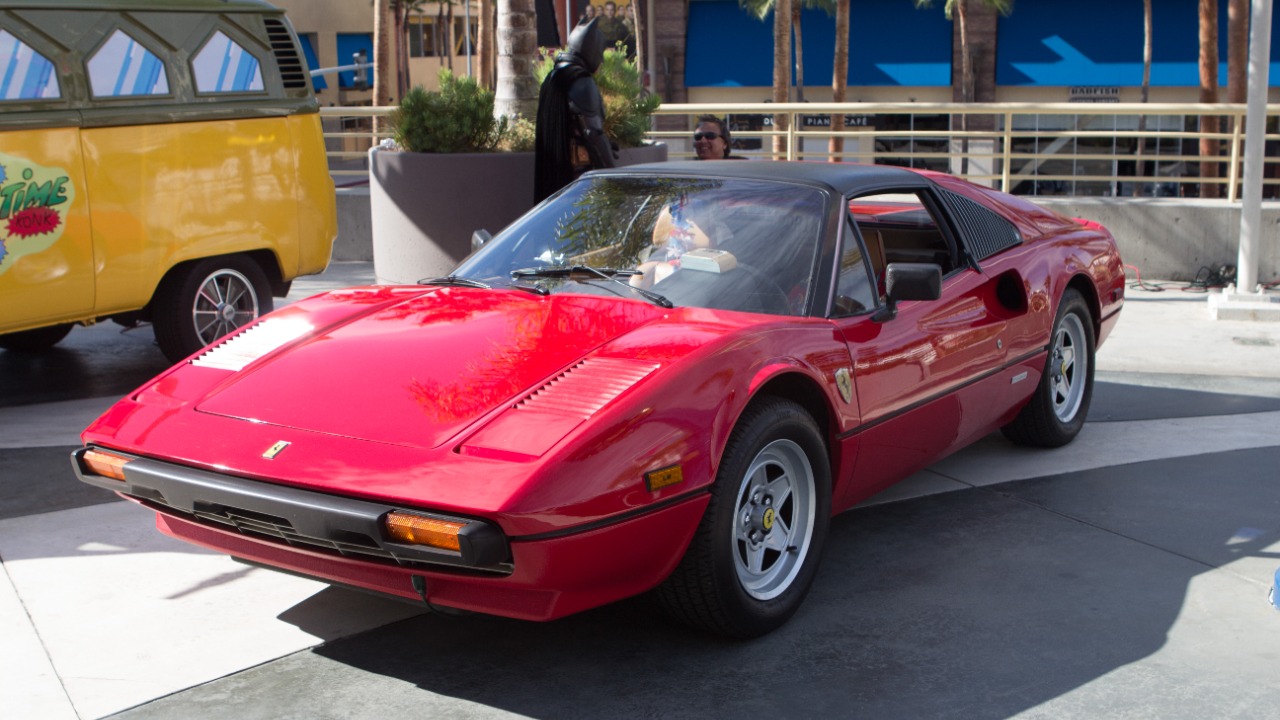
A 1979 Ferrari 308 GTS used during the production of Magnum P.I. will cross the block at Barrett-Jackson’s 2026 Palm Beach Auction in April with no reserve, meaning the car will sell to the highest bidder regardless of price. For a generation of viewers who watched Tom Selleck slide behind that targa roof every Thursday night, this is the closest thing to buying a time machine back to 1983.
The car is listed on Barrett-Jackson’s Palm Beach auction docket as Lot 297994, a Rosso Corsa 308 GTS Targa with a tan leather interior, the original 2,926 cc quad-cam V8 fed by four Weber carburetors, and a five-speed manual gearbox with Ferrari’s signature open-gate shifter. According to the listing, the car retains period-correct quad exhaust outlets, a limited-slip differential, and subtle modifications made for on-camera use, including adjustments to accommodate Selleck’s 6-foot-4 frame.
Those height modifications are part of Magnum P.I. lore that dates back to the show’s original run. Selleck has mentioned in interviews over the years that fitting into the compact Ferrari was a recurring production challenge, and the cars were altered accordingly. That detail alone separates this 308 from the roughly 3,200 GTS models Ferrari built between 1977 and 1980.
What the show did for this car
Magnum P.I. ran on CBS from 1980 to 1988 and turned Selleck into one of the biggest television stars of the decade. The premise was simple: a charming, mustachioed private investigator living rent-free on a Hawaiian estate, solving cases while borrowing his benefactor’s Ferrari. The 308 GTS appeared in nearly every episode, and its low-slung silhouette against Oahu’s North Shore became one of the most reproduced images in 1980s pop culture.
The production used multiple 308s over the show’s eight seasons. Some were hero cars used for close-ups and dialogue scenes; others were stunt vehicles. Barrett-Jackson’s listing describes this particular chassis as a documented production car, not a later promotional replica, though the auction house has not publicly detailed the full chain of custody. Prospective bidders will likely want to examine that documentation closely before raising a paddle.
The show’s continued life in syndication and on streaming platforms has kept the Ferrari-Magnum association alive for audiences who weren’t born when the series premiered. That sustained visibility is part of what makes screen-used vehicles from long-running series more valuable than props from one-off films: the exposure compounds over decades.
Where this 308 GTS sits in the Ferrari market
The 308 series spent years as the affordable entry point into Ferrari ownership, but values have climbed steadily since the mid-2010s. According to Hagerty’s valuation tools, a carbureted 308 GTS in “excellent” condition is worth roughly $100,000 to $125,000 as of early 2026, with concours-level examples occasionally reaching higher. The later fuel-injected 308 GTSi models, which most enthusiasts consider less engaging to drive, trade for somewhat less.
Carbureted cars like this 1979 example are favored by driving purists for their sharper throttle response and the mechanical immediacy of the Weber setup. The GTS targa configuration adds open-air appeal and, critically, matches the body style seen on the show. A fixed-roof GTB, no matter how clean, would not carry the same cultural weight.
But provenance is the multiplier here. Screen-used vehicles with strong documentation and broad cultural recognition routinely sell for multiples of their standard market value. The 1968 Ford Mustang GT from Bullitt sold for $3.74 million at Mecum in January 2020. A 1977 Pontiac Firebird Trans Am from Smokey and the Bandit brought $495,000 at Barrett-Jackson in 2016. Neither of those cars would have approached those figures without their Hollywood connection.
No pre-sale estimate has been published for the Magnum 308, and the no-reserve format means the market will set the price in real time. Given the scarcity of documented Magnum P.I. Ferraris at public auction, there is little direct comparable data to anchor expectations.
Barrett-Jackson’s framing
The auction house is treating this lot as a headline consignment. In a feature article written by Barbara Toombs on Barrett-Jackson’s site, the company describes the 308 GTS as an embodiment of 1980s cool and frames it as a vehicle that “transcends its mechanical specifications” through its television history. Social media posts from the auction house have invited followers to “channel their inner Tom Selleck” and teased the car’s arrival at Palm Beach.
That marketing push is deliberate. Barrett-Jackson’s Palm Beach event has historically served as a stage for consignments that draw attention beyond the core collector-car audience, and a no-reserve Magnum P.I. Ferrari checks every box: recognizable name, photogenic subject, and a built-in story that writes its own headlines.
The no-reserve structure also removes a common barrier for high-profile lots. Bidders know the car will sell, which tends to draw more participants into the room and push final prices higher than they might go under a protected reserve.
What to watch for
The key question for serious bidders is documentation. Screen-used cars live and die on provenance, and the difference between “a 308 GTS like the ones on Magnum P.I.” and “a 308 GTS verified as having been used in the production of Magnum P.I.” is potentially six figures at the hammer. Barrett-Jackson’s docket references the car’s production history, but buyers at this level will want to see supporting paperwork: production records, studio correspondence, or photographic evidence tying this specific chassis to filming.
Mechanical condition matters too, though perhaps less than it would for a standard collector Ferrari. A screen-used car’s value is weighted heavily toward its story, and most buyers at this price point will budget for a sympathetic mechanical refresh regardless. The listing notes the car has spent long stretches in private hands and storage, which is typical of screen-used vehicles but also means seals, hoses, and fluids will need attention.
Barrett-Jackson’s 2026 Palm Beach Auction runs in April. The 308 GTS is expected to be one of the event’s most closely watched lots.
More from Fast Lane Only
- Unboxing the WWII Jeep in a Crate
- 15 rare Chevys collectors are quietly buying
- 10 underrated V8s still worth hunting down
- Police notice this before you even roll window down
*Research for this article included AI assistance, with all final content reviewed by human editors.