
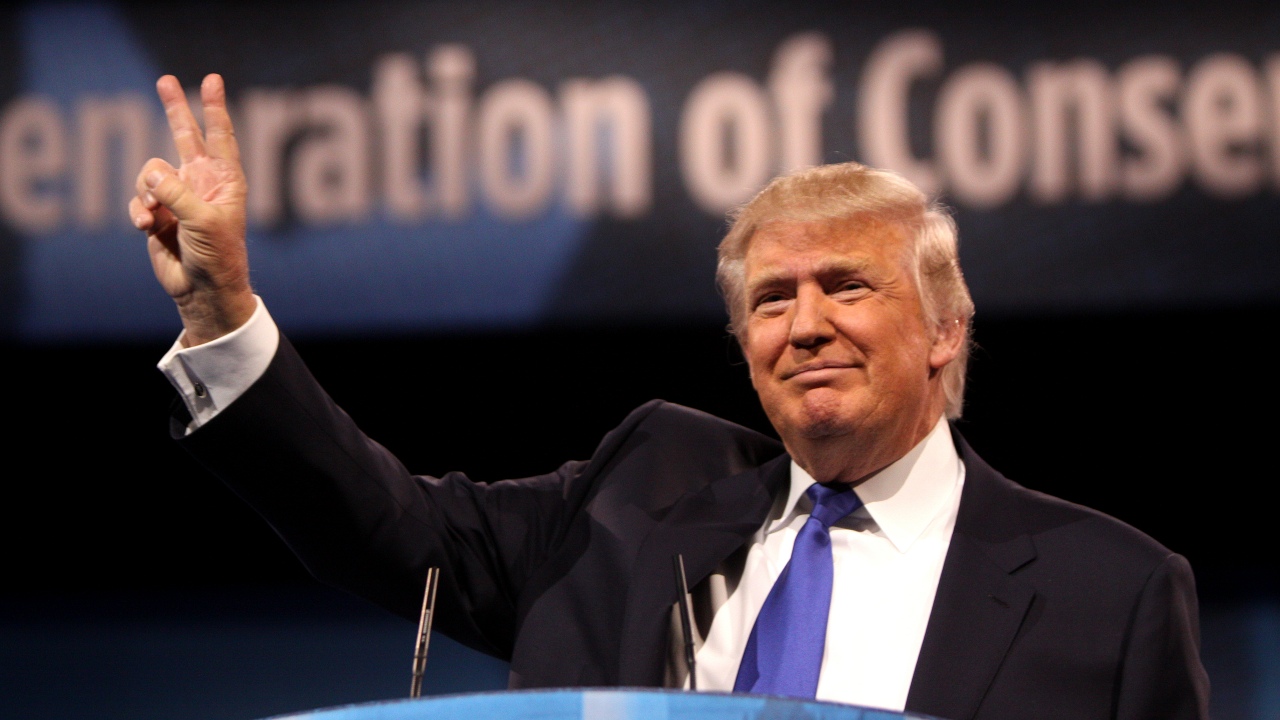
President Donald Trump is openly dismissing the North American trade pact that governs how cars and trucks move across the United States, Mexico and Canada, even as Ford Motor Co warns that the agreement is essential to its survival. The clash sets up a stark test of whether political slogans about reshoring can coexist with the complex supply chains that underpin modern auto manufacturing. At stake are not only corporate profits but also the prices consumers pay and the jobs that depend on a stable set of trade rules.
Trump’s new disdain for his own trade deal
When President Donald Trump toured a Ford facility in Dearborn, Mich, he did not simply question the value of the United States‑Mexico‑Canada Agreement, he brushed it aside. He told reporters that the USMCA offers “no real advantage” to the United States and said a renewed deal with Mexico and Canada “wouldn’t matter,” signaling that he “doesn’t really care” whether the pact is extended or allowed to lapse. He framed the agreement as “irrelevant” to U.S. interests and suggested that the country could simply walk away from the Canada‑U.S.‑Mexico deal without meaningful economic cost.
Trump has paired that dismissal with a blunt message about where he believes cars should be built. He has said “we don’t need cars made in Canada” or in Mexico, insisting that vehicles ought to be produced inside the United States and that this is already what is “happening.” In his telling, the North American framework that links factories in Ontario, Michigan and northern Mexico is not a strength but a liability, and he has indicated that he is not eager to renegotiate USMCA when its scheduled review comes due in Washington. That posture has rattled an industry that has spent decades organizing itself around a North American production base.
Ford’s warning from the factory floor
Ford Motor Co is offering a very different assessment from the shop floor and the executive suite. Chief executive Jim Farley has said plainly that a stable trade deal with Mexico and Canada is “critical” for the United States auto industry, because modern vehicles are built from parts that cross borders multiple times before final assembly. He has described the United States‑Mexico‑Canada Agreement as “vital” to North American auto manufacturing and has argued that the company “cannot live without” the certainty that the pact provides for its operations.
Farley has also linked that certainty directly to what customers pay. He has warned that trade uncertainty could make cars even more expensive, since any disruption to the current rules would force companies like Ford to reengineer supply chains, absorb new tariffs or pass higher costs along to buyers of popular models such as the Ford F‑150 and Bronco. In his view, the USMCA is not an abstract diplomatic document but the legal scaffolding that allows Ford to plan investments, manage cross‑border logistics with Mexico and Canada, and keep prices from rising even faster in a market already strained by higher interest rates and input costs.
A North American supply chain under strain
From my perspective, the core tension here is between political rhetoric that treats borders as clean lines and an industrial reality that treats North America as a single production ecosystem. Automakers have spent years building a “North American” platform in which engines, transmissions and electronics move between the United States, Mexico and Canada before a finished vehicle rolls off a line in Dearborn, Ontario or Monterrey. Industry executives have stressed that “the whole North American piece” of the trade architecture is a “big strength,” because it allows companies to balance labor costs, market access and specialized manufacturing capacity across three countries.
That is why car makers have urged Washington to extend the USMCA rather than let it unravel. They argue that the deal’s rules of origin, tariff preferences and dispute mechanisms are baked into decisions about where to locate plants and how to source parts. If those rules suddenly change, companies would face higher costs and legal uncertainty just as they are investing heavily in electric vehicles and advanced driver‑assistance systems. For Ford and its peers, the question is not ideological. It is whether they can continue to operate an integrated North American network without the predictable framework that the current Deal provides.
Protectionism, China and unintended consequences
Trump’s stance on USMCA fits within a broader protectionist approach that is reshaping global auto trade, sometimes in ways that undercut his stated goals. His administration has leaned on tariffs and tough talk to pressure allies and rivals alike, while still encouraging others to “get a deal with China” if they can secure favorable terms. That mix of confrontation and selective encouragement has created openings for Beijing, as Chinese manufacturers look to expand their footprint in markets where North American brands may be distracted by trade fights or regulatory uncertainty.
The ripple effects are already visible in North America. Canada has broken with the United States Friday by slashing its 100% import tax on Chinese electric vehicles in exchange for lower tariffs on Canadian exports that Ottawa sees as crucial to its own businesses. That move underscores how quickly partners can diverge when Washington signals that a shared framework like USMCA is optional. If the United States steps back from its own regional pact while allies cut separate deals with Chinese producers, North American automakers could find themselves squeezed between higher costs at home and more aggressive competition from Chinese brands abroad.
Jobs, prices and the politics of “not caring”
What troubles me most is how casually the political debate is treating the people whose livelihoods depend on these rules. Trump has suggested that the United States could “have it or not” when it comes to USMCA and that it “wouldn’t matter,” but auto industry leaders warn that walking away could put a “considerable number of jobs” at risk across assembly plants and supplier networks. The same integrated system that lets a Ford worker in Dearborn build a truck with parts from Mexico and Canada also supports employment in stamping plants in Ontario and electronics factories in northern Mexico that feed back into U.S. production.
Consumers are caught in the middle. Farley has cautioned that if the trade framework frays, the cost of building vehicles will rise and those increases will show up in monthly payments for families shopping for a new Ford Explorer or Mustang. He has said that in a “perfect world” he would have regulatory and trade certainty, but instead he is trying to plan long term investments while the White House signals indifference to the very Deal that underpins his company’s North American strategy. The contrast could not be sharper: a president who says he does not really care about renewing the USMCA, and an automaker that insists it is “critical” to its operations and to the broader health of the United States auto industry.
More from Fast Lane Only


Leave a Reply