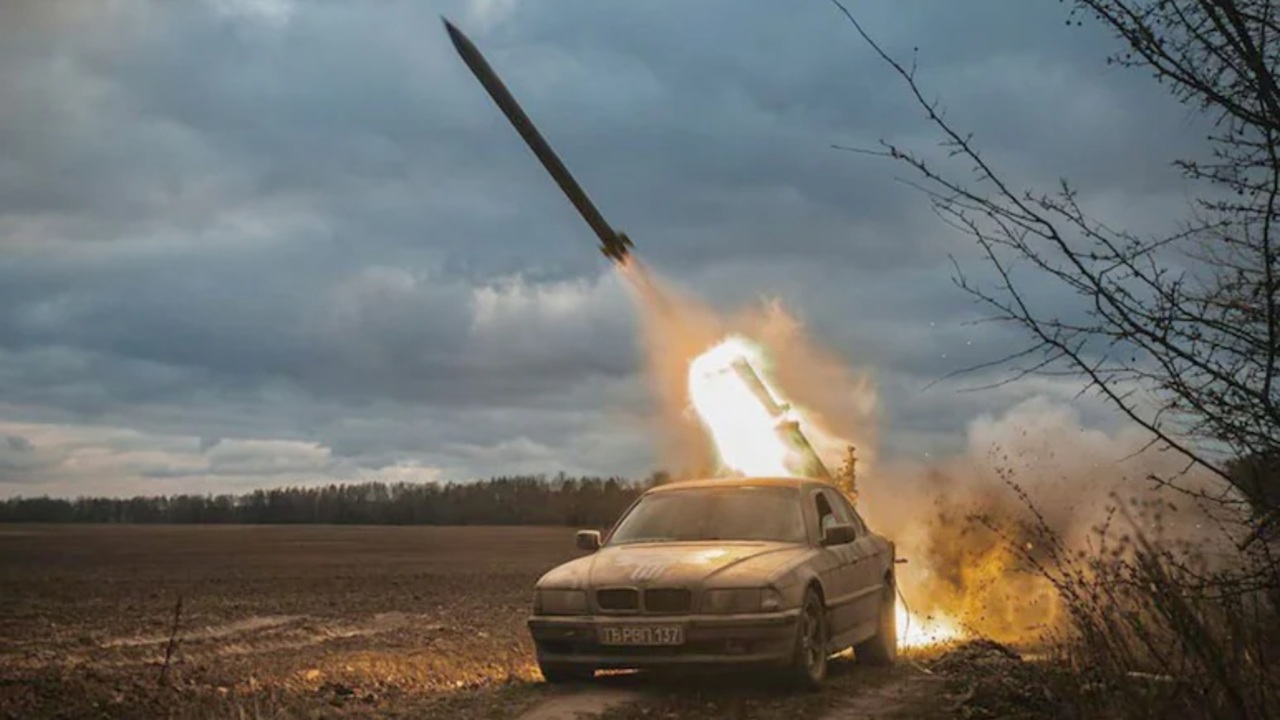
The sight of a BMW 7-Series quietly idling at the edge of a Ukrainian treeline would once have suggested a visiting dignitary, not a battlefield threat. Now, video from the front shows that same silhouette spitting rockets toward Russian positions, a luxury sedan recast as a makeshift launcher in a war defined by improvisation. The conversion captures how Ukraine is stretching every available asset, from aging civilian cars to repurposed munitions, to keep pace with a larger invading army.
By turning an E38-generation BMW into a mobile multiple launch rocket system, Ukrainian forces have fused high-end German engineering with low-budget battlefield ingenuity. I see in this hybrid machine not a gimmick but a snapshot of a military forced to innovate under pressure, adapting civilian technology to fill gaps in standard equipment and to stay one step ahead of Russian targeting.
From executive saloon to battlefield tool
The E38 BMW 7-Series was designed as an executive flagship, a car more at home outside five-star hotels than in muddy firing positions. Ukrainian soldiers have stripped that image back to bare metal utility, cutting into the rear of the sedan to mount a rack of launch tubes that effectively turns the car into a compact multiple rocket launcher. Footage circulating on social media shows the vehicle reversing into position, its trunk area transformed into a firing platform that can unleash a salvo before the driver sprints away to safety, a configuration that has been highlighted in recent coverage of the Ukrainian and Bavarian “war machine.”
Reports describe the car as an E38-generation 7-Series with its rear seats and trunk space sacrificed to accommodate a bank of rockets, creating what one account calls a BMW MLRS system aimed at Russian forces. In video shared by Ukrainian soldiers, the sedan’s silhouette is unmistakable even as the rear deck bristles with tubes, underscoring how a symbol of peacetime status has been reimagined as a weapon. The result is a platform that lacks the armor and electronics of a purpose-built launcher but offers something Ukraine urgently needs: a fast, low-profile way to move rockets around the front.
Improvised firepower and repurposed rockets
What makes this BMW conversion more than a viral curiosity is the firepower it carries. According to Ukrainian military assessment cited in one detailed breakdown, the rockets loaded into the car-mounted launcher are likely repurposed BM21 tubes or munitions stripped from other multiple launch systems. That suggests the sedan is not firing bespoke, experimental rounds but standard battlefield rockets adapted to a new, lighter platform. By marrying familiar munitions to an unconventional carrier, Ukrainian forces can draw on existing stockpiles while sidestepping the production bottlenecks that plague more complex systems.
Other reports echo that the launcher mounted on the 7-Series is a relatively simple rack that trades precision for practicality. One analysis notes that the vehicle does not have military-grade steel protection or high-precision accuracy, yet still offers an effective way to deliver rockets against Russian positions. The emphasis is on volume and mobility rather than pinpoint strikes, a pattern that fits with Ukraine’s broader use of improvised launchers to harass and disrupt enemy forces. In this context, the BMW’s role is less about replacing heavy artillery and more about adding another layer of flexible, hard-to-track fire support.
Mobility, survivability, and the “Mad Max” factor
On a battlefield saturated with drones and counter-battery radars, the ability to shoot and move quickly can matter more than armor thickness. The converted 7-Series leans into that logic. Its civilian chassis blends into traffic and rural roads, making it harder to pick out from the air than a hulking tracked launcher. Coverage of the project notes that the car’s speed and agility allow crews to move between various firing positions, a crucial advantage when Russian forces are quick to respond to detected launches with return fire or loitering munitions.
Observers have compared the sight of an old luxury sedan turned into a rocket truck to scenes from Old games and movies like Mad Max, where scavenged vehicles are welded into improvised war machines. That comparison is more than aesthetic. It speaks to a style of warfare in which industrial-age platforms are constantly hacked, reconfigured, and redeployed in ways their designers never imagined. The BMW launcher fits neatly into this “Mad Max” lineage, a rolling symbol of how Ukraine is willing to cannibalize civilian hardware to keep its artillery footprint unpredictable and survivable.
Social media spectacle and frontline messaging
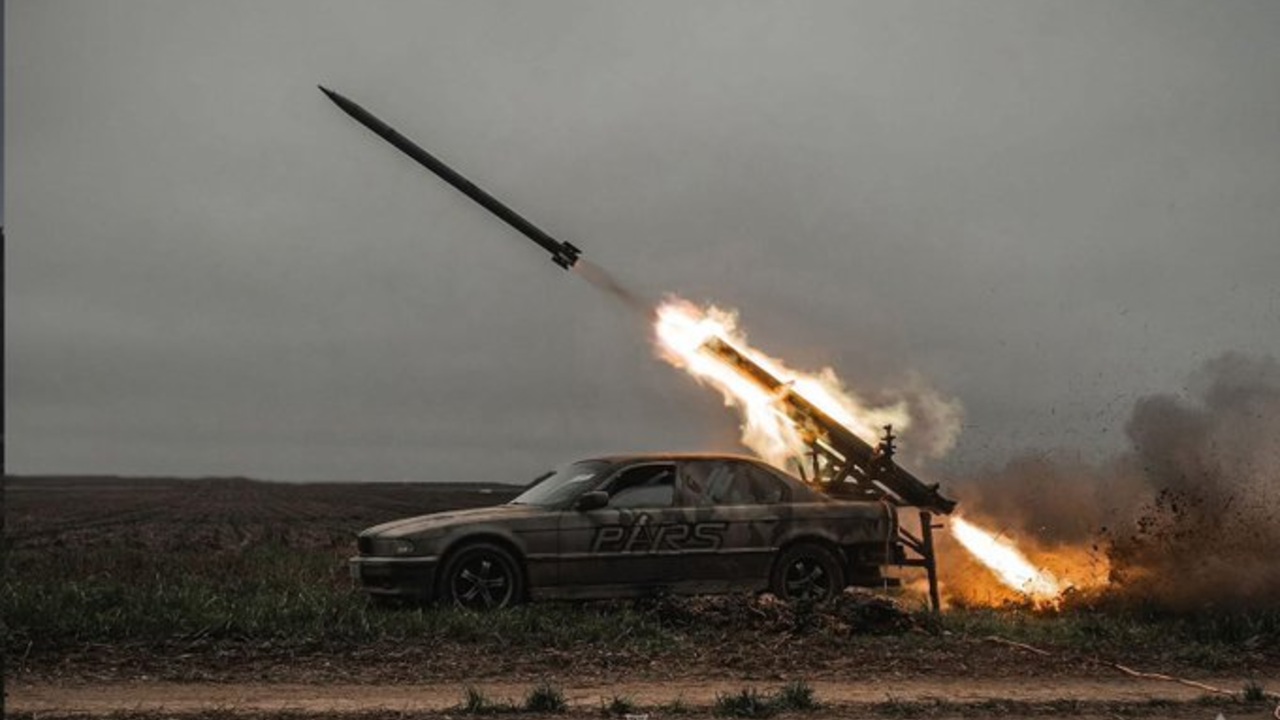
The BMW launcher might have remained a niche field modification if not for the way it exploded across social media. A short clip posted to a military-focused Instagram account shows Ukrainian soldiers firing their BMW MLRS system toward Russian positions, the caption describing “a configuration never seen” before. In the comments, one user identified as bulgarian_t34_85v2 reacts to the footage, and the post itself is tagged with engagement figures such as 138 that hint at how quickly such images circulate among military watchers and civilians alike.
Other platforms have amplified the same footage, with videos of the Ukrainian and Bavarian hybrid machine making the rounds and being dissected frame by frame. I see this online visibility serving several purposes at once. For domestic audiences, it showcases Ukrainian ingenuity and resilience, a way of saying that even luxury cars can be pressed into service when the stakes are existential. For international viewers, it reinforces the narrative of a smaller military forced to innovate against a larger aggressor, a story that can help sustain sympathy and support. And for Russian observers, the message is blunt: Ukraine will fight with whatever platforms are available, from high-end Western systems to hacked sedans.
Luxury launch platform in a resource-strapped war
Behind the spectacle lies a more sobering reality about Ukraine’s material constraints. One detailed report on the BMW conversion frames it as an “unconventional battlefield solution” born of a shortage of standard equipment. By turning a BMW 7-Series into what is described as a Luxury Launch Platform to Fight Russia, Ukrainian forces are effectively filling gaps where purpose-built multiple launch rocket systems are too scarce, too vulnerable, or too valuable to risk near the front. The sedan becomes a stopgap, a way to keep rockets in the fight even when industrial supply cannot keep up with demand.
Another account notes that although the vehicle lacks the protection and precision of dedicated launchers, it still delivers an effective strike capability against Russian targets. I read that as a reminder that in a war of attrition, “good enough” solutions can matter as much as exquisite technology. The BMW’s chassis was engineered for comfort and speed, not combat, yet its robust suspension and powerful engine make it a surprisingly capable carrier for a lightweight rocket rack. In that sense, the car embodies a broader Ukrainian approach: accept imperfection, prioritize what works, and keep pressure on the enemy even when ideal tools are unavailable.
What this says about the future of improvised warfare
The BMW 7-Series launcher is not Ukraine’s first improvised weapon, and it will not be the last. From pickup trucks mounting anti-aircraft guns to commercial drones dropping grenades, the war has already blurred the line between civilian and military hardware. What sets this sedan apart is the way it crystallizes several trends at once: the repurposing of legacy munitions, the use of civilian vehicles as stealthy platforms, and the role of viral imagery in shaping perceptions of the conflict. Each new clip of the BMW firing rockets becomes both a tactical event and a piece of information warfare.
For other militaries watching from afar, the lesson is uncomfortable but clear. In a high-intensity conflict, even wealthy states may find themselves short of specialized platforms and forced to improvise with whatever is at hand. The Ukrainian example shows that with enough ingenuity, an executive saloon can become a battlefield asset, especially when paired with repurposed BM21-style rockets and flexible tactics. I suspect that future planners will study not just the performance of such conversions, which remains unverified based on available sources in granular detail, but also their psychological impact, from the “Mad Max” imagery to the way a single Instagram reel can turn a field modification into a symbol of national resistance.