
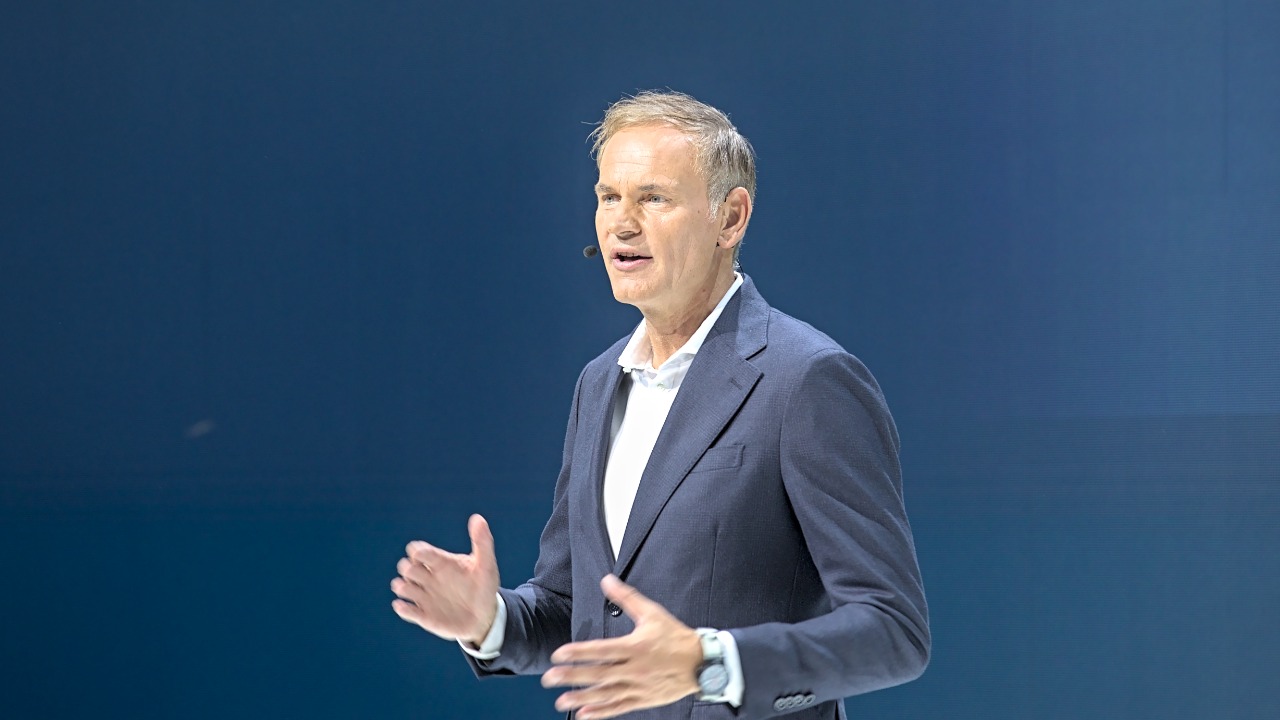
Volkswagen has handed you a front row seat to one of the most closely watched turnarounds in global industry. With Oliver Blume stepping back from his dual role at Porsche to focus solely on the group, the expectation is no longer that he will simply stabilize the automaker, but that he will prove he can reinvent it at speed. The pressure is sharpened by slipping momentum in China, lagging software capabilities, and investors who now want execution, not just strategy slides.
As you assess what comes next for the company, you are really judging whether Volkswagen can still behave like a market leader in an era defined by electric platforms, software stacks, and regionalized products. The stakes are not abstract: they touch the valuation of a $348 billion industrial giant, the future of its workforce, and the credibility of European manufacturing in a world tilting toward Chinese and American champions.
The end of the dual mandate and a longer leash
Your starting point is structural. By relinquishing his operational role at Porsche, Oliver Blume has removed the most obvious distraction from his job as group chief. For nearly two years he tried to balance being the public face of the sports car brand with steering the broader Volkswagen Group, a structure that left investors questioning whether any leader could give the necessary attention to both. The decision to concentrate on the parent company is a tacit admission that the turnaround task is too large for a split focus, and it raises the bar on what you should expect from him in Wolfsburg.
Volkswagen AG has reinforced that expectation by extending his contract, with the Supervisory Board appointing Oliver Blume as CEO until the end of 2030 and underlining that he is the long term choice to lead from Wolfsburg. That vote of confidence gives him time, but it also removes the alibi of short tenure: if results in profitability, technology, and regional performance do not improve, you will not be able to blame uncertainty at the top. The governance message is clear, the group has picked its captain and expects him to deliver.
Investor impatience and the “Key Challenges for Volkswagen”
From your vantage point as an investor or stakeholder, the narrative around Oliver Blume has shifted from promise to proof. Early on, he was framed as the pragmatic engineer who could clean up after years of overreach and internal conflict. Now, as Jan and other market voices have stressed, the focus is on whether he can tackle what have been described as the Key Challenges for, including cost inflation, complex product portfolios, and a software arm that has repeatedly missed its targets. You are no longer grading him on diagnosis, but on whether he can simplify the group and restore competitiveness where it has eroded.
Those same investors are increasingly explicit that patience is finite. The primary challenges for Volkswagen, as laid out in detailed critiques of the group’s strategy, include the drag from its software subsidiary Cariad, whose delays have hampered competitiveness in electric models that were supposed to anchor the company’s future. When you see rivals rolling out over the air updates and advanced driver assistance at scale while Volkswagen wrestles with integration issues, it is easy to understand why shareholders are pressing Blume to either fix or fundamentally rethink the software strategy.
China: from profit engine to pressure point
The most acute test of Blume’s leadership, and the one you are likely watching most closely, is China. For years, the country was the profit engine that allowed Volkswagen to fund its global ambitions, with the group enjoying a dominant position and earning billions as the market leader. That era is over. Local competitors have surged in electric vehicles, and the company’s share has slipped to the point where Oliver Blume, as CEO of the Volkswagen Group, is now under intense pressure to improve performance in Chin, with investors openly arguing that a reorientation is necessary.
That reorientation is already being framed in strategic slogans, but you will judge it on hard outcomes. With China sales slipping and software development lagging behind competitors, Blume has been pushed to embrace a “in China for China” strategy that goes beyond marketing language and into product and partnership decisions. Reporting on the group’s internal debates makes clear that With China now setting the pace in electric and connected cars, Volkswagen must localize platforms, accelerate joint ventures, and accept that what works in Europe will not automatically win in Shanghai or Shenzhen. For you, the key question is whether Blume can move fast enough in a market that no longer waits for slow followers.
Software, Cariad, and the race to catch up
If China is the geographic front line, software is the technological one. You have seen how the industry has shifted from hardware centric competition to battles over code, user experience, and data. Volkswagen’s answer was to build its own software powerhouse, Cariad, but the results so far have been mixed at best. Multiple analyses point out that the unit’s delays have pushed back key vehicle launches and left the group’s electric offerings behind rivals on features that matter to buyers, from intuitive infotainment to advanced driver assistance. For a company that once set the benchmark in engineering, this is a reputational as well as a commercial problem.
Blume’s challenge is to turn Cariad from a bottleneck into an asset without losing more time. As Jan and other observers have noted, the software missteps are now central to the pressure he faces to deliver a turnaround, because they directly affect the competitiveness of models in Europe, China, and beyond. You will be looking for signs that he is willing to streamline projects, deepen partnerships where in house development is too slow, and impose clearer accountability on a unit that has grown quickly but not always effectively. In a market where over the air updates and digital services can make or break loyalty, there is little margin for further delay.
Power, expectations, and what you should watch next
To understand why the scrutiny on Blume is so intense, you need to consider the scale of the company he leads. Oliver Blume, CEO of the $348 billion auto juggernaut Volkswagen, sits at the center of a group that spans mass market brands, luxury marques, and heavy trucks. That sheer size gives him leverage, from purchasing power to global manufacturing footprints, but it also makes change harder. When you read that he has been described as living life in the fast lane, you should remember that he is trying to steer a machine that was not built for quick pivots, even as the market demands them. The question is whether he can use that scale as a strength rather than a drag.
For you, the practical way to track his progress is to focus on a few concrete markers. First, watch whether margins improve in core brands without relying on temporary cost cutting alone. Second, monitor how quickly new electric models reach showrooms with competitive software and whether customer feedback reflects a step change rather than incremental tweaks. Third, pay attention to China, where any stabilization in share or profitability will signal that the “in China for China” rhetoric is translating into real traction. Finally, keep an eye on governance signals from the Oliver Blume era, including how decisively he reshapes management teams and allocates capital across brands. Those are the levers that will determine whether leaving the Porsche role was the prelude to a genuine turnaround, or simply the removal of an excuse.More from Fast Lane Only


Leave a Reply