
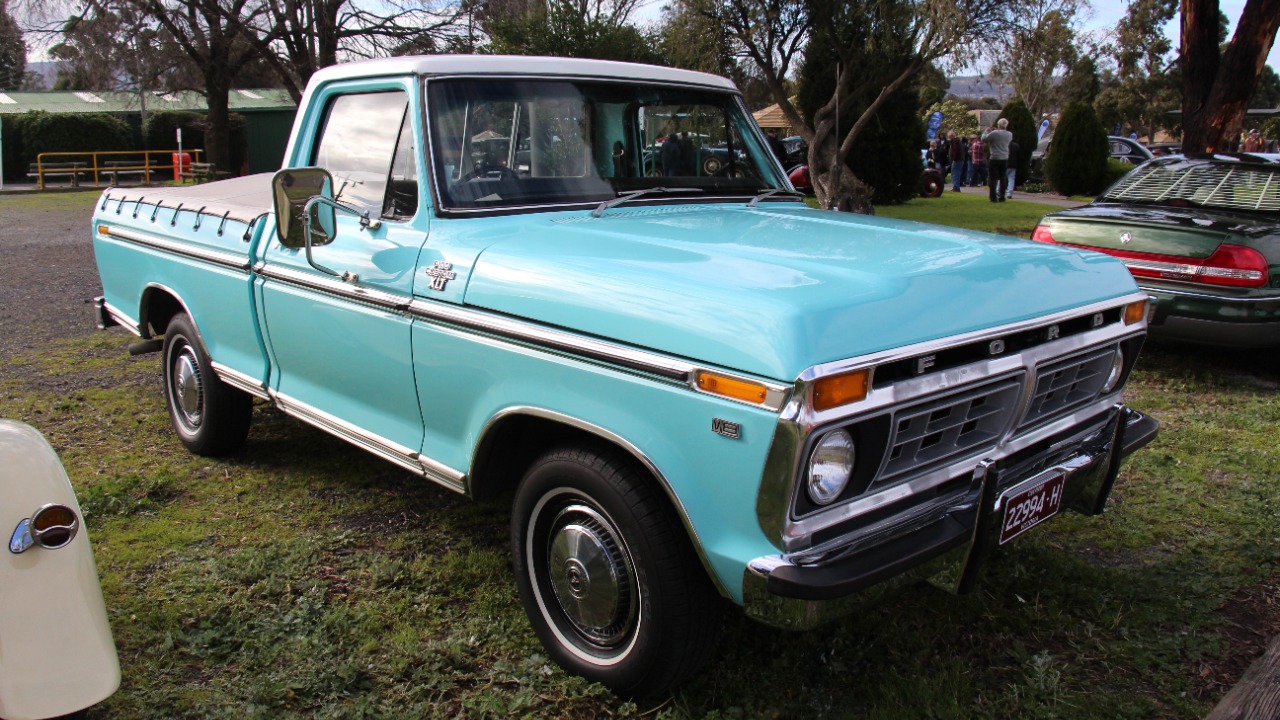
The Ford F-100 Custom Cab 390 sits at the crossroads of work-truck utility and big-block bravado, a short-lived specification that still shapes how collectors think about classic pickups. To understand when this configuration arrived and what it commands today, I need to trace how Ford’s F-Series evolved through the late 1960s and early 1970s and then follow the money in today’s valuation data.
That story starts with the fifth-generation F-Series, runs through the rise of the F-150, and ends in a market where early F-100s with the right options, including the 390 cubic inch V8, can bring serious money if the truck and its history are right.
How the fifth‑generation F‑100 set the stage for the Custom Cab 390
The F-100 that could be ordered with a 390 big-block grew out of a major redesign that reshaped Ford’s half-ton line. The company introduced the fifth-generation F-Series in 1966 for the 1967 model year, with an all-new body that was more squared-off and a Cab that was 3 inches (7.6 cm) wider than the previous generation. That broader footprint and more modern profile created the visual template many enthusiasts now associate with classic Ford pickups, and it also gave Ford room to broaden the trim and engine mix across the range, from basic work trucks to more comfortable Custom Cab models that targeted buyers who wanted car-like amenities alongside payload capacity.
Contemporary enthusiasts looking back on the 1967 Ford F-100 often highlight it as the moment the Series really stepped into the modern era of pickups, with styling and proportions that feel familiar even to today’s truck owners. Community histories of the Ford F-Series describe the 1967 F-100 as the launch point for this fifth-generation design, noting how the more squared-off body and wider Cab helped define the look we now expect from a light-duty truck. Those same accounts underscore that the F-100 sat at the heart of the lineup, positioned below heavier-duty models but above bare-bones compact options, which made it the natural canvas for Ford’s mix of trim levels, including the more upscale Custom Cab.
Where the 390 big‑block fits into Ford’s F‑Series powertrain story
The “390” in F-100 Custom Cab 390 refers to Ford’s 390 cubic inch FE-series V8, a big-block engine that had already built a reputation in passenger cars before finding a home in trucks. Technical retrospectives on the FE family note that while early variants like the 332 and 352 existed, enthusiasts and builders tend to focus on the 390 as the sweet spot in the range. One detailed overview, published on Aug 31, 1998, points out that Your search for Ford power is more likely to include the 390 than the smaller FE displacements, and it documents how this engine remained in production for pickup trucks through 1976. That long production window meant the 390 overlapped both the fifth- and sixth-generation F-Series, giving Ford plenty of time to pair it with higher-trim F-100 configurations.
By the time the sixth-generation F-Series arrived for the 1973 model year, Ford’s truck Powertrain chart shows a wide spread of Engines and Years, from workhorse sixes to larger V8s. The table lists options like a 240 CID Straight-6, with its own Power (SAE net) ratings and Notes, illustrating how the company balanced economy and torque across the lineup. Against that backdrop, the 390 sat near the top of the gasoline hierarchy in half-ton applications, marketed to buyers who needed to tow or haul heavier loads or who simply wanted more effortless acceleration. When paired with the Custom Cab trim, the 390 turned the F-100 into a relatively plush yet still utilitarian machine, one that could serve as both family transport and jobsite tool.
Pinpointing when the F‑100 Custom Cab 390 arrived
Identifying the exact first model year when “Custom Cab” and “390” could be combined on an F-100 requires stitching together what is verified and flagging what remains unverified. The fifth-generation F-Series was introduced in 1966 for the 1967 model year, and period descriptions of that launch emphasize the broader Cab and expanded trim structure, including a higher-end specification that sat above the base interior. Those same accounts confirm that the F-100 was central to the Series, but they do not explicitly state that a 390 big-block was available in the Custom Cab trim in 1967. Based on the available sources, the precise first year of the F-100 Custom Cab 390 combination is Unverified based on available sources.
What can be said with confidence is that by the early 1970s, Ford was offering a wide range of engines in its half-ton trucks, including inline sixes and V8s, and that the 390 remained in the pickup catalog through 1976. Powertrain tables for the sixth-generation F-Series show how Ford structured its Engine and Years offerings, with entries like the 240 CID Straight-6 and associated Power and SAE net figures, while separate FE engine histories confirm the 390’s continued use in trucks. Taken together, these details support the conclusion that the F-100 Custom Cab 390 was a product of the late fifth and early sixth generations, even if the exact launch year of that specific pairing is not documented in the provided material.
How the F‑100 evolved into a collectible as the F‑150 took over
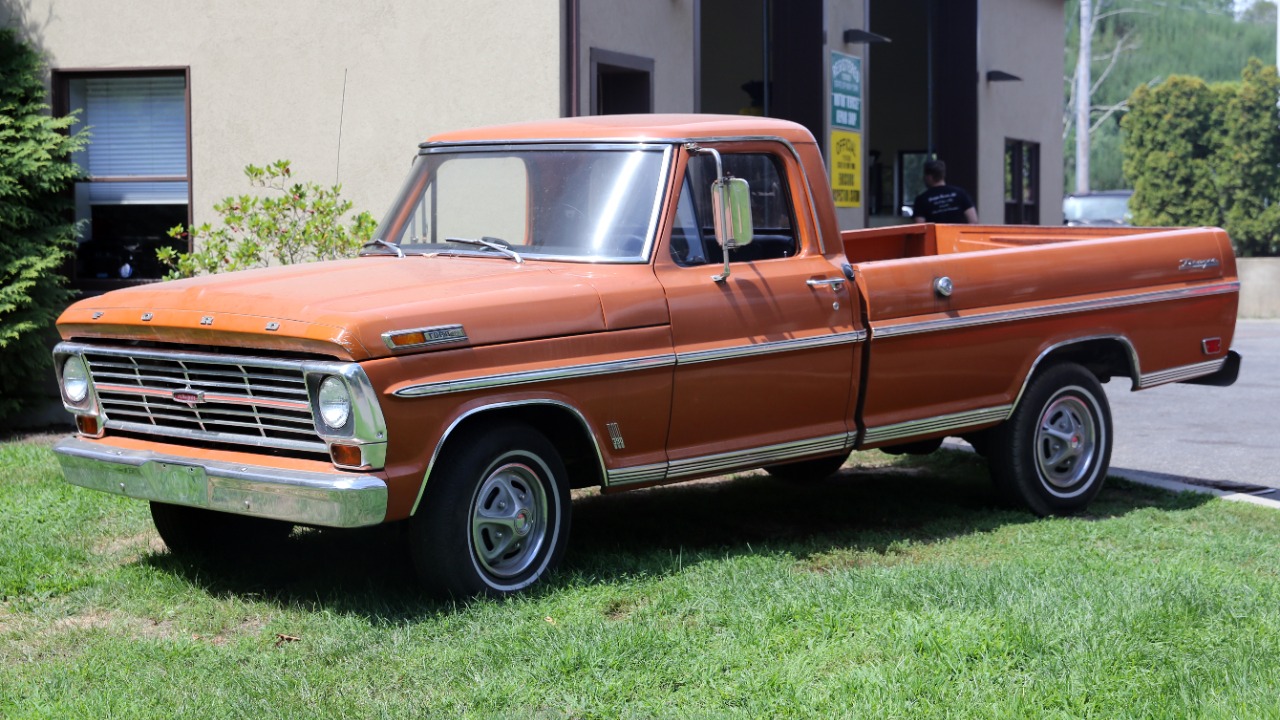
The F-100’s run as Ford’s primary half-ton did not last forever, and the way it exited the stage helps explain why certain configurations, including big-block Custom Cabs, are now prized. Valuation overviews of the Ford F-100 years note that the larger F-150 eventually overtook the smaller F-100 in popularity, and that the F-100 model was retired in 1983. Those same summaries emphasize that Collectors still gravitate toward early-model F-100s, particularly trucks with desirable options and clean bodies, which keeps demand high to this day. The shift toward the F-150, with its higher payload ratings and growing market share, effectively froze the F-100 as a finite commodity, especially in higher-spec trims.
Later buyer’s guides for the 1973 to 1979 F-Series underline how Ford continued to refine its engine mix as the F-100 approached the end of its life. One such guide, dated Jan 18, 2023, notes that Under the hood, 1973–74 F-100 trucks carried over slightly detuned inline six-cylinder engines, including 240 and 300 cubic inch units, before the company adjusted its offerings again toward the end of production in 1979. That evolution, combined with the eventual dominance of the F-150, means that earlier F-100s with more muscular engines like the 390 and better-appointed interiors such as the Custom Cab stand out in hindsight. They represent a moment when a half-ton Ford could still be relatively compact by modern standards yet optioned with serious displacement and comfort features.
What F‑100 Custom Cab trucks are worth now
To understand what a Custom Cab 390 might bring today, I start with broader F-100 valuation data and then narrow in on specific model years. A general pricing overview for Ford F-100 years explains that the F-150’s rise and the F-100’s retirement in 1983 did not dampen enthusiasm among Collectors, who still chase early trucks and help keep prices firm. That same resource highlights how the F-150 overtook the smaller F-100, with the numeric gap between 150 and 100 now mirrored in the market, where the older, lower-numbered trucks often command a premium when they are well preserved or correctly restored. The presence of a big-block like the 390, while not quantified directly in the provided data, typically pushes a truck toward the upper end of any given condition range.
Year-specific valuation tools give a clearer sense of the money involved. For a 1970 Ford F-100 Custom, the Common Questions section that addresses How much such a truck is worth notes that values vary significantly with Condition, originality, and specification. The same tool explains that buyers can typically expect to pay more for trucks in good condition with average spec, and that rarer or more desirable configurations sit above those benchmarks. Although the 390 engine is not broken out separately in the summary, experience across the classic truck market suggests that a factory big-block, especially in a Custom Cab, tends to lift a truck out of the baseline “average spec” category and into a more sought-after tier.
Recent sales benchmarks and what they imply for a Custom Cab 390
Later fifth-generation trucks provide some of the clearest hard numbers for what well-kept F-100s can bring. Valuation data for a 1972 Ford F-100 Custom lists specific body and engine combinations, including a 2dr Flareside Long Bed with a 6-cyl. 240cid/120hp 1bbl engine. In that configuration, a #3 Condition example is pegged at $17,500, a figure that reflects a driver-quality truck that is presentable but not show-perfect. The same table notes that a 2dr Flareside Long Bed with an 8-cyl. 302cid/154hp 2bbl engine also has its own #3 Condition benchmark, and that the top recorded sale over the last three years reached $192,500, underscoring how exceptional examples can break far beyond typical price guides.
Those numbers matter for anyone trying to price a Custom Cab 390. If a relatively modest 240cid six-cylinder F-100 in #3 Condition is valued at $17,500, and if the best-documented sales can push into six figures for the right specification and provenance, then a well-restored or highly original Custom Cab with a 390 big-block logically sits toward the upper end of the mainstream range, with the potential to climb higher when rarity, documentation, and presentation align. While the provided sources do not isolate a specific dollar figure for the F-100 Custom Cab 390, the combination of general F-100 valuation trends, year-specific benchmarks, and the enduring appeal of big-block Ford power provides a clear takeaway: the moment Ford paired its upscale half-ton trim with the 390 created a truck that collectors now recognize as both historically significant and financially meaningful.

Leave a Reply