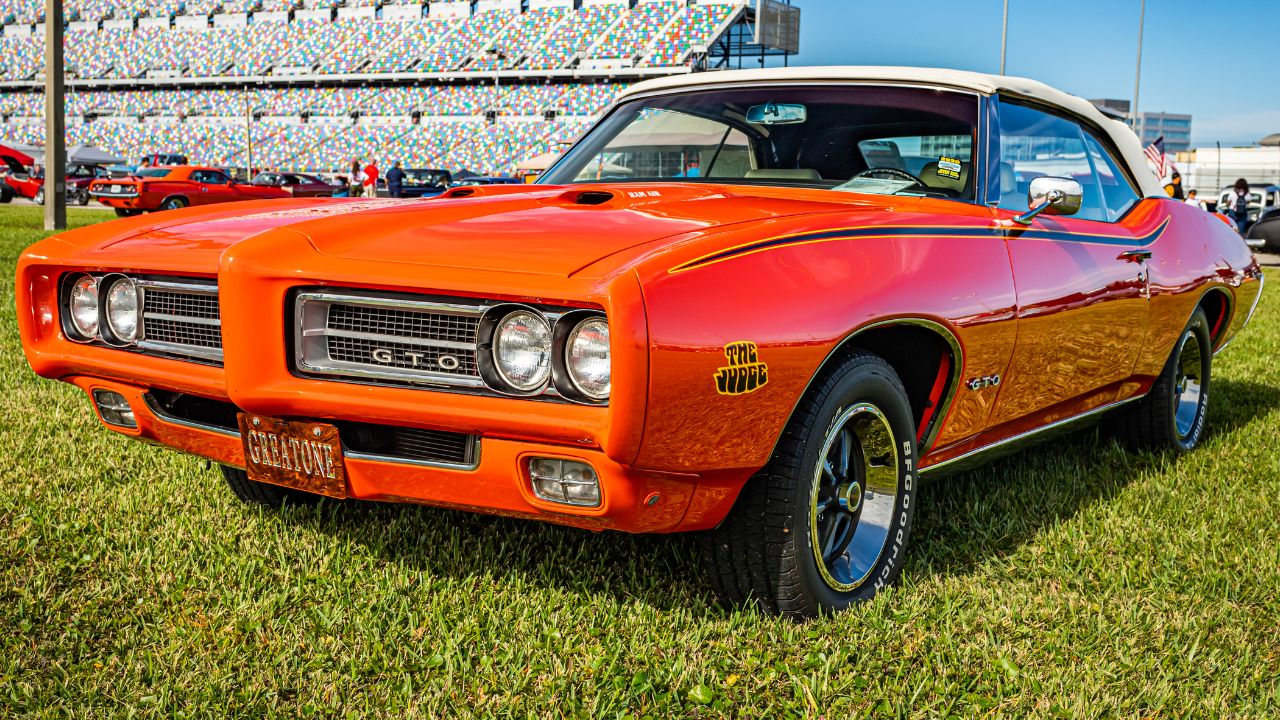
The Pontiac GTO Judge arrived at the peak of the Muscle Car Era, a loud, brightly striped answer to rivals that were turning raw horsepower into youth culture. Today, that same swagger has turned the Judge into one of the most closely watched American collectibles, with values that reflect both its limited production and its outsized place in muscle car history. I want to trace how and when Pontiac built this icon, then look at what serious buyers are paying now for the most desirable versions.
How the GTO set the stage for the Judge
Before the Judge existed, the basic GTO had already rewritten Detroit’s playbook by dropping big power into a midsize body and marketing it directly to young drivers. Other manufacturers quickly followed with their own midsized performance coupes, and the broader Other manufacturers followed suit as the Muscle Car Era gathered steam and then began drawing to a close. That competitive pressure is what pushed Pontiac to create a more flamboyant, more focused version of its already successful GTO.
By the late 1960s, Ford had the Fairlane and Chevrolet had the Chevelle at the same time as the GTO, and those cars showed how crowded the performance field had become. A later look back at the Hurst-tuned variant notes that it was not a new idea for Detroit to spin special editions off existing muscle platforms, and that context helps explain how the Hurst GTO Judge evolved from the standard GTO formula. The Judge would build on that foundation, and the Ford, Fairlane and Chevrolet Chevelle, GTO, Howeve competition is what made Pontiac push the car further in both performance and personality.
“Here comes the Judge”: launch timing and production run
The Judge did not simply appear as another option code; it was rolled out with a deliberate sense of theater. Although the Judge was announced and advertised in mid December 1968 for release in January of 69, the first cars were actually built a little earlier, which shows how eager Pontiac was to get its halo GTO into showrooms. Later reporting on the program notes that the total run of the original Judge amounted to a relatively small number of cars, and that limited production is a key part of why collectors now treat it as a blue chip muscle car. The detail that it was positioned for release in January of 69 is preserved in a period look back that opens with the line, “Although the Judge,” and goes on to describe a total run of 6,833 cars, with the figure 69 itself highlighted as a shorthand for the model year in that context, all captured in a retrospective that begins on Dec 30, 2022, December, January, 69.
That timing meant the Judge hit the market just as insurance costs, emissions rules, and changing buyer tastes were starting to squeeze the Muscle Car Era. A museum profile of a 1969 example notes that the broader Muscle Car Era was drawing to a close even as Pontiac was rolling out its most extroverted GTO, which adds a layer of urgency to the Judge’s brief production window. When I look at that compressed timeline, it is clear that the Judge was both a culmination of Pontiac’s muscle ambitions and a last stand before the market shifted away from high compression V8s, a point underscored by the way the Muscle Car Era is described as already nearing its end.
Design, personality, and the Judge’s pop culture roots
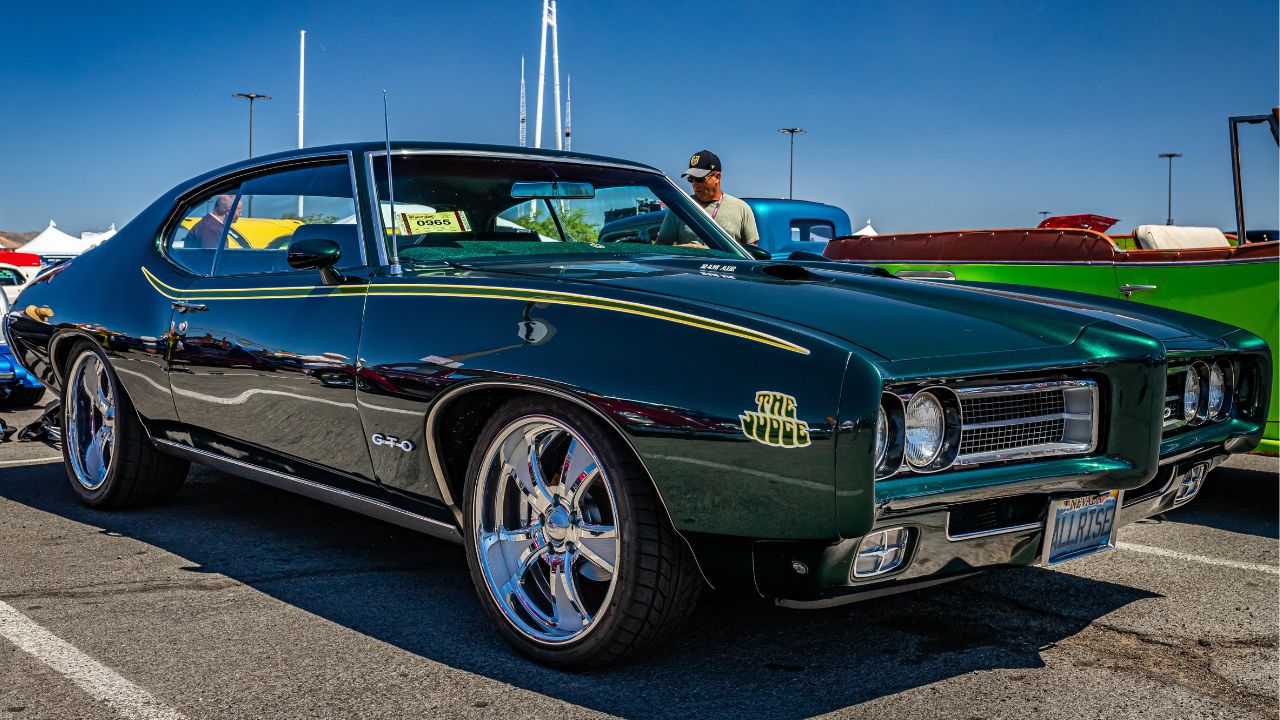
What set the Judge apart visually was how unapologetically loud it was, even by late 1960s standards. Enthusiasts still single out the 1969 Pontiac GTO Judge as one of the most legendary and flamboyant muscle cars of all time, created as a high impact package with bright paint, bold graphics, and a performance oriented image that went far beyond the base GTO. A detailed fan write up describes how the 1969 Pontiac GTO Judge is remembered as a standout in American muscle, using phrases like “Created as a high” to emphasize its over the top intent, and that same piece tags it with hashtags like #TheGoat and #PontiacPerformance to underline how the car’s look and attitude have aged into modern social media culture, all captured in a post dated Aug, Pontiac GTO Judge, Created.
The name itself came from a designer who reportedly loved comedy so much that he borrowed a catchphrase from contemporary television, turning a joke into a badge of honor on the quarter panels. A later list of Interesting Facts About The Pontiac GTO Judge notes that the car was only available for three model years and ties that limited run to its cult status, while also pointing out that The Pontiac design team leaned into humor and pop culture when they chose the Judge branding. That same overview, dated Nov, Interesting Facts About The Pontiac GTO Judge, The Pontiac, helps explain why the car still feels more like a character than a mere option package, which is a big part of its appeal in the auction lanes today.
Under the stripes: engines, Hurst influence, and performance
For all its visual flash, the Judge’s credibility rested on what sat under the hood. Second generation examples were built around Pontiac’s 400 cubic inch V8, with buyers able to choose between Ram Air III and Ram Air IV versions that were conservatively rated at 366 horsepower and 370 horsepower. A detailed market overview of the second generation Judge notes that the car boasted a 400ci Ram Air III or Ram Air IV, producing those specific power figures, and that Judge customers were effectively buying a factory hot rod with serious straight line performance, a point that is laid out clearly in the Ram Air III, Ram Air IV, Judge market summary.
The Hurst connection added another layer of performance credibility and marketing flair. A retrospective on the Hurst GTO Judge’s history explains that the idea of a special edition muscle car was not new, since Ford had the Fairlane and Chevrolet had the Chevelle at the same time as the GTO, but the way the Hurst GTO Judge evolved turned that concept into something more focused and more collectible. Another section of that same history notes that when Pontiac rolled out the Judge with the “Here comes the Judge!” tagline, it was an instant classic, and that the collaboration with Hurst helped cement its reputation among enthusiasts who cared as much about quarter mile times as they did about stripes, all detailed in a piece dated Mar 30, 2024, Mar, Ford, Fairlane and Chevrolet, Chevelle, GTO, Howeve.
How long Pontiac built the Judge, and how rare it really is
From a production standpoint, the Judge was intentionally short lived, which is a major reason it commands such attention now. A detailed rundown of Interesting Facts About The Pontiac GTO Judge points out that the car was only available for three model years, a compressed run that makes it far rarer than many other muscle nameplates that lingered through the early 1970s. That same overview, dated Nov 17, 2022, ties the Judge’s three year availability to its modern desirability and notes that collectors track specific examples through major auction houses like Mecum Auctions, all of which is summarized in the Nov 17, 2022 feature.
Within that already limited run, some configurations are dramatically rarer than others. A deep dive into the rarest versions notes that The Pontiac GTO Judge was designed to rival muscle cars like the Plymouth Road Runner and Dodge Super Bee, and then drills down into how few examples were built in certain body styles and option combinations. A follow up section on the same topic explains that including all body types and special editions, the rarest GTO Judge model ever made is counted in extremely low numbers, with convertible models making them rarer still, and both of those points are laid out in reporting dated Mar 5, 2025, Mar, Pontiac, The Pontiac GTO Judge, Plymouth Road Runner, Dodge Super Bee and expanded in a companion piece that notes how few cars exist when you include all body types and convertible models making them rarer, as detailed on Mar 5, 2025.
What the market says: recent sales and price ranges
On the valuation side, the Judge has moved firmly into serious collector territory, with price guides and auction results showing a clear premium over standard GTOs. A valuation tool focused on the 1969 Pontiac GTO Judge explains that the value of a 1969 Pontiac GTO Judge can vary greatly depending on its condition, mileage, options, and history, and it organizes those differences into Common Questions that help buyers understand why two similar looking cars can bring very different money. That same resource tracks individual sales and notes how auction results have evolved over time, with references to events like Nov 1, 2025 Mecum Auctions used to anchor specific price points in the Common Questions, Pontiac GTO Judge data.
Later model Judges show similarly strong numbers. A valuation page for the 1970 Pontiac GTO Judge lists Past sales and highlights two recent results: Sold. $92,880. 1970 Pontiac GTO Judge. Standard. North America. Nov 8, 2025 GAA Classic Cars, and $52,920. 1970 Pontiac GTO, which underscores the spread between a Judge and a non Judge car of the same year. Those exact figures, $92,880 and $52,920, are presented side by side to illustrate how the Judge package commands a significant premium, and the same Past sales section notes that these results came from North America on Nov 8, 2025, all of which is laid out in the $92,880, $52,920, Past, Sold, Pontiac GTO Judge, Standard, North America, Nov 8, 2025, Nov entry.
Price guides, trends, and what buyers should watch
Beyond individual auction headlines, broader price guides show that GTOs in general, and Judges in particular, have been trending upward. A valuation trends report on Pontiac notes that in general, GTOs are on the rise, and that according to the Hagerty Price Guide, all GTOs in condition 3 (good) have increased in value in the past five years. That same overview, titled Valuation Trends: Pontiac, emphasizes that According to the Hagerty Price Guide, the brand’s muscle cars have benefited from renewed interest among younger collectors, which helps explain why Judge prices have remained resilient even as some other segments have cooled, all summarized in the Valuation Trends, Pontiac, According, Hagerty Price Guide analysis.
For 1970 specifically, the valuation tools show how those trends translate into real money. A page dedicated to the 1970 Pontiac GTO Base lists the same Past sales figures of $92,880 for a 1970 Pontiac GTO Judge and $52,920 for a 1970 Pontiac GTO, both recorded on Nov 8, 2025 at GAA Classic Cars, which gives buyers a concrete benchmark for what a well presented Judge can bring relative to a comparable non Judge car. That resource also notes that the highest sale price for a 1970 Pontiac GTO Judge in the last three years was $1,100,000, a figure that underscores how rare, perfectly restored, or historically significant examples can break into seven digits, all of which is captured in the $92,880, $52,920, Past, Sold, Pontiac GTO Judge, Standard, North America, Nov 8, 2025 and the $1,100,000 valuation entries.
How online market data frames the Judge today
Online market trackers add another layer of context by aggregating sales across auctions and private listings. A dedicated page for the Pontiac GTO Judge in its second generation compiles recent transactions and notes that the highest sale price recorded for a Judge, 2nd Gen is $118,808, a figure that helps set expectations for buyers shopping outside the headline grabbing million dollar cars. That same overview explains that the car boasted a 400ci Ram Air III or Ram Air IV, producing 366hp and 370hp, according to conservative estimates, and that Judge customers were effectively buying a top tier performance package, all of which is summarized in the Pontiac GTO Judge – 2nd Gen Market data.
When I compare those aggregated numbers with the individual auction results and broader price guide trends, a consistent picture emerges. The Judge sits at the top of the GTO hierarchy, with rarity, performance, and cultural cachet all feeding into strong prices that have generally moved upward over the past five years. Even as the Muscle Car Era recedes further into history, the combination of limited production, distinctive styling, and documented sales like the $92,880 and $1,100,000 examples suggests that serious collectors still see the Judge as a benchmark car, and the way recent market summaries frame the Judge – 2nd Gen reinforces that status.