
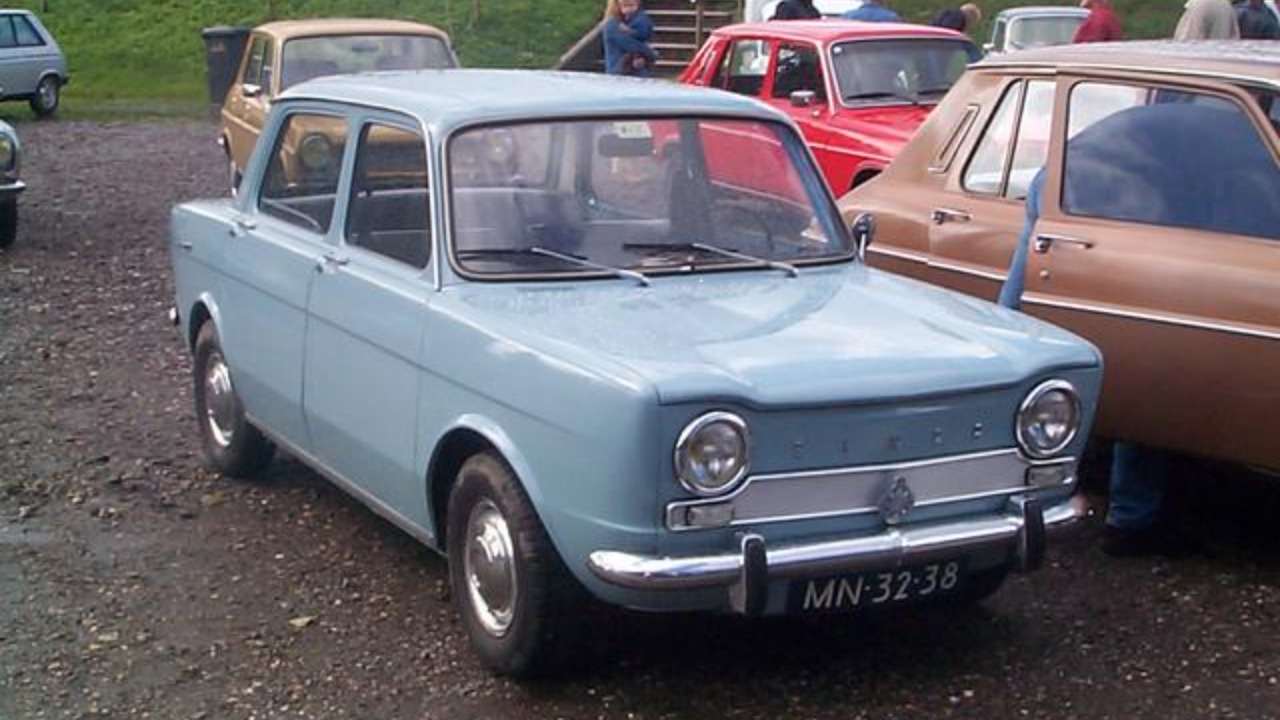
You meet the Simca 1000 at the moment Europe’s car market is learning to love the compact family saloon, and you can see exactly who it is trying to impress. It is not a luxury flagship and not a bare‑bones people’s car, but something carefully aimed at the middle, promising space, modern engineering and a price that felt reachable to a growing urban class. To understand why that mattered, you have to look at how Simca positioned this rear‑engined square‑shouldered four‑door as the car that could carry ordinary European families into a more mobile decade.
The middle‑class brief behind a square little saloon
When you look at the Simca 1000, you are seeing a company that has already climbed into the top tier of its home market and now wants to lock in that position. By the early 1960s, SIMCA was counted among France’s “big four” manufacturers, and the 1000 was the compact workhorse that helped it get there. The car’s basic formula, a small saloon with a rear engine and four proper doors, was tuned for buyers who needed to trade up from microcars and basic runabouts into something that felt like a real family car without straying into executive territory.
You can see that intent in the way the 1000 was engineered and priced to sit between the cheapest economy models and the larger national flagships. The car’s proportions gave you a surprisingly roomy cabin in a footprint that still fit narrow streets, and its mechanical layout promised simple, robust running for households that might be buying their first new car. Contemporary accounts of the Franco‑Italian baby saloon underline how deliberately it was pitched at that emerging middle, with enough style and sophistication to feel modern but not so much cost that it scared off salary‑earning families.
Franco‑Italian roots and a rear‑engined gamble
To hit that sweet spot, you are also watching Simca lean heavily on its Italian DNA. The company’s origins were tied to Fiat, and that relationship shaped the way the 1000 came together. The compact saloon’s layout and some of its engineering thinking reflected the same school that produced small Fiats, and the rear‑engined configuration echoed contemporary European experiments with weight distribution and packaging. The result was a car that enthusiasts later nicknamed a “baby Corvair”, a nod to the way the Simca 1000 blended Italian‑influenced design with a very French sense of practicality.
That rear‑engine choice was a risk, because it put Simca slightly out of step with the front‑engine, front‑drive wave that would soon define the European middle class. Yet for the early 1960s, it gave you a flat floor, a compact nose and a driving feel that felt lively compared with more conservative rivals. Period reviews of the rear‑engined saloon highlight how this configuration helped the car stand out in a crowded market, even as it demanded careful tuning to keep handling predictable for everyday drivers.
From instant French hit to cautious export player
If you were a French buyer at the time, the 1000 arrived almost perfectly timed. The Simca 1000 saloon was launched in France in October 1961 and quickly found favour with French customers who wanted a modern small family car. Its combination of four doors, usable performance and sensible running costs meant it slotted neatly into the lives of teachers, clerks and small business owners who were ready to move beyond basic transport but still counted every franc.
Outside France, though, the reception was more measured, which tells you a lot about how fragmented Europe’s middle really was. Reports on the export response describe a cooler reaction in some markets, where local tastes and tax rules favoured different body styles or engine sizes. That uneven success pushed Simca to think harder about how to tailor variants and styling to different national audiences, a challenge that would shape the 1000’s evolution through the decade.
Coupe dreams and the pull of aspiration
As you follow that evolution, you see Simca trying to keep middle‑class buyers engaged by offering them a taste of aspiration. The 1000’s basic platform spawned the 1200S coupé, styled by Bertone, which turned the sensible saloon into something you could plausibly park outside a fashionable café. Accounts of the 1200S describe how the project grew out of discussions between Simca and Italian designers, using the existing mechanical package but wrapping it in a low, sleek body that spoke directly to younger and more style‑conscious drivers.
For you as a buyer in that era, this mattered because it showed that Simca understood the middle class was not a static block. The same household that needed a practical saloon might also dream of something sportier, and the company’s willingness to spin off a coupé signalled that it wanted to keep those ambitions inside the brand. The Simca 1000 story in period footage often pivots from the everyday saloon to these more glamorous derivatives, underlining how the platform became a ladder from basic mobility to modest performance without forcing you to leave the Simca family.
Corporate chess: Fiat, Chrysler and a changing brief
Behind the showroom, the 1000’s life was shaped by corporate moves that also targeted Europe’s middle. Simca’s long‑standing tie to Fiat meant that, even in 1971, Fiat still held a 19 percent stake, even though it had stepped back from day‑to‑day control. At the same time, Chrysler was steadily tightening its grip on the French maker, a process that would eventually see the company’s name formally changed to Chrysler France as the decade wore on.
Those shifts were part of a broader American push into the European middle‑class market. In Spain, for example, the engine and truck builder Eduardo Barreir turned to Chrysler when local investors and banks would not provide enough capital, signing an agreement with the Chrysler Corporation in 1963. For you as a European buyer, that meant the Simca badge on your 1000 increasingly sat inside a global strategy, with American capital and Spanish partnerships helping to fund the cars that lined up in French showrooms.More from Fast Lane Only


Leave a Reply