
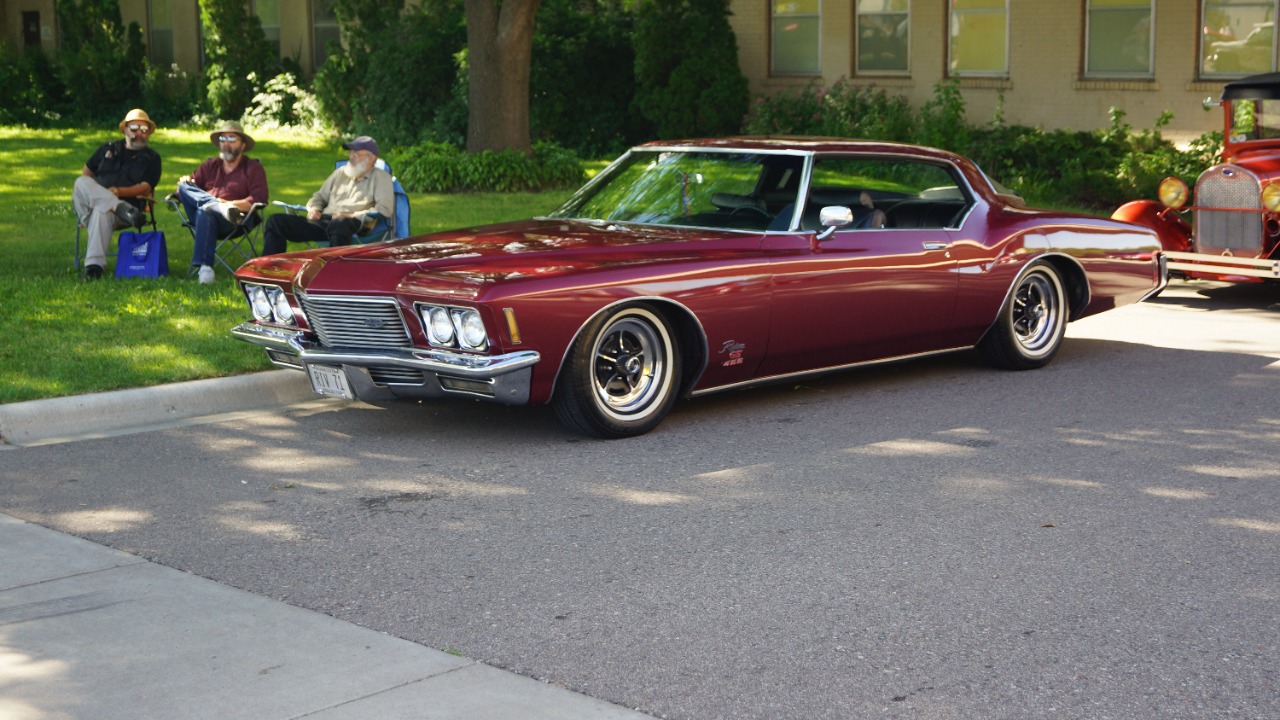
The 1973 Buick GS arrived at a turning point, trading the raw edge of late‑1960s muscle for a more relaxed, torque-rich personality that fit the new decade. Instead of chasing quarter‑mile glory at any cost, Buick leaned into smooth power, quieter cabins, and a broader comfort envelope, while still keeping a big V8 under the hood. I see that shift as the moment the GS stopped trying to be a street brawler and started to become a grand-touring bruiser with manners.
The muscle-car hangover meets Buick’s comfort instincts
By 1973, the classic muscle-car formula was running into hard limits, from tightening emissions rules to rising insurance costs, and the Buick GS had to evolve or fade. Rather than abandon performance altogether, Buick repositioned its Gran Sport hardware as the muscle-flavored version of the Buick Centur, a car that already leaned toward comfort and refinement, and that pivot gave the GS a very different mission than its late‑1960s ancestors. I read that shift as Buick acknowledging that most buyers wanted torque on tap for everyday driving, not a temperamental drag-strip special.
That context matters because it explains why the GS of this era feels more like a fast, well-trimmed cruiser than a bare-knuckle street machine. Reporting on the period notes that The Buick Gran Sport was explicitly framed as the muscle car version of the Buick Centur, which meant it had to live within the Centur’s more upscale, family-friendly brief even as it added power and attitude. When I look at that positioning, I see a brand trying to keep one foot in the performance world while stepping firmly into the comfort-first expectations of the early 1970s.
Big-block torque in a softer, quieter shell

Under the skin, the 1973 GS still carried serious hardware, and that is where the comfort-and-torque story really comes together. The centerpiece was a GM Buick 455 cu in Big-Block V8, fed by a 4‑barrel Quadrajet carburetor and supported by oversize valves and camshaft upgrades that kept the engine responsive even as regulations tightened. In Stage 1 form, that same 455 Cubic Inch V8 was rated at 360 horsepower, a figure that signaled Buick was not ready to surrender its performance credentials even as it wrapped that power in a more civilized package.
What strikes me is how Buick used that displacement not just for peak numbers, but for effortless, low‑rpm shove that suited long-distance driving and everyday commuting. The big-block layout, with its generous bore and stroke, delivered the kind of immediate, off‑idle pull that made the GS feel strong without needing to be thrashed, which fit perfectly with Buick’s reputation for smoothness. When I picture a 1973 Century GS 455 Stage‑1 Colonnade Sun Coupe easing onto the highway, I imagine a car that surges forward on a wave of torque while the cabin stays relatively hushed, a very different experience from the high-strung muscle cars of just a few years earlier.
From bare-bones bruiser to well-mannered Gran Sport
Inside, the 1973 Gran Sport walked a careful line between performance image and Buick’s traditional comfort cues. In standard form, the Gran Sport was austere, featuring the same vinyl bench seat and column‑shifted three‑speed automatic transmission you would find in more ordinary Centurys, which kept costs down and made the GS accessible to buyers who wanted the look and power without a luxury price tag. I see that as Buick’s way of saying you could still get into a GS without paying for every creature comfort, even as the brand’s broader identity leaned toward plushness.
At the same time, the very existence of that bench‑seat, column‑shift configuration underscores how far the GS had moved from its earlier, more hard-edged persona. Rather than insisting on buckets, consoles, and four‑speed manuals as the default, Buick allowed the Gran Sport to be ordered much like any other Century, then layered on performance options for those who wanted more. In practice, that meant a lot of 1973 GS cars were built as comfortable, automatic-equipped cruisers that happened to have a big engine and sportier trim, a combination that fits neatly with the idea of a muscle car pivoting toward comfort and torque rather than raw aggression.
The Stage 1 Sun Coupe as Buick’s balanced statement
If there is a single configuration that captures this balance, it is the 1973 Buick Century GS 455 Stage‑1 Colonnade Sun Coupe. Period documentation lists its Specifications with an Engine described as a GM Buick 455 cu in Big-Block V8, paired with that 4‑barrel Quadrajet carburetor and upgraded internals, and the car itself has been highlighted as a well‑mannered Buick performance model rather than a stripped-out racer. I read that combination of a Colonnade body, a sliding sunroof, and a torque-rich big block as Buick’s way of saying you could have open‑air fun, serious power, and everyday usability in one package.
The human details around that particular car reinforce how enthusiasts now see it. One notable example was Generously Lent by Philip & Grace Roitman, with the feature Written By Derek So, and it called out the 455 Cubic Inch V8 360 Horsepower Engine as the heart of a car that blended style, comfort, and performance. When I think about a couple like Philip and Grace Roitman preserving and sharing a GS 455 Stage‑1 Sun Coupe, it feels less like a museum piece from the muscle era and more like a cherished grand tourer, a car you would happily drive to a coastal town for the weekend rather than trailer to a drag strip.
Why the 1973 GS still matters to enthusiasts today
Looking back from today, the 1973 Buick GS occupies an intriguing middle ground that appeals to a specific kind of enthusiast. It is not the lightest or quickest Gran Sports ever built, and it arrived just as the classic muscle era was winding down, but its blend of big-block torque, usable comfort, and understated style gives it a charm that is easy to appreciate once you get past the spec-sheet wars. I find that many collectors now gravitate toward cars like this because they can actually be driven and enjoyed without feeling like fragile artifacts from a bygone performance arms race.
That perspective is echoed in detailed retrospectives that trace how Gran Sports evolved from raw street fighters into more rounded performance models, with Mar references to Gran Sports and The Buick Gran Sport helping to situate the 1973 cars within that broader lineage. When I connect those dots, the 1973 GS looks less like a compromise and more like a pivot point, the moment Buick decided that comfort and torque could coexist, and that a muscle-bred badge could thrive in a world that suddenly cared more about refinement than elapsed times.
For anyone considering a classic from this era, the 1973 GS rewards a slightly different mindset. You are not buying the last word in factory horsepower bragging rights, even with a 455 under the hood, and you are not getting the stripped-down austerity of a track-focused special. Instead, you are stepping into a car that reflects a very specific moment in American automotive history, when brands like Buick had to reconcile their performance heritage with changing realities and chose to do it with a big, relaxed V8 and a surprisingly comfortable ride. I think that makes the 1973 Buick GS one of the more honest cars of its time, a machine that stopped pretending to be a pure muscle car and embraced the comfortable, torque-rich personality it was always meant to have.




Leave a Reply