
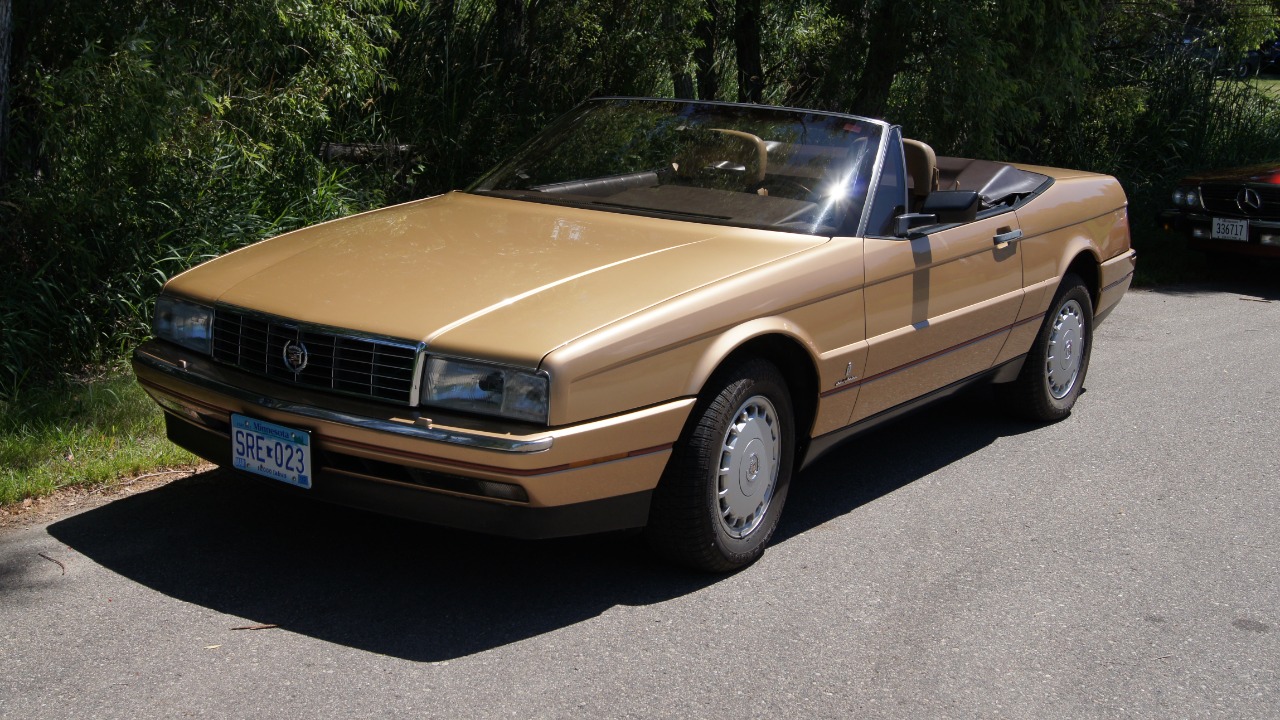
The 1987 Cadillac Allanté arrived as Detroit’s boldest attempt to meet Europe on its own turf, a low-slung two-seat roadster meant to lure buyers away from Mercedes and Jaguar. You see it now and the ambition is obvious: Italian styling, American V8 power, and a price tag that said Cadillac was ready to play in the same league as the continent’s most coveted grand tourers. Yet the car that was supposed to restore Cadillac’s prestige ended up as one of General Motors’ most fascinating near-misses.
If you are curious about how an American luxury icon tried to chase Europe and wound up building a car by air bridge, the Allanté is your perfect case study. Its story blends design bravado, logistical excess, and a mismatch between image and execution that still divides enthusiasts today.
Cadillac’s European dream
By the mid 1980s, you had a luxury market that was shifting fast, with well heeled American buyers flocking to European brands that felt more modern and sophisticated than traditional domestic sedans. Cadillac knew it needed an aspirational halo car, and the answer was a two seat roadster positioned directly against the Mercedes Benz SL and the Jaguar XJS. Period descriptions of the 1987 model make it clear that Cadillac introduced the Allante as its answer to those European icons, a car meant “to take on the world and win,” and to keep buyers from drifting permanently to imported coupes and convertibles.
Underneath that ambition sat a very specific brief. The 1987 to 1993 Cadillac Allantes were conceived as luxury two seaters built to compete with European cars that were wooing American customers in the face of strengthening foreign competition, a mission that pushed Cadillac to rethink what its flagship could be. Internal planners wanted a car that would combine the prestige of a Europe inspired roadster with the heritage of the Cadillac V 16 and the V 12 355 roadster of the 1930s, a lineage that shows how seriously the brand took this project. When you look at the Allanté in that context, you are not just seeing a pretty convertible, you are seeing Cadillac’s attempt to prove it still belonged at the top of the global luxury hierarchy.
The Pininfarina air bridge
To sell that message, Cadillac knew you would judge the car first with your eyes, so it went to Italy and hired Pininfarina to shape the body. The Allanté bodies were designed and manufactured in Italy by Pininfarina and then shipped 4,600 m (7,403 km) to the United States for final assembly with a domestically manufactured chassis and engine, a staggering distance that turned each car into a transatlantic project. The Allant shells were built just outside Turin, then loaded into specially modified aircraft that cradled the unfinished bodies, an expensive undertaking that made every Allanté a logistical marvel before it ever reached a showroom.
Because the body and some components needed to be assembled at Pininfarina’s factory in Italy, General Motors had to employ a fleet of jets to ferry the cars to Detroit, a process that enthusiasts later nicknamed the “air bridge.” When the cars arrived, they were marketed as “The New Spirit of Cadillac,” a phrase General Motors used when the Allant, also known as the Cadillac Allante, debuted in 1987 as a limited production statement car. If you picture that supply chain, you start to understand why the Allanté’s sticker price climbed so high and why critics later called it a vanity project that included a convoluted construction process rather than a rational business case.
Style, hardware, and the gap to Europe
From behind the wheel, the Allanté gave you a mix of familiar Cadillac comfort and European flavored restraint, but it never quite matched the sharpness of its rivals. Contemporary reviewers noted that Cadillac never tumbled to the fact that the Mercedes 300SL was not just a cut down Mercedes sedan, it was a race bred world class sports car, and that gap in philosophy showed up in the way the Allanté drove. The car used a front wheel drive layout derived from Cadillac sedans, and while it offered respectable performance and a smooth V8, it lacked the rear drive balance and track honed feel that defined the best European roadsters of the era.
If you look at the broader run of 1987 to 1993 Cadillac Allantes, you see a pattern of incremental improvements that never fully closed that gap. Early cars leaned heavily on luxury features and digital gadgets, while later versions added more power and chassis tuning in response to strengthening foreign competition, but the basic architecture remained closer to a refined boulevard cruiser than a sports car. Enthusiast retrospectives often point out that Cadillac, for all its effort, could not quite match the coherence of the European benchmarks it was chasing, no matter how hard Cadillac might try to tweak the formula.
Price, perception, and a “spectacular failure”
Even if you were willing to forgive the front wheel drive layout, the Allanté’s price made it a tough sell. By 1993, the price had risen to $64,843, which works out to over $100,000 in today’s money, and that put the car squarely against some very serious European machinery. In a 1992 comparison test, the Allanté faced a $71,888 rival and struggled to justify its cost with performance alone, a mismatch that left many buyers wondering whether they were paying for engineering or for the privilege of owning a rare Italian bodied Cadillac. When you remember that this was still a time when Cadillac’s core lineup leaned heavily on front drive sedans, the leap in price and positioning felt even more dramatic.
Later commentators have not been gentle. One detailed video review flatly calls the Cadillac Allante a spectacular failure for GM, with the host Mar admitting that the car has retained a place in his heart even if the car does not quite deserve it. Another walk around from Sep features Kelly describing how Cadillac introduced the Alante, or Cadillac Alante as he pronounces it, as their first two seat roadster since the 1930s, only to see it become Cadillac’s most expensive failure. When you add in the fact that the Allanté’s complex production and limited volume made it hard to turn a profit, you start to see why the car’s reputation has long been tied to its financial performance as much as its styling.
From showroom misfit to niche collectible
For all that, you might be surprised by how much affection the Allanté still inspires when you encounter one at a cars and coffee. Enthusiast pieces describe the Cadillac Allanté (1987 to 1993) as a convertible legend lost to time, conceived as Cadillac’s answer to European luxury roadsters and remembered as a logistical marvel that ultimately consigned it to niche collector status. The Allant is often grouped with other ambitious but flawed convertibles that deserve a second look, cars whose drama filled development stories now add to their charm rather than counting against them. If you are drawn to underdogs, the Allanté’s mix of Italian and Detroit influences can feel oddly irresistible.
Market watchers note that production ran from 1987 through 1993 and that The Allante did attract new customers into Cadillac showrooms and achieved modest sales, even if it never became fully respected in its market segment. A later marketplace listing for a 38k mile 1993 example reminds you that when it debuted in 1987, General Motors called the Allant “The New Spirit of Cadillac,” and that the cars were assembled just outside of Turin, Italy before crossing the Atlantic. Today, you can watch Jeff introduce a 1987 Cadillac Elante as an Italian and Detroit hybrid, or revisit period road tests that show how the car looked and felt when it was new, and you start to see why some buyers now view it as a quirky alternative to more predictable European classics.
More from Fast Lane Only

Leave a Reply