
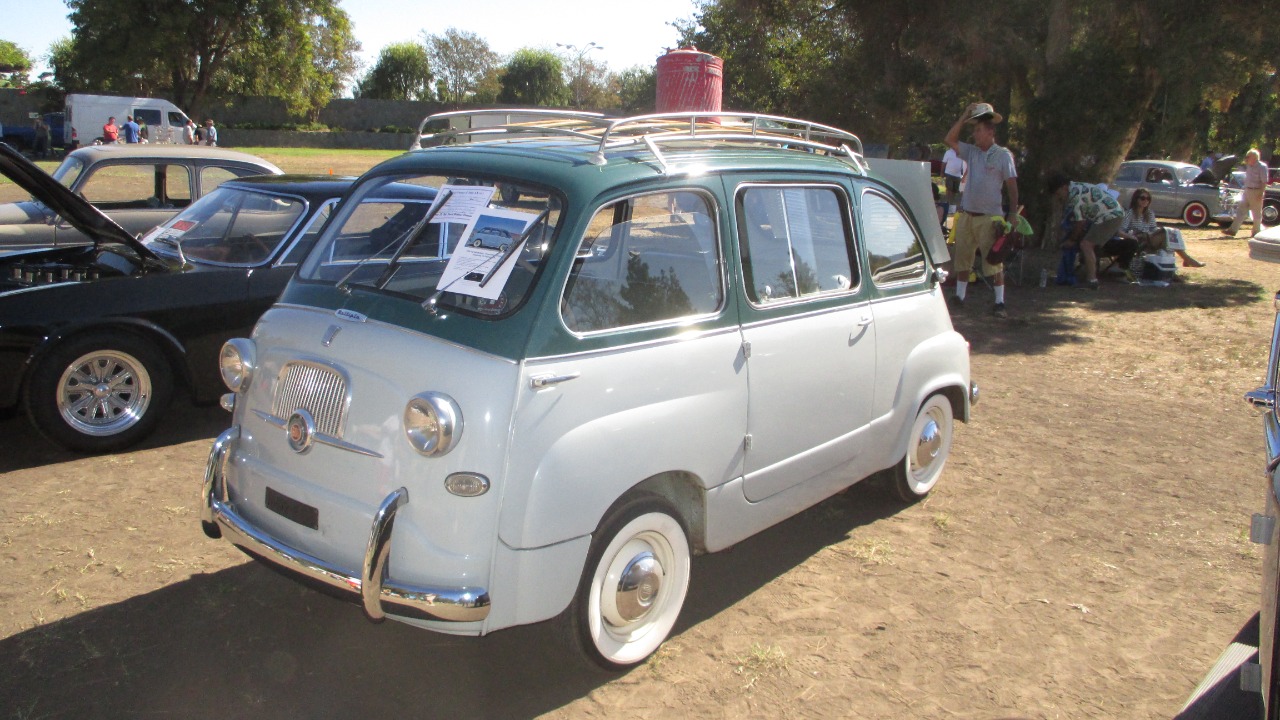
You usually hear about the cute Fiat 500 when people talk about postwar Italian cars, but it was the 1956 Fiat 600 and its radical Multipla variant that quietly rewired how cities moved. By squeezing family, work and public transport into one tiny footprint, it helped dense European streets adapt to mass motorisation without completely surrendering to traffic. If you look at today’s debates about walkability, shared vehicles and compact living, you are still living with choices that car set in motion.
To see why, you need to look beyond nostalgia and treat the 600 as urban hardware. It was a tool that let ordinary households, taxi fleets and small businesses claim mobility in places that had been built for feet and trams, not tailfins and freeways. In doing so, it nudged planners, mayors and everyday drivers toward a different idea of what a modern city could look like.
The people’s car that fit the old city
When Fiat launched the 600 in the mid‑1950s, it was not just adding another small car to the showroom, it was offering a way for working families to join the motor age without abandoning tight historic streets. The compact four‑seater used a rear‑engine layout and short wheelbase so you could thread it through medieval alleys and park in courtyards that would have defeated bulkier sedans, a practicality that helped make the Fiat 600 a familiar sight across southern Europe. Earlier this year, heritage specialists marking its 70th anniversary stressed that the 600 was faster and more usable than Fiat’s older city runabouts, which meant you could commute from new suburbs yet still slip into the centre, a combination that made it an instant hit at the Geneva Motor Show.
The car’s influence went far beyond Italy. Under licence, The SEAT turned the 600 into the defining car of the twentieth century for Spanish households, with the SEAT 600 becoming the first vehicle that any Spaniard could realistically buy as the country tried to join the ranks of industrial power in the world. In other words, this was not a niche city toy, it was the backbone of mass motorisation in places where streets were centuries older than the automobile. A recent video essay on the model even argues that while everybody knows the 500, the 600 is actually the bigger deal in Italian motoring history, precisely because it carried so much of the everyday load.
Dante Giacosa’s urban Lego set
What really reshaped cities, though, was not just the basic 600 but what Fiat’s engineers did with its platform. Because the Belvedere’s wagon body could not be replicated on the 600’s rear‑engine layout, Fiat’s Director of Engineering, Dante Giacosa, treated the little car as a kind of urban Lego brick and designed a new body that could handle taxi and light delivery duties without growing much longer than the original 600. Employing the 600’s wheelbase, platform and running gear, and adopting a forward‑control layout that pushed the driver over the front axle, Giacosa created a tall, one‑box shape that maximised interior volume while keeping the footprint tiny, a configuration later described as ideal for both families and small businesses that needed to weave through traffic and narrow lanes.
That design became the 600 Multipla, and it was as much a piece of urban design as a car. By putting the engine at the back and the cabin up front, the Multipla could seat up to six people or swallow cargo while still occupying little more road space than the base model, a trick that made it one of the world’s first recognisable minivans built on the Fiat 60 platform. Contemporary accounts of the project note that Dante Giacosa was deliberately chasing multi‑purpose flexibility, and later retrospectives describe how this very basic but effective architecture let owners flip between school runs, shop deliveries and weekend trips without ever needing a bigger, more intrusive vehicle.
The 600 Multipla as rolling public space
The breakthrough moment came when Fiat introduced the 600 Multipla in 1956 and presented it at the Brussels Motor Show, where the oddball silhouette and exceptional interior space signalled a new idea of what a city car could be. Period descriptions of the Brussels Motor Show debut emphasise how the 600 M body offered a completely new shape that could carry families for over a decade of service, yet still slot into the same parking spaces as the standard saloon. In practice, you were getting a rolling living room that could host kids, grandparents and luggage without demanding more asphalt or wider streets.
That flexibility turned the Multipla into a kind of shared public space on wheels. Fiat’s own heritage notes describe how Its reliability and low running costs made the Taxi version a runaway success, and it became widespread in Italy’s main cities, making the 600 M a familiar part of the urban landscape as drivers ferried commuters, tourists and night‑shift workers through historic centres. Accounts of the Taxi configuration stress that this very basic but effective interior could be reconfigured quickly, so the same vehicle might serve as a family car on Sunday and a workhorse on Monday, a pattern that reduced the total number of vehicles needed to keep a city moving.
The taxi that taught cities to share
Once municipal authorities saw what the Multipla could do, it started to reshape how they thought about fleets and street space. Produced between 1956 and 1967, the Fiat 600 Multipla became a revolution in the Italian taxi scene, with operators discovering that a compact yet spacious cabin could deliver a surprising result in terms of passenger capacity despite its small size. In cities from Milan to Rome, the Fiat Multipla showed that you did not need a hulking sedan to run an efficient taxi service, you needed clever packaging and a willingness to prioritise occupancy over sheer metal.
Heritage material on the model points out that this taxi role was not an afterthought but central to the Multipla’s identity, with the 600 M often photographed in busy piazzas and station forecourts as a symbol of modern Italian mobility. Later celebrations of the car in places like London have leaned into that history, with events highlighting how the legendary shape once conquered European capitals by offering a shared, flexible alternative to private sedans. When you hail a ride in a compact MPV today, you are following a template that the Multipla normalised: small footprint, high occupancy, constant reuse.
From family hauler to micro‑van and camper
For you as a city dweller, the genius of the 600 Multipla was that it blurred the line between private and commercial space. Owners could fold and flip seats to turn it into a micro‑van, a layout that later enthusiasts describe in posts about the 1959 Fiat Multipla 600 Van Micro Car as a standout example of Italian ingenuity that could handle both kids and cargo in New York‑style density. That dual role is celebrated in fan communities that share images of the Van Micro Car, where the same compact shell appears as a delivery van one day and a family shuttle the next.
The platform even lent itself to leisure in ways that prefigured modern van‑life culture. Commentators on a tiny fiberglass camper conversion note that the 600 Multipla came at a crucial point in Italian car history, when much of Italy’s manufacturing capacity was still recovering, yet people were eager to explore again. In that context, the pairing of a Multipla with a lightweight camper let families head for the coast or countryside without buying a separate tow car, a small but telling example of how one compact chassis could unlock multiple lifestyles without multiplying vehicles on the road.More from Fast Lane Only

Leave a Reply