
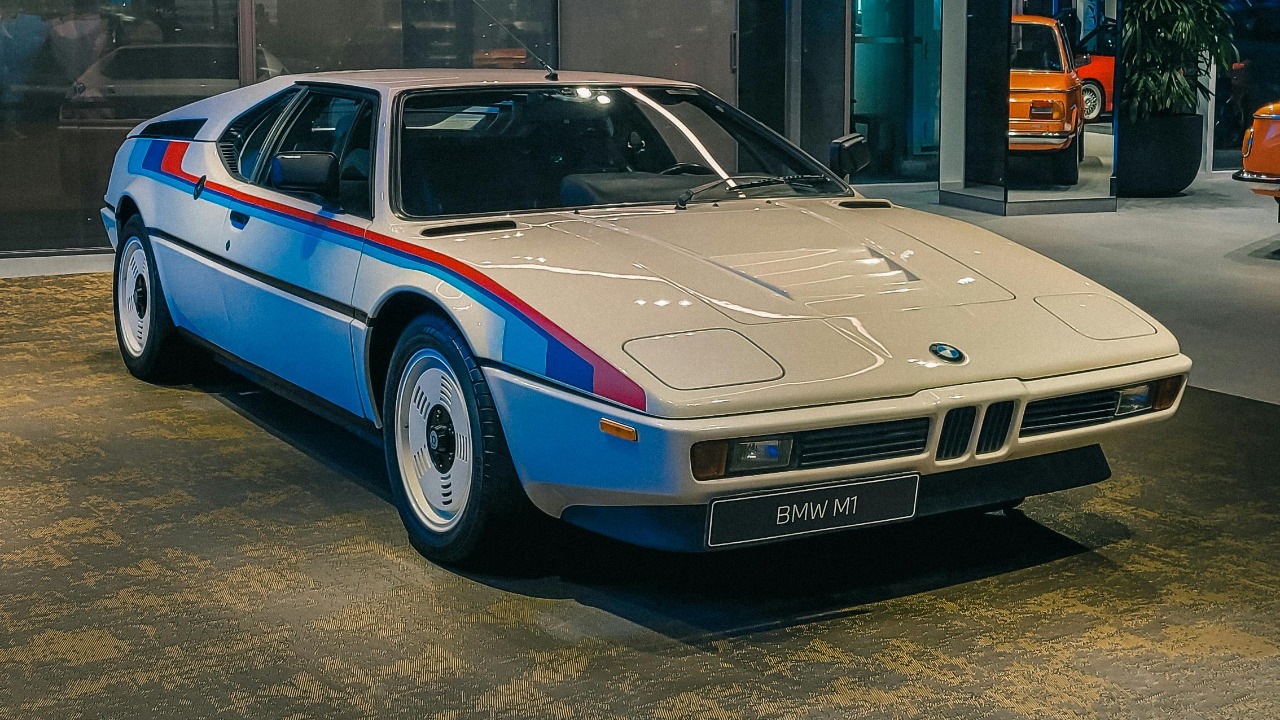
The BMW M1 occupies a strange and compelling place in performance-car history, a mid-engined supercar from a company better known for fast sedans and practical coupes. It was conceived as a motorsport weapon, built in tiny numbers, and then left without a true successor, which is why it still stands apart from the rest of Munich’s output. I see it as the rare moment when BMW let its racing department run wild, only to discover that the world around it was changing too fast for the project to make sense.
The chaotic origin story that set the M1 apart
The M1 was never destined to be a normal product-planning exercise, and its birth explains much of its enduring mystique. BMW wanted a mid-engined car to challenge the Italians in top-level racing, and the company initially turned to Lamborghini to make it happen, a partnership that quickly unraveled amid financial turmoil in Sant’Agata. Accounts of the project’s early years describe a saga involving a collapsed contract, a scramble to reclaim designs, and even a sense that BMW had to “steal” its own car back from its original partner, a drama captured in detail in a video on how BMW stole the M1 from Lamborghini.
That chaotic start meant the M1 arrived as a kind of orphan, a car without the straightforward corporate backing that later M products enjoyed. Instead of being integrated into a clear showroom-to-racetrack pipeline, it was shuffled between suppliers and programs, from the aborted Lamborghini build to a patchwork production process that involved Italian coachwork and German final assembly. The project’s roots in a racing program that never fully materialized, and the sense that missteps and even misappropriation of public money swirled around it, left the M1 with a backstory far removed from the tidy narratives that surround modern BMW M cars.
Born a supercar, not a sports coupe

Even stripped of its drama, the M1 is unusual because it is a true supercar from a brand that otherwise specialized in front-engined machines. I knew from the first time I studied its proportions that this was not just a faster 3 Series but a low, mid-engined wedge designed to sit alongside the most exotic machinery of its era. One detailed first-hand account describes how the writer approached the car knowing it was the first, and arguably only, supercar BMW ever built, and how the experience of spending a day with it confirmed that impression of a unique, mid-engined BMW supercar legend.
That mid-engine layout, combined with the car’s low roofline and long rear deck, gave the M1 a stance that separated it from contemporary 6 Series coupes or later M3s. It was not a tuned version of a family car but a purpose-built two-seater with a racing-derived straight-six mounted behind the driver. The cabin, with its simple analog instruments and businesslike ergonomics, reinforced the impression that this was a machine designed first for speed and stability, then adapted just enough for road use. In an era when most BMWs balanced performance with everyday practicality, the M1’s uncompromising supercar format made it an outlier from the moment it appeared.
Engineering that still feels ahead of its time
Under the skin, the M1’s hardware helps explain why it continues to fascinate engineers and drivers. The car’s straight-six featured four valves per cylinder and mechanical fuel injection, a combination that was advanced for a road-going engine of its day and directly linked to BMW’s racing ambitions. Official material on the car’s development notes that Its four valves per cylinder worked together with that injection system to deliver the kind of power and responsiveness expected from a top-tier sports car of the era.
On the road, that specification translated into a driving experience that still feels unusually pure. Owners and testers describe a chassis that communicates clearly, steering that remains unfiltered by modern electronics, and an engine that thrives on revs without feeling fragile. The M1’s suspension and braking were tuned with racing in mind, so the car feels composed at speeds that would unsettle many of its contemporaries, yet it retains enough compliance to be usable on real-world roads. That blend of motorsport-grade engineering and just-enough comfort is part of what keeps the M1 relevant in a world of far faster but often more remote-feeling supercars.
Rarity, value, and the cult of the M1
If the engineering makes the M1 special, the production numbers make it almost mythical. Contemporary analysis of the model’s history notes that with less than 450 produced, a driver is effectively guaranteed not to see another one on the road, let alone have the chance to follow another M1 through a set of corners. That scarcity has turned every surviving example into a rolling piece of motorsport history, and it is a key reason collectors treat the car as a blue-chip asset rather than just another classic BMW.
The market has responded accordingly. One detailed valuation overview describes how the M1 has become a high-dollar collectible, with typical asking prices ranging from USD 500,000 to 600,000, a range explicitly tied to its status as the first German mid-engined supercar and its tiny production run. That same analysis, Published by Author Ted Marcus, frames the car as “born at the wrong time,” a machine that arrived just as regulations, racing rules, and economic conditions were turning against such ambitious projects. The result is a car that feels both historically important and commercially anomalous, a combination that fuels its cult status.
A race car that could not fully go racing
The M1’s competition story is another reason it stands apart from the rest of BMW’s M portfolio. The car was conceived to compete at the highest levels of sports car racing, yet shifting regulations and delays meant it never truly got the factory-backed campaign its creators envisioned. One widely shared video analysis captures this contradiction in a single line, noting that while its backstory was a disaster, the BMW M1 itself is one of the most incredible cars of its time, a sentiment echoed in a Revelations episode that calls it a race car that could not go racing.
To salvage the project, BMW created the Procar series, a one-make championship that ran as a support event to Formula 1 and put star drivers into identical M1s. That series gave the car a brief but intense moment in the spotlight, and official retrospectives describe how the combination of its advanced engine, mid-engined layout, and distinctive styling helped it transition from Procar curiosity to long-term icon. Yet the fact remains that the M1 never enjoyed the kind of sustained factory racing program that later M3 and M4 models did, which only deepens its aura as a brilliant but slightly miscast machine.
Italian rivals, German intent
Context matters when judging why the M1 feels so unusual, and its competitive set in period was dominated by Italian brands. In the 1960s and 70s the Italians ruled the mid-engine supercar universe, with Ferrari and Lamborghini defining what an exotic should look and feel like. BMW’s decision to enter that arena with a car that combined German engineering discipline and Italian-influenced styling was bold, especially for a company whose reputation rested on sedans like the 5 Series and coupes like the 3.0 CSL.
The M1’s styling and construction reflected that cross-border approach. Italian designers shaped its wedge profile, while BMW engineers focused on the drivetrain and chassis, creating a car that could stand alongside a Ferrari 512 BB or Lamborghini Countach in terms of presence but felt distinctly different to drive. The result was a supercar that did not fully belong to the established Italian tradition or to BMW’s own lineage of front-engined performance cars, which is part of why it still feels like a one-off experiment rather than the first step in a long-running series.
The M1’s shadow over modern BMW M culture
Even decades later, the M1 continues to influence how BMW presents its performance division, particularly when the brand wants to signal a connection to its most exclusive past projects. At major events, the company still showcases special examples, such as a Polaris Silver car originally owned by M division founder Jochen Neerpasch, displayed alongside modern highlights like From the Concept Touring Coupe and an M3 Touring in Speed Yellow. That kind of curation places the M1 at the center of BMW’s performance story, even though it has no direct successor in the current lineup.
The company has also used the M1 as a touchstone for modern collaborations. One official feature highlights how, As the first and only original vehicle from BMW M GmbH, the M1 has now effectively received a sibling in the form of the BMW XM Kith Concept, a far larger and more complex machine that still nods to the two-seater with a flat silhouette. By explicitly linking a modern, electrified SUV to the M1, BMW acknowledges that this late-1970s supercar remains the spiritual benchmark for what a halo M product should represent, even if the form factor has changed dramatically.
Why the M1 still feels like Munich’s exotic outlier
All of these threads, from the chaotic Lamborghini partnership to the limited production run and the aborted racing program, converge on a simple reality: the M1 does not fit neatly into BMW’s otherwise orderly history. It is the only mid-engined supercar the company has ever built, it was produced in vanishingly small numbers, and it arrived at a moment when regulations and market forces were turning against exactly this kind of project. That combination of ambition and misfortune has given the car a mystique that more commercially successful models rarely achieve.
When I look at the current BMW range, with its powerful but practical M3s and M5s and its high-riding XM, the M1 stands apart as a reminder of a time when Munich briefly tried to beat the Italians at their own game. Its advanced engine, its Procar exploits, its role as a design and branding reference point, and its status as a half-million-dollar collectible all reinforce the sense that this was a one-time experiment. That is why, decades later, the M1 still reads less like the start of a dynasty and more like a rare, exotic outlier that BMW has never quite dared to repeat.


Leave a Reply