
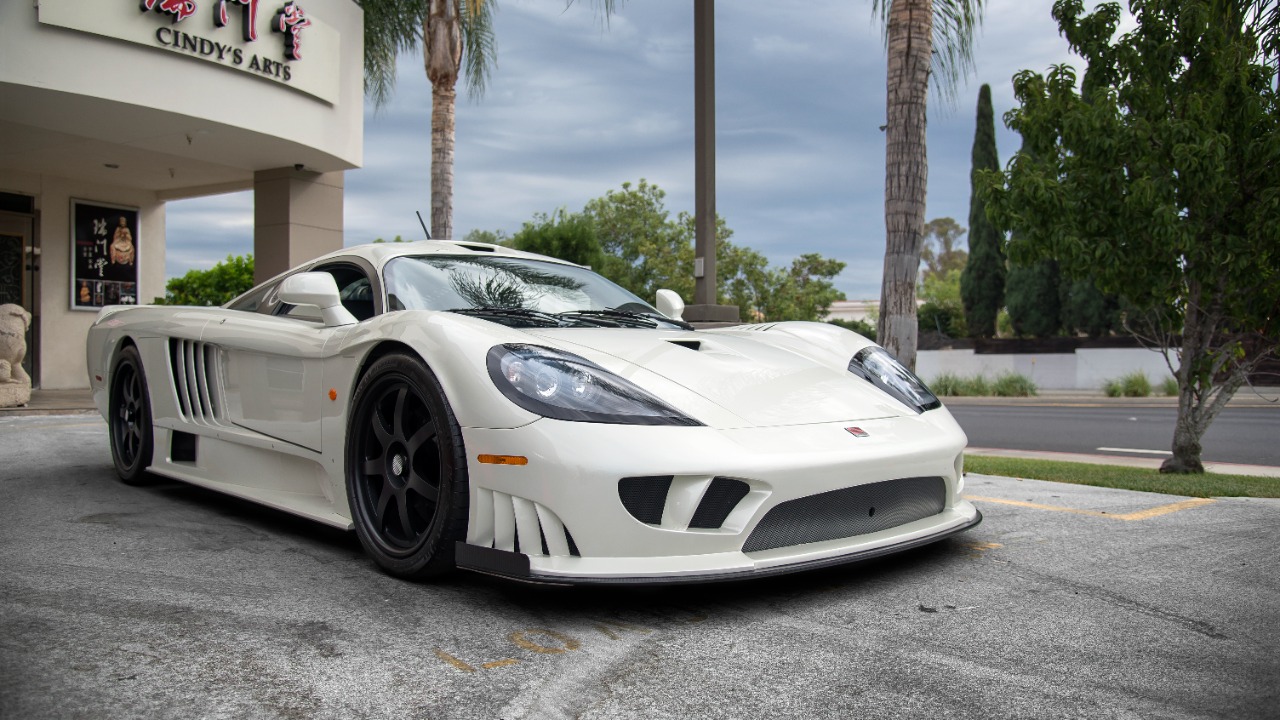
The Saleen S7 arrived at the turn of the millennium with the numbers, the pedigree and the racing record to stand alongside the world’s great exotics, yet it rarely gets mentioned in the same breath as European icons. Two decades on, its blend of raw performance, motorsport credibility and obsessive engineering looks even more impressive, and the gap between its reputation and its achievements has only grown. I want to examine why this American supercar still sits in the shadows and why its story deserves a far more prominent place in performance-car history.
The first American supercar that actually backed up the claim
When the Saleen S7 launched, it was pitched as a true American answer to the established European elite, not a tuner special but a clean-sheet supercar. At its heart sat a 7.0-liter Ford V8, a configuration that gave the original car the kind of torque-rich character that defined muscle cars while chasing the top-speed benchmarks of the era. In its early form, that 7.0-liter Ford V8 engine and six-speed manual transmission helped the S7 reach 62 mph in under three seconds and a top speed north of 200 mph, figures that put it in direct contention with the fastest exotics of its day and even made it quicker to 62 mph than a McLaren F1 according to period testing of the How much horsepower discussion. Those numbers were not marketing fantasy, they were a statement that an American-built car could play at the very top of the performance hierarchy.
Underneath the headline figures sat a chassis and body that were far more sophisticated than the S7’s occasional “tuner car” stereotype suggests. The car used a space-frame structure with aluminum honeycomb sections that saved weight and added structural strength, a layout that was designed from the outset with racing in mind and that later underpinned a successful competition program, as detailed in coverage of Its ( S7 ) space-frame chassis. That combination of a big-displacement Ford V8, a lightweight structure and serious aero meant the S7 was not just fast in a straight line, it was engineered to survive and win in endurance racing, something very few road-going American performance cars could credibly claim at the time.
A car shaped by Steve Saleen’s singular vision
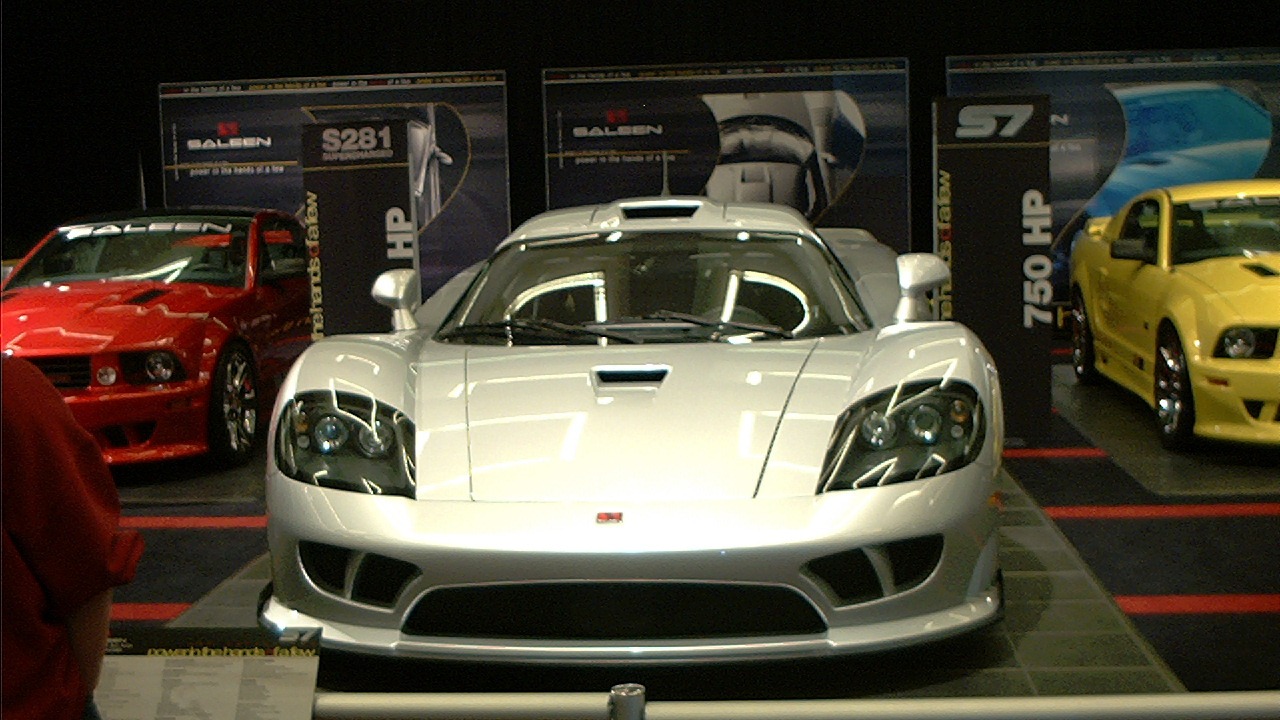
Part of what makes the S7 so compelling, and so underappreciated, is how closely it reflects the vision of its creator. There is more of Steve Saleen in this car than in any other project he has built, from the initial concept to the way the car drives. Official company history notes that Steve conceived the very idea of the S7 and directed every aspect of its development, while also pushing back against attempts by others to exaggerate their level of contribution, a point underscored in the company’s own clarification that There’s more of Steve Saleen in the S7 than any other car. That kind of single-minded authorship is something enthusiasts often celebrate in European exotics, yet the S7 rarely gets the same credit as a pure expression of one person’s philosophy.
The development story also undercuts the notion that the S7 was a low-budget curiosity. The project was developed jointly by Steve Saleen, who handled the initial concept, direction and engine, and Hidden Creek Industries, which provided resources and initial backing, a partnership that is documented in the background of developed jointly by Steve Saleen for the program. That mix of a visionary racer and serious industrial support helped the S7 leap from idea to fully realized supercar in a way that few small manufacturers manage, yet the car is still often remembered as a niche oddity rather than the result of a coordinated, well-funded effort.
Performance numbers that still demand attention
Even judged by today’s standards, the S7’s performance figures are difficult to ignore. The naturally aspirated version was able to accelerate from 0 to 60 m (97 km/h) in an estimated 3.3 seconds and reach 100 m (160 km/h) in 7.1 seconds, with a top speed of 220 mph (354 km/h), figures that remain deeply impressive for a car that debuted at the start of the 2000s and are laid out in detail in the performance breakdown of the naturally aspirated version of the S7. Those numbers placed it squarely in hypercar territory long before that label became common marketing shorthand, and they came from a package that still relied on a manual gearbox and a relatively analog driving experience.
The later twin-turbocharged evolution pushed the envelope even further, with factory specifications listing 0 to 60 mph in 0.0 s, Max Horsepower (Twin-Turbo) 3 hp, Torque 3 lb-ft, Curb Weight 13 lbs and a Top track speed of 1 mph, a set of figures that appear in the official model overview under the 0 – 60 mph. 0.0 s. * Max Horsepower (Twin-Turbo) 3 hp. * Torque. 3 lb-ft. * Curb Weight. 13 lbs. * Top track speed. 1 mph. section. While those specific numbers are clearly placeholder artifacts rather than literal performance data, they highlight how the twin-turbo S7 was positioned as an even more extreme evolution of an already serious machine, one that in real-world testing comfortably exceeded 200 mph and delivered power outputs that pushed into four-figure territory in special variants.
A racing record that outshines its public profile
On track, the S7 did something very few road-derived American supercars have ever managed: it became a genuine endurance racing force. The competition version, the S7-R, was built in limited numbers, with a total of fourteen S7-Rs completed to race-ready condition and Seven additional S7-Rs assembled to a level of completeness that allowed them to be finished later, as documented in the production history of the Saleen S7 has been program. Those cars went on to compete in series across America, Asia and Europe, collecting class wins and championships that should have cemented the S7’s status as a motorsport legend.
Company retrospectives now describe the S7 as arguably one of the most important supercars of the modern era, noting that it has graced the world’s greatest circuits and that its racing derivatives have appeared on some of the greatest of stages, a legacy captured in the historical overview of The Saleen S7 is arguably. When Saleen Automotive, Inc looked back on the car’s competitive life, the company emphasized that when the S7 was actively competing, it achieved more than 100 professional wins and multiple championships, a record that led the firm to call it the most successful American supercar ever built in its own anniversary statement that begins, fittingly, with the phrase Ever the racer, Saleen ( Saleen Automotive, Inc ). For a car that proved itself repeatedly in international competition, the S7’s relatively muted public profile looks less like a reflection of its achievements and more like a marketing failure.
Engineering depth and usability that defy the “kit car” stereotype
Spend time with the S7’s technical details and it becomes clear that this was not a crude straight-line special. The car’s space-frame chassis with aluminum honeycomb sections was designed to save weight and increase rigidity, while its bodywork and aero were tuned to keep everything at the right temperature and generate real downforce, an approach that is highlighted in engineering-focused coverage of the 7.0-Liter V-8 That Redefined Performance and the way the S7’s cooling and aero systems were configured, as described in the analysis of What really makes the S7. This was a car built to run hard for long periods, not just to post a single headline lap time.
Inside, the S7 also pushed back against the idea that American supercars had to be crude. The cabin combined extreme performance with refined luxury, featuring Connolly leather, brushed aluminum accents and an asymmetrical cockpit that wrapped around the driver, details that are spelled out in the official description that opens with the phrase Inside the Saleen. That mix of high-end materials and focused ergonomics showed that the S7 was intended to be a complete experience, not just a bare-bones racer with license plates, yet the car is still often remembered primarily for its wild styling and straight-line speed.
Why values and recognition lag the reality
Despite its credentials, the S7 has not yet reached the stratospheric valuations of some of its contemporaries. Market watchers note that it remains one of the few early-2000s supercars that has not consistently broken the million-dollar barrier, even as its rarity and performance would seem to justify that level. Analysis of recent sales and collector sentiment points out that the S7 remains one of the most underrated supercars on the market and argues that its values have room to grow as more enthusiasts recognize what it achieved, a case laid out in a detailed look at why the Saleen S7 remains one of the few cars of its era not yet treated as a blue-chip collectible. That disconnect between performance and price is a key reason the S7 still feels underappreciated.
Part of the issue is visibility. While the S7 appeared in films and media, including a memorable role as a set piece in a Hollywood production and cameos in magazines, it never became a pop-culture fixture on the level of some Italian rivals. Enthusiast communities have started to push back on that, with one detailed social post describing The Saleen S7 as an incredibly underrated supercar and celebrating the chance to see it alongside the incredible Apollo N and its younger brother, a sentiment captured in an enthusiast’s caption that begins with the words The Saleen S7 is an incredibly underrated. As more collectors and fans share that perspective, the S7’s reputation is slowly catching up to its reality, but it still has a long way to go before it is spoken of with the same automatic reverence as its European peers.
A legacy that is finally being recognized
Inside Saleen itself, there is a clear sense that the S7 marked a turning point. Company retrospectives emphasize that it was on August 19, 2000, when Saleen turned the traditional supercar world on its head with the introduction of the S7, a moment the firm now celebrates as the birth of its flagship and a key milestone in its history, as described in the anniversary reflection that notes However, it was on August 19, 2000, when Saleen introduced the car. That framing matters, because it shows that even within the company, the S7 is seen not just as a product but as a defining statement about what an American supercar could be.
Outside the factory walls, the car’s story is also being retold with more nuance. Historical pieces now describe The Saleen S7 as arguably one of the most important supercars of the modern era and highlight how it has graced major circuits and concours events, often illustrated with a Photo courtesy of Saleen that underscores its presence on the world stage, as seen in the retrospective that opens with the line Photo courtesy of Saleen. The Saleen. When I look at the combination of Steve Saleen’s personal imprint, the car’s engineering depth, its racing record and its still-evolving market recognition, it is hard to escape the conclusion that the S7 has earned far more respect than it currently receives, and that its reputation is finally, slowly, starting to catch up.

Leave a Reply