

The Spyker C8 has never tried to blend into the supercar crowd. Where rivals chase lap times and wind-tunnel perfection, this Dutch oddity leans into theatrical design, obsessive craftsmanship and a kind of mechanical showmanship that feels closer to haute horology than mass-produced performance. That is exactly why it has endured in enthusiast memory as a handcrafted icon, even if it remained a rare sight on the road.
Rather than compete head-on with the usual Italian and British exotics, the C8 carved out a narrow lane for buyers who wanted a rolling piece of sculpture as much as a fast car. Its story is one of deliberate eccentricity: aviation-inspired styling, jewel-like interiors and a small company that chose artistry over volume, even when that meant staying on the margins of the market.
How a revived Dutch marque chose art over outright speed
The modern Spyker story is rooted in a conscious decision to build something different from the dominant supercar script. When Victor Muller reintroduced the brand and launched the Spyker C8 Spyder, he did not position it as a direct challenger to Ferrari, McLaren or Lamborghini, but as a low-volume alternative for people who valued design drama and craftsmanship first. Reporting on the company notes that, despite their striking looks, Spyker cars never truly went head to head with Ferrari or Lamborghini on raw performance, instead courting a niche audience that valued artistry over outright numbers, a stance that defined the C8 from its earliest days and is underscored in detailed histories of Despite their striking looks.
That philosophy shaped the first production model of the reborn company, the Spyker C8 Spyder, which arrived as the initial modern expression of the brand under Victor Muller. The car was presented as an all-aluminium, hand-built, mid-engined supercar with a short wheelbase and a cabin that deliberately evoked the cockpit of a modern jet fighter, a combination that signalled how far Spyker was willing to lean into its aviation heritage and artisanal positioning, as period technical write-ups on the Spyker C8 Spyder make clear.
A cabin that treats craftsmanship as a performance
Step inside a C8 and the priorities become obvious: the interior is not just a place to sit, it is a stage for the brand’s obsession with visible engineering. Exposed gear linkages, turned aluminium surfaces and toggle switches arranged like aircraft controls turn every drive into a small ceremony, and contemporary reviews of the C8 Spyder describe the interior as luxurious and exotic, with the drama of the design doing as much work as the engine in shaping the experience, a point reinforced in assessments of how the interior of the C8 became a talking point in its own right.
Later evolutions of the model line kept that theatrical spirit but worked to make the cabin more usable. The Spyker C8 Preliator, for example, was framed by the company as the evolution of a classic, with a focus on improving ergonomics and functionality while preserving the brand’s signature detailing, a balance that official material on The Spyker C8 Preliator highlights explicitly. Independent descriptions of the same car note that the interior offered more space, higher comfort levels and better ergonomics than earlier C8s, showing how Spyker tried to refine the oddball charm into something owners could live with on longer journeys, as seen in technical breakdowns of the Preliator interior.
Design language: aviation cues and sculpted metal
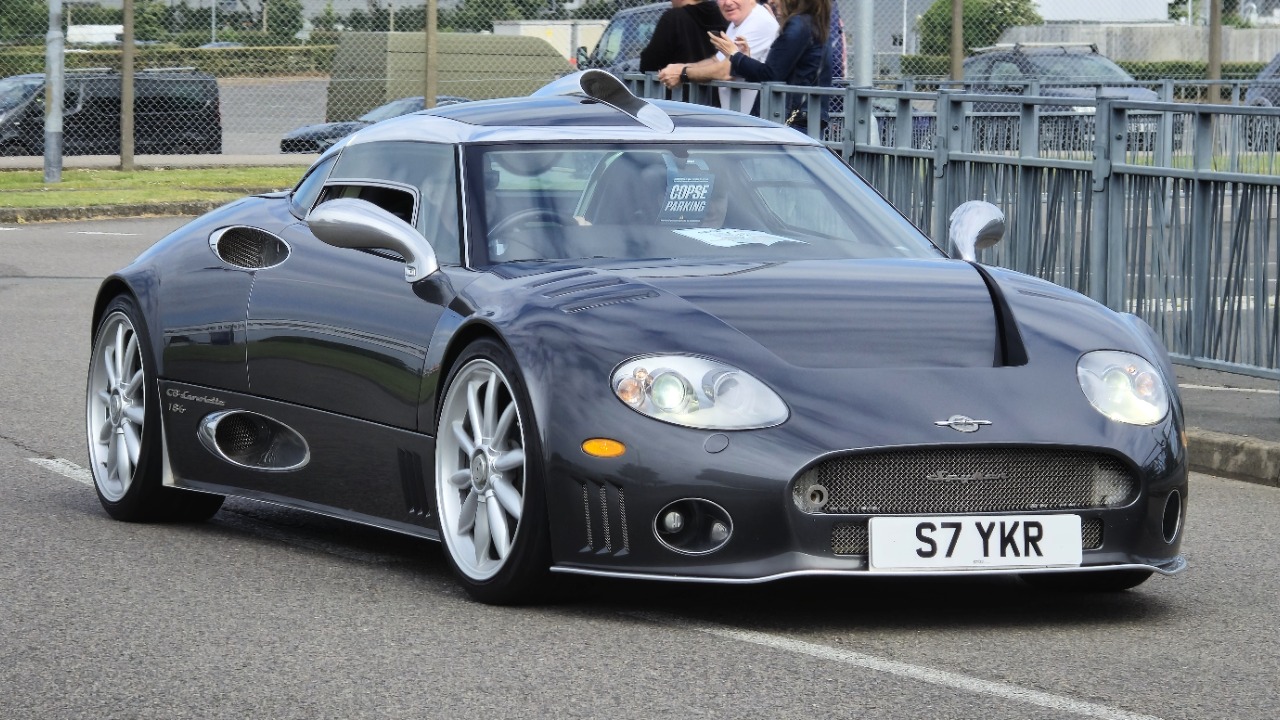
From the outside, the C8 family wears its eccentricity even more loudly. The proportions are compact and muscular, but it is the details that set it apart: fuselage-style bodywork, a prominent wide grille intake and rear cannon-port vents that look like they were lifted from a vintage aircraft rather than a contemporary supercar. Descriptions of the Spyker C8 Laviolette emphasise these elements, noting fuselage-type styling, those distinctive vents and a propeller-inspired motif that runs through the car, all executed with a focus on the highest quality of finish, as catalogued in sales material for the Spyker C8 Laviolette.
The Aileron variant pushed the same language further, pairing the brand’s aviation cues with a more elongated profile and a cabin that was explicitly described as hand crafted, with comfort and space that exceeded expectations for such a low-volume exotic. Technical notes on the C8 Aileron highlight a hand-built cabin with comfort and space aplenty, along with a sound system and equipment list that underscored Spyker’s values of craftsmanship and exclusivity, a philosophy that comes through clearly in documentation of the Hand crafted Aileron.
Engineering as a supporting act to the spectacle
Underneath the visual drama, the C8’s engineering was competent and, in some respects, quietly sophisticated, but it was rarely the headline. The chassis development on the C8 Aileron, for instance, was described as the most efficient in Spyker’s history, with technologies and measures that improved rigidity and dynamics while still allowing the car to remain relatively light. Official brochures stress that these technologies and measures delivered the most efficient chassis the company had produced, and that Every Spyker was built to a consistent standard that included features such as Xenon headlights as standard equipment, details that are spelled out in technical literature on the Spyker C8 Aileron.
Comfort was another area where the C8 quietly diverged from the stereotype of a punishing supercar. Contemporary driving impressions of the Spyker C8 Spyder describe it as superbly comfortable for an all-aluminium, hand-built, mid-engined machine, with the short wheelbase and carefully tuned suspension delivering a ride that surprised those expecting something harsh and uncompromising. That balance of comfort and drama is captured in technical summaries that describe the car as Superbly comfortable despite its exotic layout, reinforcing the idea that Spyker wanted owners to enjoy the spectacle without suffering for it.
Rarity, racing echoes and the making of an icon
Part of the C8’s mystique comes from how seldom it appears in the wild. Enthusiast accounts of the Spyker C8 Laviolette describe it as quite rare, urging anyone who stumbles upon one to take a closer look at the details, from the intricate bodywork to the way the car hauls down the road when driven hard. One such profile introduces it explicitly as This Dutch supercar, called the Spyker C8 Laviolette, and notes that if you encounter one you should consider yourself lucky, a sentiment that captures the car’s scarcity and is echoed in coverage that frames This Dutch Spyker as a rare sight worth savouring.
The C8’s design also carries deliberate references to Spyker’s early twentieth century racing and aviation history, which helps explain why it resonates so strongly with a small but passionate audience. Analyses of the C8 Spyder point out that the car pays homage to the original brand’s goals and works with aerospace influenced designs in the steering wheel, dashboard and bodywork, with every exposed mechanism and propeller motif reinforcing that lineage, a connection that is laid out in detail in discussions of how The car pays homage to the original Spyker ethos.
When a car becomes rolling sculpture
For all the talk of chassis efficiency and comfort, the C8’s lasting impact is aesthetic and emotional. Commentators who have spent time with the car argue that The Spyker C8 might have the mechanical credentials to stand out, but that it is really the build quality, the sense of drama and the sheer visual spectacle that make it feel like automotive art. One detailed examination notes that the C8 attracts more attention than many other so called supercars, precisely because it looks like nothing else on the road, a point that is driven home in essays that frame The Spyker C8 as the moment when a car becomes art.
That sense of sculpture is not accidental, it is baked into the way the car was conceived and presented. Analyses of the C8 Spyder’s styling describe it as a unique design study that showcases serious racing pedigree, with the exterior made even more impressive by the fact that no two cars are exactly alike in their detailing and finish. Those same reports underline that the Spyker C8 Spyder looks unique and shows serious racing pedigree in a way that sets it apart from more conventional exotics, reinforcing its status as a handcrafted oddball that has earned its place in the pantheon of modern icons, as captured in commentary that the Spyder Looks Unique And Shows Serious Racing Pedigree.


Leave a Reply