
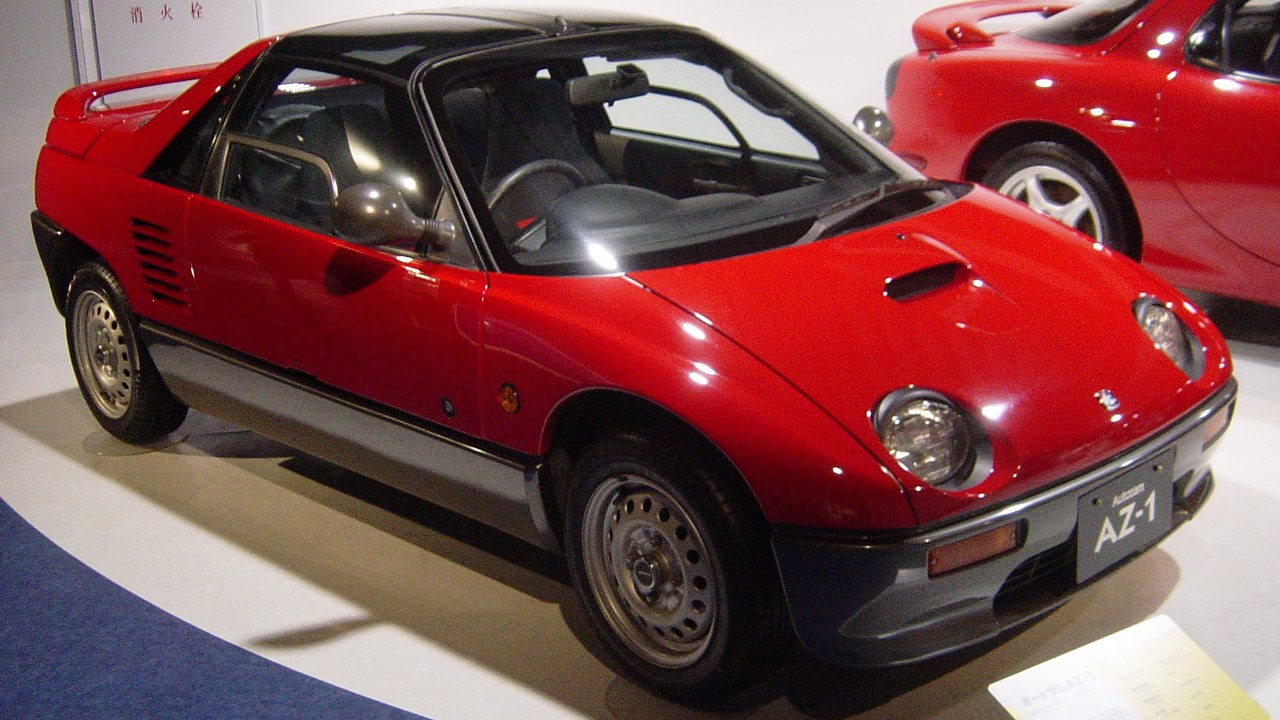
The tiny Mazda Autozam AZ-1 has long been a cult favorite for its dramatic gullwing doors and modest kei car performance, a visual promise its original three-cylinder engine could never quite keep. Now a radical widebody build has finally given this “world’s weakest” gullwing sports car the rotary power its styling always suggested, turning a once underpowered curiosity into a compact missile. The transformation is not only mechanical, it is a statement about what happens when Japan’s strict kei regulations are treated as a starting point rather than a limit.
From kei car curiosity to rotary showcase
I see the appeal of the Mazda Autozam AZ-1 as rooted in contradiction, a car that looks like a junior supercar yet was engineered to fit within Japan’s kei car rules. Those regulations capped displacement and power, so the original Japanese market AZ-1 relied on a small turbocharged three-cylinder engine that prioritized compliance over outright speed, which is why it has often been described as the weakest gullwing sports car despite its exotic silhouette and compact mid-engine layout. For fans of rare Japanese machines, that mismatch between appearance and performance has always been part of the charm, but it also created a lingering sense that the Mazda Autoz deserved more.
The new build that has emerged in Tokyo finally answers that long-standing “what if” by discarding the kei constraints and installing a rotary engine in the Autozam AZ-1’s tiny chassis. Reporting on the project describes how the car, once neatly aligned with kei dimensions and output, now uses a significantly more powerful rotary unit that fundamentally changes its character while preserving the original mid-engine configuration. In that sense, the car moves from being a clever exercise in regulation-friendly packaging to a showcase for what happens when the same compact platform is allowed to chase performance without compromise.
Widebody stance that throws out the rulebook
What strikes me first about this reimagined AZ-1 is not the engine, but the stance. The car now wears a widebody kit that pushes its proportions far beyond the narrow footprint mandated by kei rules, with dramatically flared front and rear fenders that visually plant it on the road. Descriptions of the build emphasize how the widened bodywork and aggressive aero details immediately signal that this is no longer a softly tuned city car, but a serious performance project that uses the original gullwing shell as a canvas rather than a constraint.
The work is credited to Goda Bodywork, and the result is a Widebody Autozam AZ that looks purpose built for the show floor in Tokyo and for high speed use beyond it. By extending the arches and reworking the body, the builders have created space for wider wheels and tires, which are essential to harness the new rotary power. The transformation is so extensive that the car effectively abandons its kei origins, trading the tidy, upright stance of the stock Mazda Autozam AZ for a low, squat posture that aligns more closely with track-focused sports cars than with the light, narrow kei coupes it once competed against.
Rotary power and a dramatic jump in performance
Underneath that widened shell, the rotary engine is the centerpiece of the story. The sources describe how the original kei-spec powertrain has been replaced with a rotary unit that delivers a substantial increase in output, enough that the car’s power-to-weight ratio is now described as extremely high. In a chassis as small and light as the Autozam AZ-1, even a moderate rotary installation would be transformative, but the reporting makes clear that this is not a mild upgrade, it is a complete redefinition of the car’s performance envelope.
What I find most compelling is how the rotary’s characteristics align with the AZ-1’s inherent strengths. The compact size of a rotary engine suits the tight mid-engine bay, and its willingness to rev complements the car’s short wheelbase and low mass. With such power in such a lightweight chassis, the build moves the Mazda Autozam AZ into territory that invites comparison with other Japanese micro sports cars like the Honda Beat and Suzuki Cappuccino, but with an output advantage that those factory kei models never enjoyed. The pairing of a high revving rotary with a chassis originally designed for modest power creates a machine that is likely as demanding as it is exhilarating.
Breaking free from kei car history
To appreciate how radical this project is, I find it useful to remember what the Autozam AZ-1 represented when it was new. As a kei car, it was bound by strict limits on size and engine displacement, which shaped everything from its narrow track to its modest power figures. The car’s gullwing doors and mid-engine layout were bold flourishes within that framework, but they did not change the underlying reality that this was a small, tightly regulated vehicle designed for Japan’s crowded streets and tax categories, not for outright speed.
The rotary widebody build turns that history on its head. One report notes that the Mazda Autozam AZ, once bound by kei car rules, now breaks them all with its widebody and serious firepower, a concise summary of how far the car has moved from its origins. The project even follows a vehicle that was previously involved in a crash, suggesting that the builders used a damaged chassis as the basis for a complete reinvention rather than a simple restoration. In doing so, they have created a machine that pays visual homage to the original kei concept while openly rejecting the regulatory compromises that defined it.
Why this tiny gullwing matters to enthusiasts
For me, the significance of this rotary AZ-1 goes beyond its spec sheet. It captures a broader trend in enthusiast culture, where rare Japanese models are being revisited and reinterpreted with modern performance expectations. The Mazda Autoz has always attracted a dedicated following because of its rarity and distinctive design, and this build shows how that affection can evolve into ambitious reengineering rather than mere preservation. By giving the “weakest” gullwing sports car the engine many fans felt it always deserved, the builders have created a rolling argument that heritage and experimentation can coexist.
There is also a symbolic resonance in seeing a car that once epitomized compliance with kei regulations now presented in Tokyo as a defiant outlier. The Widebody Autozam AZ, shaped by Goda Bodywork and powered by a rotary engine, stands as a compact rebuttal to the idea that small cars must be modest. It reminds me that some of the most interesting projects emerge when enthusiasts take familiar platforms and push them far beyond their original brief, not to erase their history, but to explore the untapped potential that was always hiding under the surface of those gullwing doors.
More from Fast Lane Only



Leave a Reply