
Monster trucks aren’t just oversized pickups with big tires—they’re finely tuned machines built to defy gravity, soak up abuse, and entertain crowds by the thousands. What started with car-crushing demos in muddy fields has turned into a full-blown motorsport with real engineering, serious horsepower, and global fanbases.
This list covers 10 of the most iconic monster trucks ever built—trucks that didn’t just show up, but changed the game. Whether they dominated the racing bracket or flew the highest in freestyle, these trucks helped shape what monster truck competition looks like today.
Bigfoot – The Original Monster

Bigfoot is where it all started. Bob Chandler’s original Bigfoot was a lifted 1974 Ford F-250, but over the years it evolved into a full-blown monster truck icon. By the mid-’80s, it was crushing cars on purpose and pioneering 66-inch tires, four-link suspension, and tube-frame chassis designs.
Modern versions of Bigfoot use supercharged 540 cubic inch engines producing over 1,500 horsepower. A full build today can run north of $300,000. With over 30 iterations and countless race wins, Bigfoot didn’t just break ground—it laid the foundation for an entire motorsport.
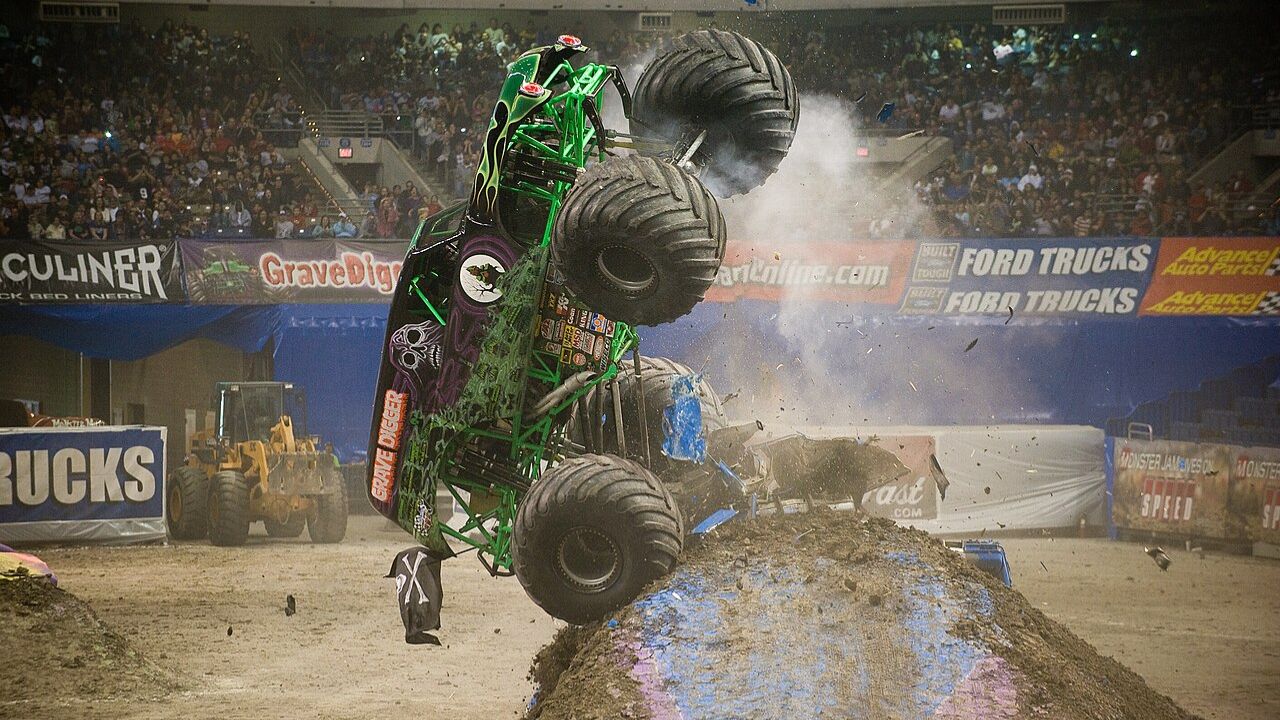
Grave Digger – The Fan Favorite

Grave Digger started as a backyard project in 1982, but Dennis Anderson’s mud truck with a repurposed ’51 Ford panel body quickly became a superstar. Known for its green flames, eerie styling, and aggressive driving style, Grave Digger became the rebel of the monster truck world.
Today’s versions are built on a tubular frame with nitrogen-charged shocks and weigh roughly 12,000 pounds. Powered by a blown 540ci engine making around 1,500 hp, each truck costs close to $250,000 to build. It’s one of the most successful and instantly recognizable names in the sport.
Maximum Destruction (Max-D) – The Showman’s Ride

Introduced in 2003, Max-D took the sport by storm with its spiked body, futuristic look, and fast, high-flying freestyle runs. Tom Meents drove it like it had no value, often rolling over and somehow still finishing on top. Max-D quickly became a Monster Jam icon.
Underneath the body is a standard monster truck setup: a 540ci Merlin engine, massive 66-inch tires, and a custom tube chassis. The suspension features 30 inches of travel for those huge landings. Max-D is known not just for wins, but for pushing the limits of what a 12,000-pound truck can do.
El Toro Loco – Built to Buck

El Toro Loco debuted in 2001 with its signature snorting bull look and orange paint, immediately standing out from the crowd. While originally just an alternate body for a Grave Digger chassis, it evolved into a serious competitor with its own wild fanbase and racing legacy.
It runs a supercharged V8 like most top trucks, pushing around 1,500 hp. The fiberglass bull body and animated nostrils are just the surface—it has the same racing-grade four-link suspension and sway bars as the rest of the field. And yes, the horns are as tough as they look.
Monster Mutt – Bark With a Bite

Monster Mutt looks playful with its floppy ears and wagging tongue, but it’s no joke. Introduced in 2003, the dog-themed truck competes with a full-blown racing platform underneath. It uses the same 540ci supercharged engine and custom chassis design as other top-tier trucks.
The truck’s design was so popular, it spun off into multiple variants like Monster Mutt Dalmatian and Monster Mutt Rottweiler. Each one costs about $250,000 to build and competes in freestyle, racing, and even high jump competitions. It’s proof that personality and performance can share the same chassis.
Bounty Hunter – The Privateer Threat

Bounty Hunter has been one of the most successful privateer teams in monster truck history. Run by Jimmy Creten, it’s consistently gone head-to-head with factory-backed teams and walked away with wins, including the 2005 Monster Jam World Finals Racing Championship.
Bounty Hunter runs a Patrick Chassis, a 540ci engine, and uses a custom suspension tuned for Creten’s aggressive driving style. It weighs in just over 10,000 pounds, with travel exceeding 30 inches at all four corners. The build cost is lower than factory teams, but the results are anything but.
Blue Thunder – Ford’s Factory Muscle

Originally sponsored by Ford, Blue Thunder hit the scene in 2001 as the factory’s answer to the rising popularity of Grave Digger and Maximum Destruction. It sported a fiberglass body based on the F-150 and a 1,500-horsepower supercharged big-block under the hood.
The truck runs a standard CRD chassis and long-travel suspension built to soak up rough landings. While its factory support has fluctuated over the years, it remains a staple in the Monster Jam circuit and continues to be a crowd favorite for its aggressive style and thunderous performance.
Avenger – The Throwback Hero

Jim Koehler’s Avenger is one of the longest-running independent trucks still in competition. Known for its classic 1957 Chevy Bel Air body and bright green paint, Avenger combines old-school flair with serious racing hardware.
Despite its retro looks, Avenger uses modern gear: a custom chassis, 540ci engine, and high-performance suspension setup that’s kept it competitive for decades. Koehler’s freestyle wins at multiple World Finals prove that experience—and a little chaos—can still bring home trophies. Plus, the flying Bel Air silhouette is one fans never forget.
Lucas Oil Stabilizer – Built Like a Tank

Lucas Oil Stabilizer looks more like a missile hauler than a monster truck, and that’s exactly the point. Built with a unique extended body and rugged aesthetic, it was designed to promote Lucas Oil products while still performing on the track.
It’s based on a Patrick chassis and runs the usual 540ci supercharged V8, making close to 1,500 hp. The truck weighs around 12,000 pounds and uses high-travel nitrogen shocks to handle arena landings. It may not win beauty contests, but Stabilizer is a serious competitor with a military-grade presence.
Captain’s Curse – A Pirate with Horsepower

Captain’s Curse combined the chassis and drivetrain of a proven race truck with a flashy pirate-themed body and color scheme. Launched in 2007, it was driven by Pablo Huffaker to a Monster Jam World Finals freestyle championship in its debut year.
It runs the standard supercharged Merlin engine and is built for balance, allowing it to land tricks cleanly and transition quickly between jumps. The pirate motif may look like marketing, but under the fiberglass is a purpose-built race machine. Like any good swashbuckler, it stole the show more than once.
Like what you read? Here’s more by us:
*Created with AI assistance and editor review.


