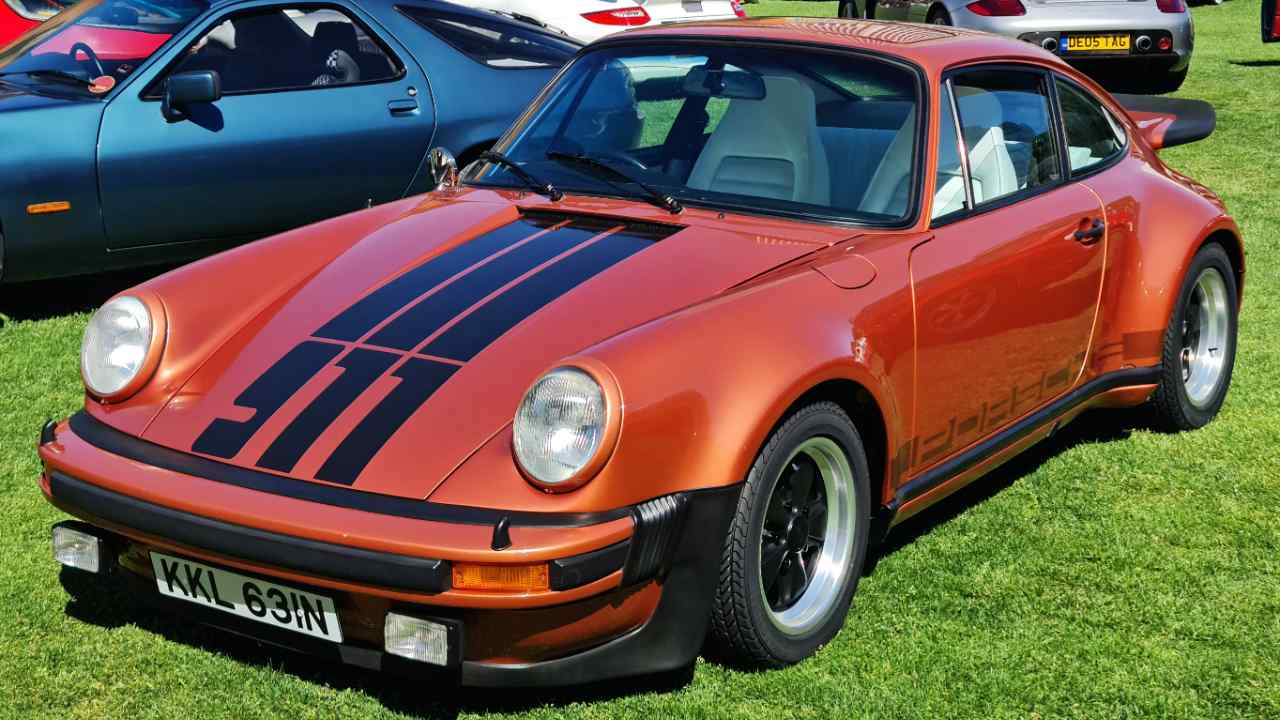
The 1975 Porsche 911 Turbo did something no earlier boosted road car quite managed: it turned a racing technology into a must-have status symbol that could be ordered from a showroom in meaningful numbers. It was not the first turbocharged car, or even the first performance model to use forced induction, but it was the first turbo supercar that people around the world could actually buy and see on the street. Half a century later, its blend of menace, luxury, and motorsport engineering still shapes how I think about every fast turbocharged car that followed.
To understand why that first production 911 Turbo mattered so much, I find it useful to look at what came before, how Porsche translated its racing experiments into a road-going 930, and how the car’s wild reputation helped turbocharging go from obscure engineering trick to everyday feature. The story is not just about power figures, it is about how one model rewired expectations of what a supercar could be.
Turbocharging before the 911 Turbo
By the time Porsche bolted a blower to the back of a 911, turbochargers were already proven in heavy industry and commercial transport. In the late 1930s, engineers were fitting experimental units to trucks, and the first successful application in this field came when Automotive turbocharger prototype projects showed how much extra power and efficiency could be squeezed from a given displacement. That work laid the groundwork for smaller, more responsive units that could eventually fit under the hood of a passenger car.
Passenger vehicles picked up the idea in the early 1960s, when manufacturers started experimenting with forced induction as a shortcut to V8 performance. According to detailed histories of early turbo road cars, the first company to really commercialize the concept in a production automobile did so in 1962, when engineers paired a compact engine with hardware from the turbo‑production company Garret. Those early efforts proved the concept but also exposed the pitfalls of crude boost control, marginal fueling, and drivers unused to sudden surges of power.
American pioneers and their limits
Before Stuttgart’s flat-six ever inhaled compressed air, American brands had already tried to sell turbocharged excitement to regular buyers. In the early 1960s, Oldsmobile launched the Oldsmobile Jetfire, marketed as America’s First Turbocharged Muscle Sedan, a compact coupe that promised big-engine thrust from a smaller V8. There was a sense that there was a forgotten chapter in American performance history here, because the Jetfire’s complex fluid injection system and reliability headaches meant its moment in the spotlight was brief. As one retrospective puts it, There was a bold idea, but the market and the technology were not quite ready.
Chevrolet and others followed with their own boosted experiments, and both the Oldsmobile Jetfire and the turbocharged Corvair are now recognized as some of the first turbocharged cars offered to the public. Yet these models remained curiosities, sold in small numbers and often remembered more for their quirks than their performance. Later, even Buick would revisit the formula with a boosted personal coupe, and in the grand scheme of automotive technology, one analysis notes that turbocharging is a relatively recent phenomenon, with a Buick Forgotten Turbocharged Coupe Used Famous Name And Slant Back Styling illustrating how niche the idea remained. These cars hinted at the future, but none of them reset global expectations in the way the 1975 911 Turbo would.
When Porsche turned racing tech into a road-going 930
What changed in the 1970s was that Porsche approached turbocharging not as a gimmick, but as a direct transfer from its motorsport program. The company had already used forced induction in endurance racing, and When Porsche developed the 930, it treated the project as an engineering bridge between the track and the street. Internal histories describe how the brand revealed the 911 Turbo, its first-ever turbo-charged series production car, at the Paris Motor Show, positioning it as a halo model that would sit above the rest of the 911 range.
Production of the road car followed soon after. Detailed model records note that the initial production car is launch and production starts in February 1975, on the H-series platform, with early examples built as 1975 model year cars and later ones registered as 1976 model year cars. Those same records from Porsche 911 Turbo 3.0 (930) show how carefully Porsche ramped up output, expecting to sell only a few hundred units but quickly discovering that demand for a turbocharged 911 far outstripped those conservative forecasts. This was not a limited-run homologation special, it was a series-production supercar.
The performance that made “Turbo” a legend
On paper, the first 911 Turbo’s numbers were startling for its era, and they still feel brisk today. Contemporary factory claims stated that Porsche expected the car to sprint from 0 to 60 m in just over five seconds, with 100 m arriving only a few heartbeats later, figures that put it firmly in exotic territory. Later road tests of the Porsche 911 Turbo would repeat those numbers and add the whispered nickname “widowmaker,” a nod to the way the rear-engined layout and sudden boost could punish overconfident drivers.
Yet the car’s appeal was never just about straight-line speed. In period advertising for the market launch, Porsche described the 911 Turbo as the “crowning point” of the 911 line, One of the fastest of the time and a symbol of the evolution of a timeless classic. Company archives emphasize that One of the core goals was to combine race-car performance with everyday usability, something earlier turbo experiments had largely failed to achieve. The flared arches, whale-tail spoiler, and deep-dish wheels signaled aggression, but inside there was leather, refinement, and the sense that this was a car you could drive to work as well as to the track.
How the 1975 911 Turbo scaled the supercar idea
What truly sets the 1975 car apart, in my view, is the way it normalized turbocharging at the very top of the market and then pulled the rest of the industry along. Technical histories of the brand point out that Driving the first-ever 911 Turbo ticks off one for the automotive bucket list, precisely because it was seen as the world’s first series-production supercar to rely on a turbocharger rather than displacement alone. One retrospective describes it simply: As the world’s first series-production supercar with a turbocharged engine, the Driving the 911 Turbo created a template that other manufacturers would follow for decades.
Broader industry analyses back up that sense of a turning point. One overview of early boosted models notes that, Among the many advancements that reshaped the automotive landscape, turbocharging had struggled to gain a foothold with mainstream buyers until a handful of high-profile performance cars changed perceptions. It points out that, Obviously, things did not start with efficient family hatchbacks, and Not even 20 years ago the turbocharger in the general automotive industry was still seen as exotic hardware, even though the first turbocharged mass-market production car had appeared more than a decade before that. In that context, the 1975 911 Turbo sits as the aspirational icon that made forced induction desirable, while the first turbocharged mass‑market production car and its successors translated the idea into everyday transport.
A legacy that still shapes every boosted sports car
Looking back from today, it is striking how much of the modern performance-car playbook can be traced to that first production Turbo. Detailed brand histories explain that Porsche did not invent the turbocharger, and that the idea goes back to a patent filed in the early twentieth century, but they also stress how the company’s racing work presaged the 911 Turbo’s powertrain and made it viable for the road. In one long-form review titled History of the Turbocharger and Porsche, the author notes that Porsche’s persistence with the concept turned a once-esoteric technology into a core part of its identity.
That identity still resonates. A recent feature on the model’s heritage points out that, for various technical reasons, turbocharging did not get a foothold in the automotive world until much later, and Porsc engineers used the 911 Turbo to prove that a boosted engine could power what was then the fastest series production car in the world. The piece on the roaring history of the 911 Turbo underlines how that achievement still echoes every time a new boosted 911 is launched. When I watch modern manufacturers chase efficiency and power with ever-smaller engines and ever-smarter turbos, I see the 1975 car not just as a museum piece, but as the moment the supercar went truly global, sold at scale, and forever linked the word “Turbo” with the thrill of being pinned back in your seat.
More from Fast Lane Only: