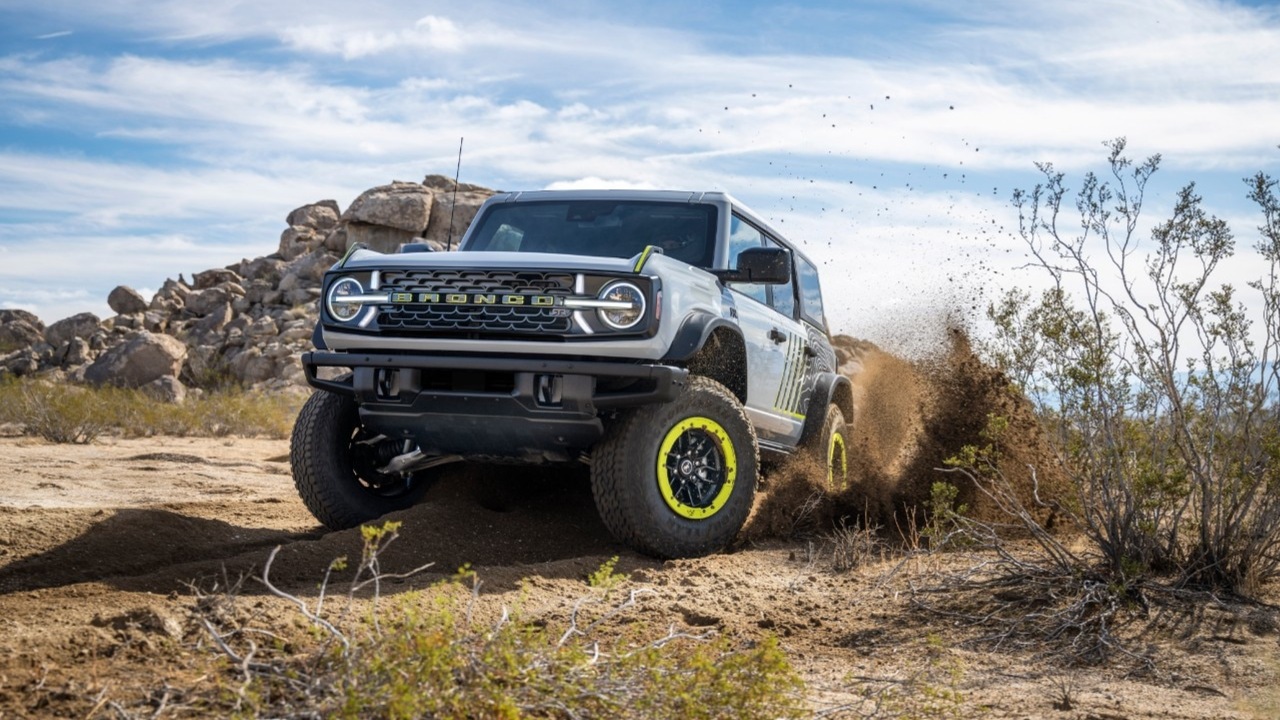
Ford is not content to let the Bronco rest on retro charm and rock-crawling credibility. With the new Bronco RTR, the company is explicitly chasing a generation raised on TikTok clips of desert jumps and high-speed drifts, not just slow-motion shots of locking differentials. The result is a factory-backed off-road package that promises Raptor-like drama at a lower price, and a clear attempt to pull younger drivers into the Bronco orbit.
Rather than reinvent the entire SUV, Ford and RTR Vehicles have taken the existing Bronco platform and tuned it for fast, repeatable punishment in the sand and on fire roads. The strategy is straightforward: keep the core hardware familiar, then layer on suspension tech, software tricks, and visual attitude that photograph as well as they perform. It is a calculated play to turn trail riding into something that looks as shareable as a drift video.
From rock crawler to high-speed “Built for” dirt
At its core, the Bronco RTR is a shift in emphasis from slow, technical off-roading to what Ford and RTR describe as being Built for high-speed dirt. The standard Bronco already arrives with serious hardware, and reporting on the broader lineup indicates that the 2027 Bronco is expected to continue with familiar turbocharged engines and off-road focused trims. Instead of chasing more displacement, the RTR treatment leans on the existing turbocharged 2.3-liter four cylinder, which Ford describes as “ripe for upgrades,” and then reworks the supporting systems to keep that power usable when the terrain turns violent.
Ford’s own technical breakdown notes that engineers upgraded the cooling and turbo management for sustained high-speed running, including a Raptor-sourced 1,000-wa cooling fan and race-derived anti lag software that keeps the turbo spooled when the driver lifts off the throttle. That anti lag feature, highlighted in descriptions of The RTR, is not just a spec sheet flourish, it is the kind of instant response that makes short, punchy clips of dune runs feel more dramatic and controllable. By pairing this with a wide track stance, high clearance suspension, and 33 inch rugged terrain tires out of the gate, Ford is effectively repositioning the Bronco from a rock crawler into a desert runner that still fits in a suburban driveway.
Suspension tech that chases Raptor drama without the Rapt price
The most consequential changes sit underneath the Bronco RTR. Ford executives have been explicit that the goal is Raptor-level suspension performance without the full Rapt price tag, and the hardware list backs that up. The RTR package borrows heavily from setups previously reserved for the Bronco Badlands and even first generation F-150 Raptor style components, including tougher tie rods and a high clearance suspension tuned for big hits rather than just articulation. Descriptions of the package emphasize that this is not a cosmetic lift, but a system designed to handle repeated landings and whoops at speed.
Optional equipment pushes the Bronco RTR even closer to its Raptor cousin. When buyers add the Sasquatch Package, they step up to 35 inch Goodyear tires and HOSS 3.0 with Fox internal bypass shocks, a combination that Ford characterizes as “Raptor-level suspension tech without the Raptor price.” In testing at Johnson Valley, a proving ground that also hosts desert racing, the development team validated a philosophy they call Built Light and Built To Dance, pairing a four door body with tuned dampers to keep the truck controllable when it is airborne. For younger drivers who may never touch a rock garden but dream of filming slow motion jumps, that balance of capability and cost is the central promise.
Styling and attitude tuned for the camera
Performance alone does not sell to the TikTok crowd if the vehicle does not look the part. On that front, the Bronco RTR leans heavily into visual drama that reads instantly on a phone screen. The wide track stance and high clearance suspension give the SUV a planted, aggressive posture, while RTR Evo 6 beadlock capable wheels and 33 inch tires fill the arches in a way that makes even a parking lot photo look like a prelude to a desert run. An RTR grille with signature lighting, referenced in early walkaround coverage, adds a distinctive front end that separates the RTR from more traditional Bronco trims.
Color and trim choices are equally deliberate. Commentators have pointed to options such as Add the Avalanche Gray paint, which makes the Bronco stand out both in the city and in the desert, as a key part of its visual appeal. Ford’s own promotional language describes the Bronco RTR as “Styled with RTR attitude” and “Inspired by Johnson Valley,” signaling that the design brief was as much about channeling the look of Baja and King of the Ha style race trucks as it was about functional aero or weight savings. For a generation that often encounters cars first through short videos and social posts, that kind of instantly recognizable silhouette is a powerful hook.
Chasing a younger buyer without alienating the faithful
Behind the hardware and styling, Ford is candid about the demographic target. Officials say the typical Bronco customer is about 48 to 50 years old, a solid base but not the youth movement the brand wants for long term growth. By contrast, Vaughn Gittin Jr. and the RTR ecosystem have built large followings among younger enthusiasts, particularly on social platforms where short clips of jumps, drifts, and trail runs circulate widely. Ford hopes the RTR will help lower that average age by tapping into those audiences and giving them a factory backed way to buy into the look and capability they see online.
The strategy is not to abandon existing Bronco loyalists, but to add a new branch to the family tree. The Bronco RTR joins the Mustang RTR in the catalog, and Ford has emphasized that this new model will be available directly from Ford dealers rather than as an aftermarket conversion. That positioning, described in launch materials as Introducing Bronco RTR and Joining the Mustang RTR, signals that the company sees RTR as a semi formal sub brand aimed at younger, more social media savvy drivers. By keeping the core Bronco trims intact, including the Bronco Badlands and other rock focused variants, Ford can court new buyers without diluting the truck’s original mission.
Social-first development, from Johnson Valley to Detroit Auto Show
The way Ford has rolled out the Bronco RTR underscores how central the TikTok generation is to the project. Rather than relying solely on traditional auto show debuts, the company and RTR Vehicles seeded short clips and reels that highlighted the truck “Built for high-speed dirt,” “Styled with RTR attitude,” and “Tested where it matters.” Those snippets, many of them shot in Johnson Valley with the Bronco kicking up rooster tails and landing big jumps, are tailor made for platforms where attention spans are short and visuals matter more than spec sheets.
At the same time, Ford has not abandoned conventional stages. The company unveiled the Bronco RTR ahead of the Detroit Auto Show, positioning it as a headline off-road model and reinforcing that this is not a niche tuner special. Video coverage from that event shows Ford executives stressing that they “gave it the suspension tech to handle the hits” while also focusing on details like reinforced steering and cooling for drivers who will spend long periods “playing in sand.” By combining that message with a steady stream of social content, Ford and RTR are trying to bridge the gap between the auto show floor and the algorithm driven feeds where younger buyers live.
More from Fast Lane Only