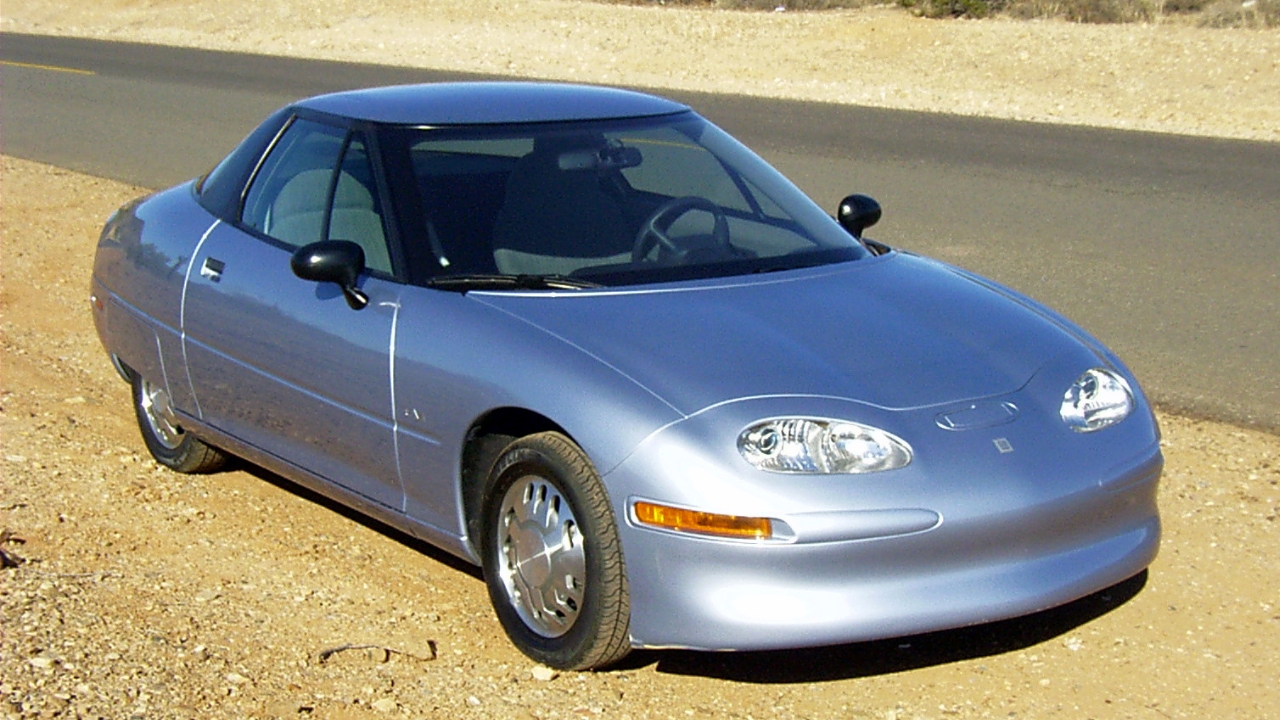
The GM EV1 arrived in the 1990s as a sleek, battery-powered coupe that hinted at a future in which electric cars were normal rather than novel. Instead of becoming a foundation for that future, it was withdrawn, crushed, and turned into a cautionary tale about how far ahead of its time it really was. The story of the EV1 shows how General Motors briefly grasped the shape of the electric age, then let it slip away long before the market and regulators caught up.
Three decades later, with electric vehicles moving from niche to mainstream, the EV1 looks less like an odd experiment and more like an early draft of the world’s current automotive transition. Its technology, design choices, and abrupt cancellation still shape how engineers, environmental advocates, and executives think about battery cars, corporate risk, and the cost of walking away from a breakthrough too early.
From experimental prototype to forbidden object of desire
The EV1 grew out of a period when General Motors was probing the limits of electric propulsion, including projects such as the Electrovair, which showed how high production cost and battery limitations could stall promising ideas. By the mid-1990s the company committed to a purpose-built electric coupe, and in 1996 the General Motors EV1 became the first modern, mass-produced battery electric car offered by a major manufacturer. According to program records, the car was leased in limited numbers in California and Arizona, with production spread over three model years.
From the outset, the EV1 was treated less as a product and more as a controlled experiment. Lessees were never allowed to buy their cars outright because General Motors wanted to retain full control of the vehicles. When the program ended, the company recalled almost every car and sent most to the crusher, leaving only a small number of disabled examples donated to museums and universities. That decision turned the surviving shells into museum pieces and the lost cars into objects of myth.
Ahead of its time in technology and design
Technically, the EV1 anticipated many features that are now taken for granted in modern electric vehicles. Contemporary accounts describe how the car’s aerodynamic body, low rolling resistance tires, and sophisticated power electronics allowed it to achieve real-world ranges that made daily commuting feasible, even with the relatively primitive lead-acid and nickel metal hydride packs of the era. A detailed look at the project notes that the EV1’s innovations went well beyond its battery pack, with engineers rethinking everything from climate control to regenerative braking to make the most of limited energy, an approach captured in early technical retrospectives.
Inside, the car presented a minimalist, almost concept-car-like environment that previewed the digital dashboards and simplified controls of present-day EVs. Ahead of the driver was a very sparse view, just a steering wheel and a compact digital instrument cluster, with status indicator lights hidden in a sculpted binnacle and a center stack that favored clear, simple controls over clutter. That interior, described as a fascinating 1990s vision of the future, survives in a handful of preserved cars and in detailed photography that highlights how ahead of the driver everything was oriented around efficiency and clarity rather than luxury.
Why GM walked away from a working future
For all its promise, the EV1 never escaped the status of loss-making halo project inside General Motors. Internal assessments concluded that electric cars occupied a narrow niche and that the two-seat EV1, with its expensive components and low volumes, could not be justified as a long-term business. Company statements cited in program summaries explain that, despite favorable customer reception, executives believed battery cars would remain a small segment for the foreseeable future and chose to redirect resources to hybrids and fuel-efficient combustion models instead.
The decision unfolded just as regulatory and market signals were beginning to shift. Electric vehicle advocates, environmental organizations, and former lessees later accused General Motors of deliberately undermining the EV1 program, arguing that the company had the technology in hand but lacked the will to scale it. Commentators have pointed out that GM had already demonstrated electric expertise by winning the World Solar Challenge in Australia with a solar-powered racer, and some analysts argued that the company could have led the electric revolution if it had treated the EV1 as a foundation instead of a detour.
The EV1’s strange afterlife and rising legend
Once the leases were terminated, the EV1 program took on a darker tone, as customers watched cars they loved disappear onto transporters bound for destruction. A small number escaped that fate, either through institutional donations or bureaucratic oversight, which is how an ultra-rare 1999 GM EV1 could later be found abandoned in an Atlanta parking garage. Coverage of that car noted that the Toyota Prius reached America in 2000 and that General Motors was losing money on the EV1 because lease payments did not cover costs, and the company had already chosen to end the program as hybrids began arriving in larger numbers.
That scarcity has since transformed surviving EV1s into coveted artifacts. A recent case in which one disabled example surfaced in a tow impound lot showed bidders pushing offers far beyond its practical value due to its historical significance. The EV1 in that story could not legally be driven on public roads, yet its role as a symbol of a road not taken was enough to ignite intense bidding.
How the EV1’s shadow falls on today’s EV boom
Two and a half decades after General Motors stopped making the EV1, every major automaker is building battery electric models, including GM itself. Retrospectives have described how the EV1 was ahead of its time and how, twenty-five years after production ended, the industry is finally moving toward goals such as phasing out new gas-powered vehicles by 2035 in some jurisdictions. Analysts and former program insiders quoted in Dec reflections argue that the EV1 set early precedent for electrification, showing both what was technically possible and how fragile such efforts can be inside large corporations.
Those who lived through the program recall that, despite its short life, the EV1 overcame what had been thought impossible for battery cars and inspired the industry’s move toward electrification. Imagining a world where GM doubled down on the EV1 has become one of the enduring ‘what if’ stories of automotive history. The contrast between that hypothetical path and the reality of a crushed fleet underscores how the EV1 predicted the electric future decades early, then vanished, leaving later generations to rebuild much of what it had already shown could work.
More from Fast Lane Only