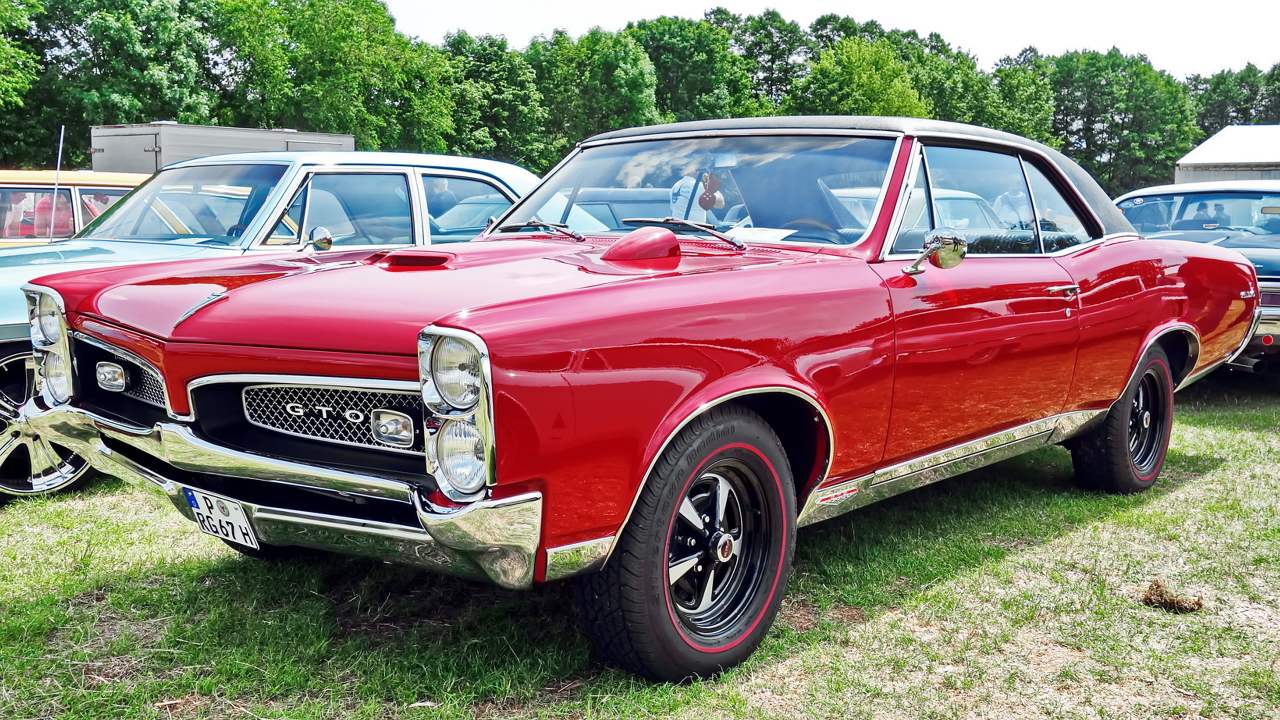
Pontiac built its reputation on the idea that the same sheetmetal could hide very different personalities. From the first GTO to late compact hatchbacks, the division treated engines as the primary tool for transforming ordinary platforms into sharply distinct machines. That strategy did more than create a few fast cars, it produced entire families of models whose character, value, and legacy were defined by what sat between the fenders.
Tracing those choices, from radical V8s to overhead-cam sixes and shared Toyota powertrains, shows how one brand used engines to stretch a single body into multiple stories. The result was a lineup where two cars that looked alike on the street could feel worlds apart on the road and in the collector market.
From mild Tempest to landmark GTO
The clearest early example of Pontiac reshaping a car through engines came when the modest Tempest morphed into the GTO. Internal planners initially expected the Tempest to be little more than a reworked version of a Chevrolet compact, essentially a re-skinned and re-trimmed relative of the rear engine Corvai, but engineers pushed for something more ambitious. That push culminated in the decision to pair the intermediate body with serious V8 power, turning a sensible family car into a performance statement that would be widely regarded as the first true American muscle car.
In 1964, Pontiac took that intermediate platform and created the GTO, a package that revolutionized the American car scene by pairing a big engine with a relatively light body. The move was not simply about adding horsepower, it was about offering buyers a choice between a conventional Tempest and a GTO that felt like a different species despite shared underpinnings. The GTO’s success proved that a carefully chosen engine could redefine a model line, and it set the template for Pontiac’s later habit of using powertrains to carve out distinct identities within a single platform.
Super Duty and the spectrum of V8 personalities
Once Pontiac understood how transformative engines could be, it leaned into that strategy with a wide spectrum of V8s. At the extreme end sat the 421 Super Duty, a racing-bred engine that turned otherwise familiar full-size cars into specialized weapons. Between 1962 and 1963, approximately 185 cars were powered by the 421 Super Duty V8, a tiny production run that made those Super Duty machines some of the rarest muscle-oriented Pontiacs ever built. The presence of that 421 did more than add speed, it separated those cars from standard Production Pontiacs in purpose and in the way enthusiasts still talk about them.
Further down the ladder, Pontiac used more accessible V8s to create subtler gradations of character. The 400 cubic inch engine became a workhorse, but Pontiac was not shy about tweaking the 400 to suit different needs. Less performance oriented models received 2 barrel carburetor versions that emphasized smoothness and everyday drivability, while higher specification variants used hotter internals and induction to push the same basic block to a whole new level. All those baby boomers on the cusp of mobility could walk into a showroom and choose between a comfortable cruiser and a street brawler, often differentiated primarily by which V8 sat under the hood.
Overhead cams, four cylinders, and engineering experiments
Pontiac’s willingness to experiment with engines was not limited to big V8s. The original Pontiac Tempest with a 4 cyl engine used a powerplant created by loping off one bank of the division’s V8, a cost conscious decision that still produced a distinctive driving experience. Instead of simply accepting that compromise forever, engineers at Gen and within Pontiac kept pushing for more advanced solutions, including an overhead camshaft six that broke with Detroit convention. That engine, often called the OHC six, gave smoother operation, higher rev potential, and a more modern character than the pushrod units that dominated domestic showrooms.
Those efforts culminated in what enthusiasts now recognize as How Pontiac Built America First Modern Overhead Cam Engine, a genuine milestone in domestic engineering that showed the division was willing to risk complexity in pursuit of refinement. Pontiac engineered an overhead camshaft design that gave the engine a more sophisticated feel, and that choice changed the personality of the cars that carried it, even when their styling remained conservative. The same basic body could be ordered with a conventional inline six or with this advanced cammer, and buyers who chose the latter effectively bought a different kind of car, one that signaled technical ambition rather than simple value.
Option codes, rare Judges, and the collector split
If the GTO proved that one engine could create a new category, the Judge showed how a carefully structured option package could turn a familiar model into a legend. The Judge Option Transformed The GTO by bundling visual cues with serious performance hardware, and at the heart of that transformation was the engine. The Code WT1 Judge option package added $337 to the standard GTO price and included a Pon tuned for higher output, especially when paired with Ram Air induction. On paper it was still a GTO, but in practice the Judge felt like a sharper, more focused machine, and the market has treated it accordingly.
The split becomes even more dramatic when looking at ultra rare combinations such as the Pontiac GTO Judge Convertible fitted with the Ram Air IV engine. That configuration, built in tiny numbers, turned an already special American muscle car into an auction headliner, with values that reflect how profoundly the Ram Air IV changes the car’s identity. Two 1969 GTOs can sit side by side, one a regular convertible with a milder V8, the other a Judge with Ram Air IV, and the difference in desirability, performance, and historical weight comes down largely to the engine and its associated option code. Pontiac understood that by tightly controlling these powertrain packages, it could create stratified tiers of rarity within a single model year.
From shared blocks to Toyota power: the late era
Even as the classic muscle era faded, Pontiac continued to use engines to differentiate its cars, sometimes in more subtle ways. All Pontiac blocks from 59-up shared the same side mounts, which meant that, within limits, a wide range of V8s could be swapped among models. That interchangeability allowed both the factory and later enthusiasts to reconfigure cars, turning a modest coupe into a de facto performance model simply by installing a stronger engine. Exceptions such as 70 to 79 Firebirds, which required adapter mounts from specialists like Nunzi, only underscored how much of Pontiac’s identity was tied to the idea that its engines formed a flexible family.
By the 2000s, the strategy took a different form with compact cars like The Pontiac Vibe. Pontiac for model years 2002 to 2010 marketed The Vibe as a small hatchback, but its mechanical heart came from a partnership that produced a badged engineered variant of a Toyota design. The Pontiac Vibe was Jointly developed by General Motors and Toyota, and this Pontiac hatchback came with two different options tied to the Toyota ZZ Series. In practical terms, that meant a buyer could choose between a modestly powered commuter and a livelier, higher revving version, again creating distinct personalities within one body. Even in this late stage, with corporate pressures and shared platforms, Pontiac leaned on engines, whether homegrown or sourced from partners, to keep its cars from feeling interchangeable.
Across these decades, from the first GTO to the last Vibe, Pontiac treated the engine bay as the brand’s true design studio. Radical V8s like the 421, experimental overhead cam sixes, carefully priced options such as The Code WT1 Judge package, and even Toyota based fours all served the same purpose, to let one platform support multiple, wildly different cars. That philosophy continues to shape how enthusiasts, collectors, and ordinary drivers remember the division, because in Pontiac’s world, the badge on the grille mattered less than the engine that defined the drive.
More from Fast Lane Only