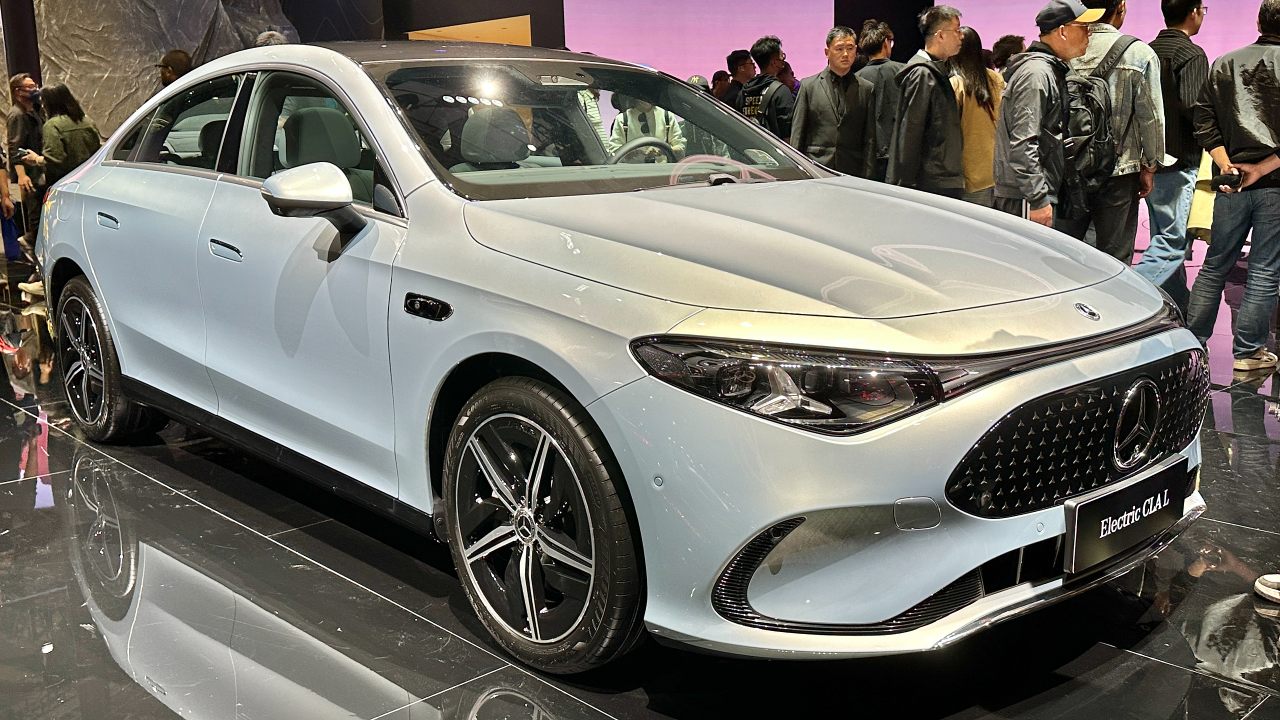
The all-new Mercedes-Benz CLA has displaced the Tesla Model Y at the top of Europe’s safety rankings, a symbolic changing of the guard in a market that has treated Tesla as the benchmark for crash protection and driver assistance. By securing the highest overall score in Euro NCAP’s 2025 evaluations, the CLA did not simply edge a rival; it reset expectations for how comprehensively a compact electric car can protect its occupants and the people around it.
How the CLA took Euro NCAP’s top spot
I see the significance of the CLA’s achievement in the way it dominated Euro NCAP’s structured evaluation rather than in a single headline score. In the 2025 test programme, Euro NCAP named the Mercedes-Benz CLA both its overall Best Performer and its Best Small Family Car, a double title that reflects strength across Adult Occupant, Child Occupant and Vulnerable Road User protection as well as safety assist technology. Euro NCAP’s own description of 2025 as its “busiest year” underscores how crowded and competitive the field has become, which makes the CLA’s clean sweep more telling than a win in a thin category.
From my perspective, what matters is that the CLA’s performance was not a statistical fluke but the result of a deliberate safety strategy. Euro NCAP’s Best in Class announcement highlights how the car excelled in the core Adult Occupant and Child Occupant metrics that anchor consumer trust, while Mercedes-Benz’s own description of the model as the Best Performer in the 2025 evaluation reinforces that this is the safest car Euro NCAP tested that year, not just the safest Mercedes. In a landscape where incremental gains are hard won, that breadth of excellence is what allowed the CLA to move ahead of the Tesla Model Y and every other contender.
Beating Tesla at its own safety game
For much of the past decade, I have watched Tesla use Euro NCAP scores as proof that its vehicles were at the forefront of safety innovation, particularly in the compact SUV segment where the Model Y has been a reference point. The 2025 results change that narrative. Reporting on the outcome makes clear that the Mercedes CLA “edges two Teslas” to become Europe’s safest car, a formulation that underlines how directly the CLA’s victory came at Tesla’s expense rather than in a vacuum. The Model Y, which has previously been celebrated for its crash performance and driver assistance, now finds itself ranked behind a newcomer that has matched its electric credentials while surpassing it in the latest test cycle.
I read that shift as more than a scoreboard update. When Euro NCAP names a single Best Performer, it effectively crowns a technology leader for the year, and in 2025 that leader is not Tesla but the Mercedes-Benz CLA. Coverage of the results stresses that the CLA’s margin over the Tesla pair was narrow but decisive, which is precisely what makes it so consequential: in a regime where top contenders already score highly, any model that can move ahead must do so through careful optimisation of structure, restraint systems and active safety logic. The Model Y remains a strong performer, but the CLA’s ascent signals that Tesla’s long-standing grip on the safety narrative in Europe is loosening.
The tech that pushed the CLA ahead
What impresses me most about the CLA’s package is how its safety edge rests on a blend of structural engineering and intelligent electronics rather than on one headline gadget. Reports on the Euro NCAP outcome point to the car’s “active bonnet” as a key differentiator, a feature that lifts the hood in a collision with a pedestrian to create more deformation space and reduce injury risk. That hardware is paired with a highly tuned automatic emergency braking system, with one assessment describing the CLA’s AEB as “refined”, a word that in this context signals not just effectiveness but smooth, predictable intervention in complex traffic scenarios.
Euro NCAP’s own Best in Class tables show how those technologies translate into high scores for Vulnerable Road User protection and Safety Assist, categories that reward cars which can prevent or mitigate crashes rather than simply survive them. Mercedes-Benz, in its description of the CLA as the Best Performer in the 2025 evaluation, explicitly links that outcome to “long-standing expertise and commitment”, a phrase that, in my reading, reflects years of iterative work on sensor fusion, braking algorithms and occupant restraint coordination. The result is a car that does not simply react to impacts but actively manages risk in the seconds before metal meets metal.
From safety lab to showroom halo
I find it telling that the CLA’s safety triumph arrives just as Mercedes-Benz is positioning the model line as a broader technology flagship. The company has already presented the all-new CLA as the “smartest, most flexible” compact in its range and highlighted that the spacious CLA Shooting Brake will share the same powertrain technologies. That positioning matters because it shows how the safety story is being woven into a larger narrative about intelligence and versatility, rather than treated as an isolated engineering achievement. When a car that is marketed as a digital and packaging showcase also emerges as the safest vehicle tested in a given year, it gains a halo that extends well beyond crash labs.
Euro NCAP’s recognition of the CLA as both Best Performer and Best Small Family Car gives Mercedes-Benz a powerful marketing tool, but I see a subtler effect as well. Families considering a compact electric car now have a model that combines a premium badge, a practical Shooting Brake variant and the highest available independent safety endorsement. That combination raises the bar for rivals, including Tesla, which must now respond not only with software updates but with hardware and structural innovations that can match the CLA’s blend of occupant protection and active safety.
What the 2025 crown means for the next safety race
In my view, the CLA’s coronation as the safest car tested in 2025 will ripple through the industry in two important ways. First, it validates Euro NCAP’s increasingly demanding protocols, which now place as much weight on Vulnerable Road User protection and Safety Assist as on traditional Adult Occupant scores. The fact that the Mercedes-Benz CLA could rise to the top in that environment suggests that manufacturers who invest in holistic safety concepts, from active bonnets to sophisticated AEB, will be rewarded. Second, it signals that the era in which Tesla could rely on its early lead in structural safety and driver assistance is ending, at least in Europe, as legacy brands deploy dedicated electric platforms with safety baked in from the outset.
Looking ahead, I expect the next phase of the safety race to focus on how consistently these systems perform in the messy reality of everyday driving, not just in controlled crash tests. Euro NCAP’s 2025 Best in Class announcement already hints at this by emphasising that its evaluations are designed to “anchor real-world confidence”, a phrase that, to me, reflects a growing emphasis on scenarios like junction turning, cyclist detection and child pedestrian protection. The CLA’s success shows that a manufacturer can meet those expectations without sacrificing design or practicality. For Tesla and its competitors, the message is clear: the safest car crown is now in play, and reclaiming it will require more than incremental tweaks to existing platforms.
More from Fast Lane Only