A California driver who had just taken home a new Ford Mustang GT was in handcuffs less than an hour later, accused of blasting down the highway at 139 mph and having the car impounded on the spot. The incident, which unfolded near Modesto, has become a vivid example of how quickly excitement over a powerful new car can turn into a criminal case and a cautionary tale about speed and responsibility.
According to the California Highway Patrol, the driver was clocked at nearly double the posted limit, racing past a specially marked patrol vehicle before officers moved in to stop the car. What might have been a celebratory first drive instead ended with a tow truck, a stack of citations, and a story that has ricocheted across car forums and social media.
From showroom thrill to roadside arrest
The core facts are stark. A man bought a new Mustang GT, left the dealership, and within roughly 60 minutes was allegedly pushing the car to 139 mph on a California highway. Officers say the driver accelerated hard, passed traffic aggressively, and triggered a pursuit that ended only when the car was boxed in and pulled over. Reporting on the case notes that the vehicle was a red Ford Mustang GT, a V8 performance model that can surge from a calm cruise to triple-digit speeds in seconds when the throttle is pinned.
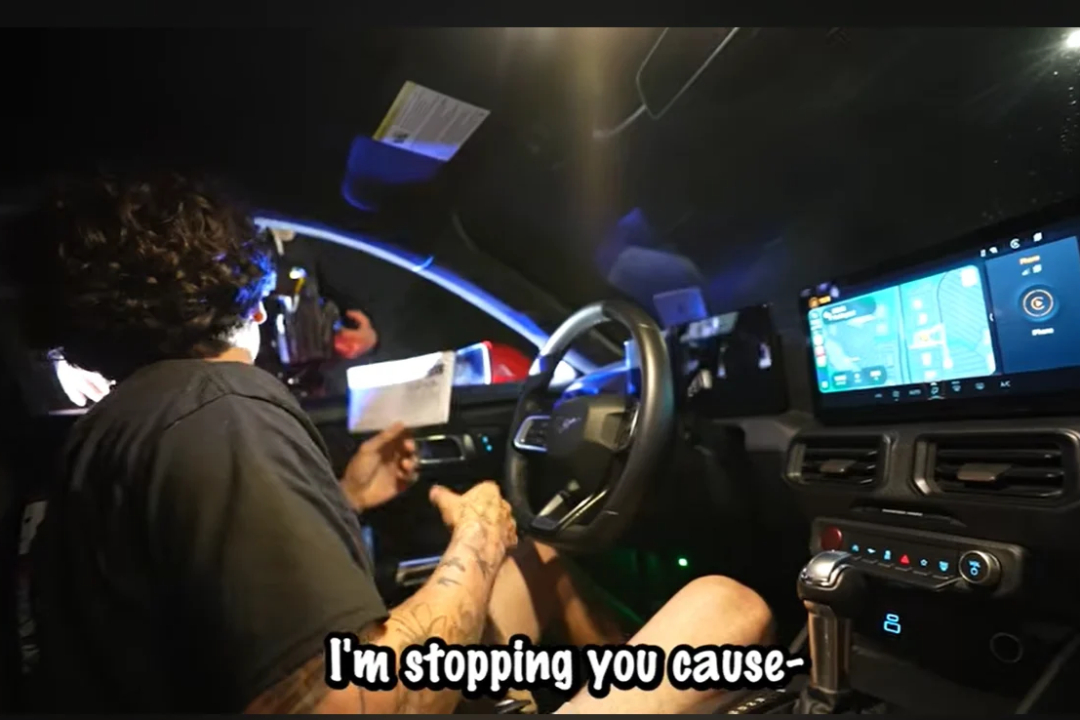
Investigators say the driver had owned the car for about an hour when the speed run took place, a detail that has fueled both disbelief and frustration among law enforcement. Accounts of the stop describe how, after the car blew past a specially marked California Highway Patrol unit, the officer initiated a stop and eventually had the Mustang loaded onto a flatbed with the driver under Arrest on suspicion of Speeding and reckless driving. Coverage of the case has emphasized that the vehicle was impounded almost immediately, a direct response to what authorities describe as dangerous behavior on a busy roadway.
How the California Highway Patrol says it unfolded

According to the California Highway Patrol, the incident began when a Mustang roared past a CHP vehicle at what the officer immediately recognized as an extreme speed. The patrol unit, which was specially marked and operating in traffic enforcement mode, accelerated to catch up and used radar to confirm that the car was traveling at 139 mph. At that speed, officers later noted, even a slight mistake or unexpected lane change from another driver could have produced a catastrophic crash.
Once the speed reading was locked in, the CHP unit activated its lights and siren and began a pursuit. Moments later, sirens lit up and the chase was on, with the officer working to close the gap while also managing the risk to other motorists. When the Mustang finally yielded, officers conducted a roadside investigation, confirmed that the car had been purchased roughly an hour earlier, and decided to impound it. The California Highway Patrol has used its official channels to highlight the case as an example of why it deploys specially marked units and targeted enforcement in corridors where high performance cars, including the Mustang, are known to appear.
Why 139 mph is more than “just speeding”
Driving at 139 mph is not simply a matter of edging over the limit, it fundamentally changes the physics of any potential crash. At that velocity, a car covers more than 200 feet per second, which means a driver has only fractions of a second to react to brake lights, debris, or a vehicle merging from an on-ramp. Safety experts routinely point out that stopping distances increase dramatically as speed climbs, and at 139 mph even modern performance brakes and stability systems cannot fully compensate for the forces involved.
Law enforcement officials in California have framed this case as a textbook example of reckless driving rather than a routine ticket. They note that the Mustang GT’s power, while legal and heavily marketed, becomes a public safety problem when it is unleashed on crowded public roads instead of controlled environments like racetracks. In their public comments, officers have stressed that at that speed, even a minor collision could have been catastrophic for everyone nearby, echoing broader research that links extreme speed to disproportionate rates of severe injury and death.
The Mustang mystique and the temptation to show off
The Ford Mustang GT occupies a special place in American car culture, and that context matters in understanding why this story resonated so widely. The car’s V8 engine, aggressive styling, and long history in movies and motorsport all contribute to an image built around power and performance. When a driver leaves a dealership in a brand new Mustang GT, the psychological pull to test the limits can be intense, especially on open stretches of highway that seem to invite a hard acceleration run.
Coverage of the Modesto case has leaned into that tension between marketing and responsibility. Reports describe how the driver’s first hour of ownership turned into a 139 mph sprint that ended with the car on a flatbed and the owner facing serious consequences. Commentators have noted that the story taps into a familiar pattern, where new owners of high performance cars, from Mustang GT models to other V8 coupes, underestimate how quickly these vehicles can reach illegal speeds. The phrase “speed comes with responsibility” has surfaced repeatedly in reaction to the case, capturing the idea that the thrill of a powerful car must be balanced by an understanding of its potential to cause harm.
What this case signals about enforcement and driver behavior
For the California Highway Patrol, the arrest is more than a one-off headline, it is a data point in a broader push to crack down on extreme speeding and street racing behavior. The agency has invested in specially marked cruisers and targeted patrols in areas where high speed runs are common, including corridors near cities like Modesto, California, and other parts of the state where performance cars are popular. By publicizing incidents like this Mustang GT impoundment, the CHP is signaling that drivers who treat public roads as test tracks can expect not only tickets but also arrests and vehicle seizures.
From my perspective, the story also underscores how quickly a series of small decisions can escalate into a life altering event. A driver leaves a dealership excited, decides to “see what it can do,” ignores the speedometer as it sweeps past legal limits, and within minutes is facing flashing lights, a towed car, and a criminal record. The Modesto Mustang case, with its 139 mph reading and its barely one hour gap between sale and stop, crystallizes that arc in a way few stories do. It is a reminder that modern performance cars, whether a Mustang GT or any other high horsepower model, demand not just skill but judgment, and that law enforcement in California is increasingly prepared to step in when that judgment fails.
More from Fast Lane Only: