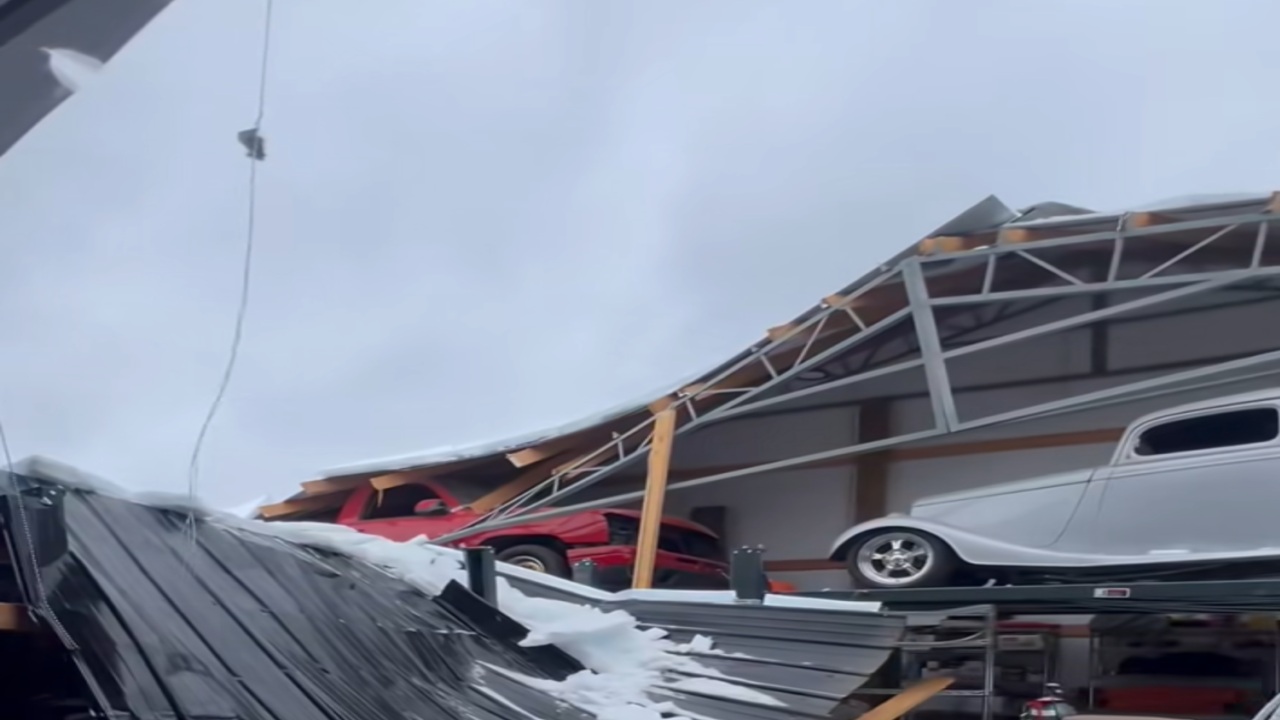
An ice storm that swept across parts of the South earlier this week did more than glaze highways and snap tree limbs. In a rural race shop, the weight of accumulating ice brought down a roof onto a collection of drag cars that their owners describe as irreplaceable, the product of decades of family labor and hard-won prize money. The collapse left twisted sheetmetal, shattered fiberglass, and a community of racers suddenly confronting how fragile even the most carefully guarded projects can be.
The damage at Geeslin Family Racing’s facility has quickly become a cautionary tale for grassroots motorsports, where insurance gaps, aging buildings, and increasingly volatile weather collide. What was once a sanctuary for high horsepower builds is now a scene of crushed chassis and broken parts, and the fallout is rippling far beyond one team’s property line.
The collapse that crushed a racing legacy
Geeslin Family Racing’s shop was packed tight when the storm rolled in, with drag cars, parts, and tools filling nearly every square foot of floor space. As ice accumulated on the building’s roof, the structure could not carry the load, and a large section gave way directly over the cars. When the family and friends were finally able to step inside, they found hoods caved in, roll cages pinned under beams, and body panels folded in ways that only a structural failure can produce, turning what had been a working race operation into a disaster scene.
The team’s collection was not a row of anonymous shells, but a lineup of custom builds that had been refined pass after pass at local and regional tracks. According to reporting on the incident, the shop held multiple drag cars that the Geeslin family considered “priceless,” not because of auction value but because of the years of fabrication, tuning, and shared memories invested in each chassis. The collapse did not simply damage equipment, it interrupted a family’s ongoing project of building and campaigning competitive cars under the Geeslin Family Racing banner.
Why these drag cars are effectively irreplaceable
To outsiders, a wrecked drag car can look like a pile of bent tubing and fiberglass, but for a team like Geeslin Family Racing, each car represents a long chain of decisions and experiences that cannot be recreated with a checkbook. Many grassroots drag cars start life as modest street machines, then evolve through countless upgrades: a small-block swapped for a big-block, a carbureted setup replaced with fuel injection, suspension geometry revised after every tricky launch. Over time, the car becomes a rolling notebook of what the team has learned, and that history is embedded in every weld and bracket.
Reports on the shop collapse emphasize that the cars inside were custom builds, tailored to the family’s driving style and the specific tracks where they compete. Even if insurance covers some of the loss, sourcing equivalent chassis, engines, and driveline components in the current market would be a steep challenge. Supply chains for performance parts remain tight, and many of the pieces in a seasoned drag car are either discontinued or heavily modified one-offs. The result is that the damage is not just financial, it is temporal: the years required to get back to the same level of refinement are gone, and no payout can buy that time back.
Ice storms, aging shops, and a changing risk profile
The failure of the Geeslin shop roof highlights a vulnerability that many small racing operations share. Race shops are often built or expanded incrementally, with additions tacked on as budgets allow and collections grow. Roof structures that were adequate for typical winter weather can be pushed past their limits when an ice storm settles in, loading trusses with a dense, uneven weight that they were never engineered to bear. In this case, the storm’s intensity turned what had been a safe storage space into a hazard, and the cars paid the price.
For grassroots teams, reinforcing or rebuilding a shop to modern structural standards is rarely at the top of the spending list, especially when every spare dollar tends to flow toward engines, transmissions, and entry fees. The Geeslin Family Racing collapse illustrates how that calculus can backfire when severe weather arrives. As ice events become more disruptive in regions that historically saw more snow than freezing rain, the risk profile for metal-roofed, lightly insulated buildings changes, and the cost of not upgrading can suddenly be measured in crushed race cars rather than hypothetical engineering diagrams.
Insurance gaps and the financial shock to grassroots racers
Beyond the physical wreckage, the ice storm’s impact on Geeslin Family Racing underscores how exposed many small teams are to catastrophic loss. Standard property policies often treat race cars and specialized equipment differently from ordinary vehicles or tools, and coverage limits can lag far behind the real-world cost of replacing a competitive drag car. Even when a policy is in place, deductibles, exclusions for competition use, and caps on custom parts can leave owners with a payout that barely covers a fraction of what was destroyed.
In the wake of the roof collapse, the Geeslin family faces the prospect of rebuilding in an environment where performance parts, machine work, and fabrication time are all more expensive than when many of their cars were originally assembled. That financial shock is magnified by the timing: an ice storm does not wait for the off-season or a convenient pause in racing plans. For a team that may have already invested heavily in fresh engines or new safety gear for the upcoming year, the sudden need to divert funds into structural repairs and replacement cars can derail an entire season, and in some cases, push a family operation to the brink of stepping away from the sport altogether.
Community response and what comes next for Geeslin Family Racing
Grassroots drag racing has always relied on community, and the damage at the Geeslin shop has prompted an outpouring of support from fellow racers, fans, and local businesses. In similar situations, teams often see offers of spare parts, shop space, and volunteer labor arrive faster than formal insurance decisions. While specific fundraising efforts for Geeslin Family Racing are unverified based on available sources, the broader pattern in the sport suggests that other racers understand exactly what has been lost and are quick to step in with whatever help they can provide, from loaner trailers to used slicks.
For the Geeslin family, the path forward will likely involve hard choices about which cars can be salvaged, which must be written off, and how to prioritize rebuilding the shop itself. The ice storm’s damage has turned their facility into a case study in both the vulnerability and resilience of small racing programs. If they are able to return to the track, it will be with cars that carry not only the scars of competition but also the memory of a winter when nature reached into a closed shop and rearranged years of work in a single night. Whatever form their comeback takes, the collapse has already left a lasting mark on how racers across the region think about protecting the machines they hold most dear.
More from Fast Lane Only