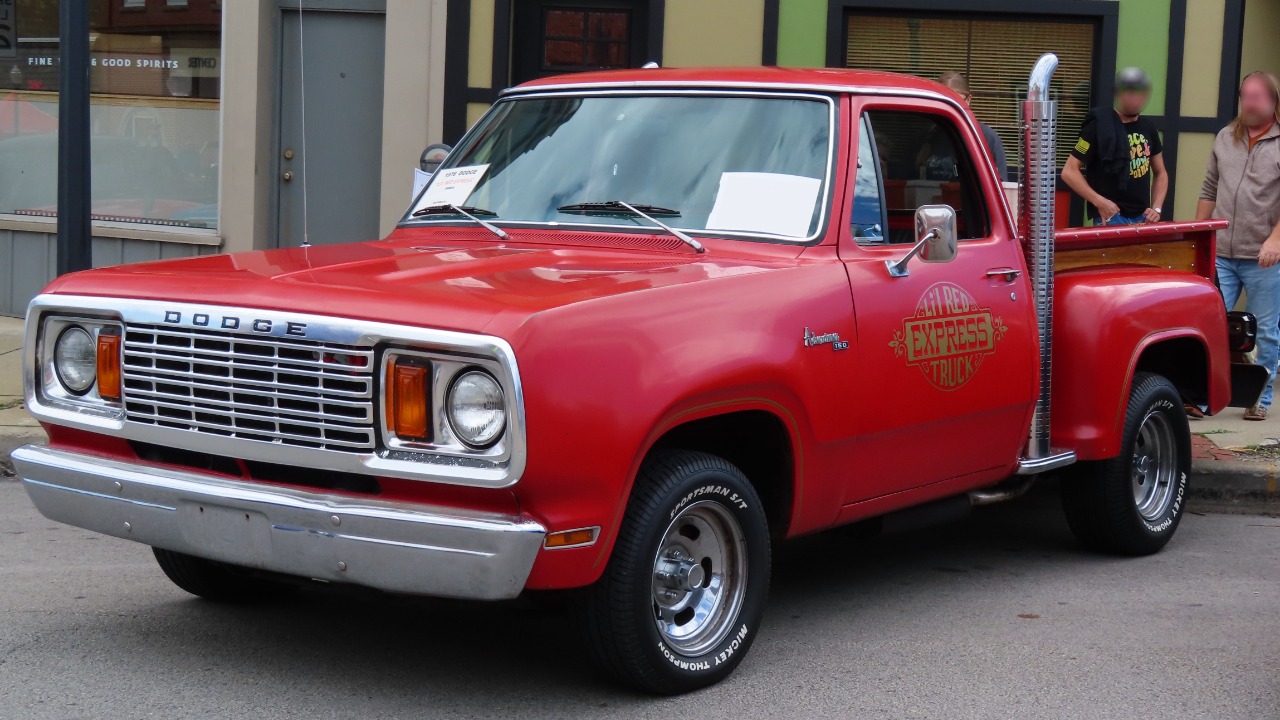
Among 1970s performance machines, one of the quickest American vehicles to reach highway speeds did not wear a low-slung coupe body or a fiberglass sports-car shell. It was a bright red pickup that looked more at home at a lumberyard than on a drag strip. While Corvettes drew the posters and the prestige, this oddball truck quietly outran them in the numbers that mattered.
The Dodge Lil’ Red Express Pickup Truck turned emissions-era logic on its head, using clever classification rules and bold styling to deliver performance that caught rivals off guard. In an age when muscle cars were being strangled by regulation, this workhorse-shaped hot rod showed that ingenuity could still trump convention, even when few enthusiasts were paying attention.
The loophole that let a pickup embarrass sports cars
By the mid 1970s, performance fans knew that the party was over. The US government had layered on a slew of new Emissions regulations that choked engines, robbed them of power, and in essence killed the classic muscle car era, as detailed in accounts of how The US rules reshaped Detroit. Traditional coupes lost compression, cubic inches, and charisma, while insurance rates and fuel costs finished off what was left of the big-block boom. Against that backdrop, nobody expected a short-bed truck to become a performance benchmark.
Dodge engineers saw an opening in how regulators classified light trucks and drove the Lil’ Red Express straight through an emissions loophole. Because it was registered as a pickup rather than a passenger car, the truck could avoid some of the most restrictive standards that hobbled contemporary muscle machines. That freedom allowed Dodge to install a tuned 360 cubic inch V-8 that period testing recorded as quicker to 100 mph than any other American-built production vehicle of its day.
From work truck to outlaw sprinter
The starting point for this unlikely hot rod was the D150 Adventurer short-bed pickup, a humble work truck chassis that became the basis for Dodge’s performance experiment. Based on the D150 Adventurer short-bed pickup, the Lil’ Red Express was positioned as a performance alternative to the anemic muscle cars of the late 1970s, and contemporary testing found that it could out-accelerate both the Chevrolet Corvette and Pontiac Trans Am. In a market where Chevy and Ford were struggling to keep performance alive, Dodge seized the moment with a design that combined show-truck theatrics with drag-strip intent.
Under the hood, the production truck carried a 360 cubic inch small-block, a figure that appears repeatedly in period descriptions of the tuned 360 cid V-8 and in enthusiast walkarounds that describe the 360 CI V8 engine in a 1978 Dodge Li, Red Express Pickup Truck finished in Red Paint. One preserved example highlights the engine’s distinctive sound and the truck’s bright red paint finish. The combination of relatively light curb weight, aggressive gearing, and that 360 made the truck far quicker than its square body and wood-panel bed suggested.
The day a “hillbilly” truck humbled Corvettes
Contemporary road tests were not the only place where the Li’l Red Express shocked the establishment. On the street, its performance blindsided drivers who expected a novelty act rather than a serious threat. One enthusiast account recalls how Ford executives were reportedly stunned when this Dodge hit the streets, describing it as a rustic-looking pickup that suddenly appeared in the fast lane and outpaced more glamorous machinery. In that retelling, the truck’s rustic image became an asset, allowing it to surprise unsuspecting rivals from Chevy and Ford at stoplights and on highway on-ramps.
Performance data backs up those anecdotes. In 1978, Dodge’s quirky Lil’ Red Express pickup was the quickest American-made vehicle from 0 to 100 mph, beating contemporary sports cars while still carrying a full pickup bed and tall exhaust stacks. The truck achieved those numbers in showroom trim, with its 360 cubic inch V-8 tuned for both torque and midrange punch. In an era when even halo cars struggled to meet enthusiast expectations, the fact that a short-bed pickup could claim the quickest 0 to 100 m sprint turned the hierarchy of American performance on its head.
Why the Li’l Red Express remains underrated
Despite its achievements, the Li’l Red Express occupies a curious place in enthusiast memory. The truck arrived at a time when traditional muscle coupes still dominated nostalgia, so a bright red pickup with wood trim and vertical exhaust stacks was easy to dismiss as a gimmick. Valuation analysts who track classic Mopars note that the model’s combination of limited production, regulatory loopholes, and period-leading acceleration gives it stronger historical significance than its novelty image suggests. For collectors who grew up on posters of low-slung coupes, adjusting to the idea that one of the quickest American vehicles of the late 1970s was a truck has taken time.
More from Fast Lane Only