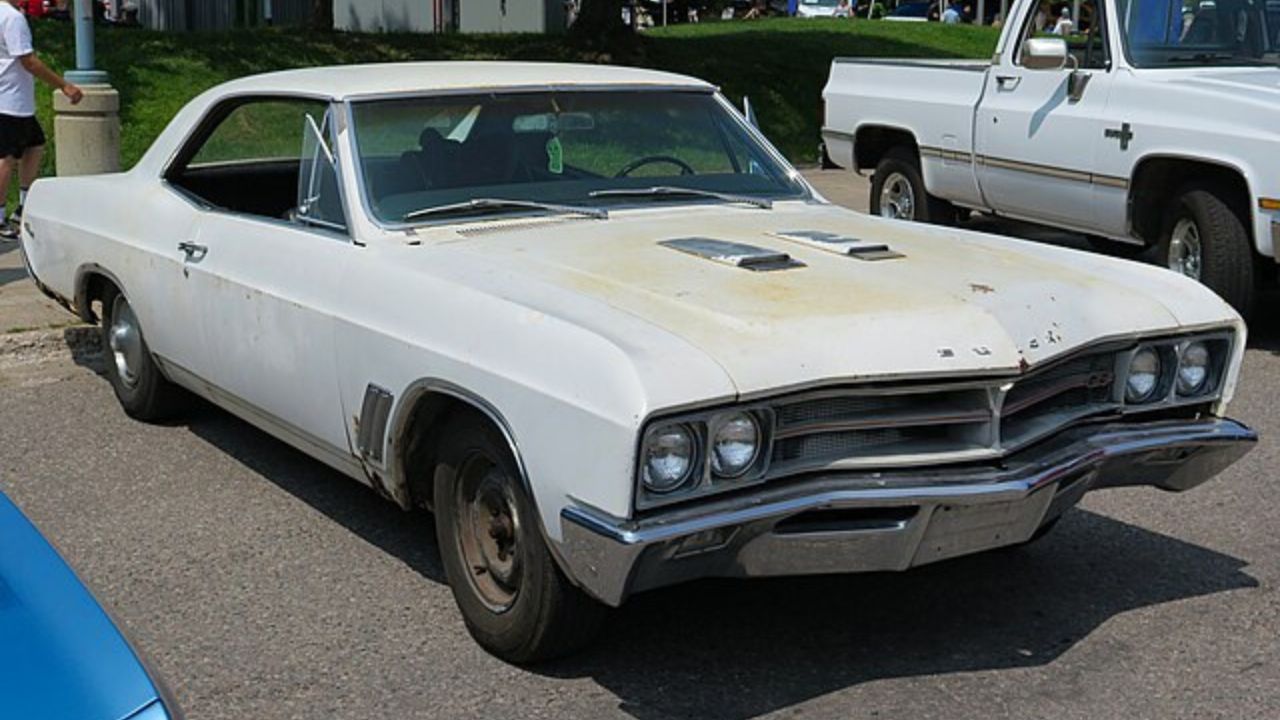
The 1967 Buick GS 400 arrived at a moment when Detroit’s midsize muscle war was already raging, yet it chose a different path from the bare‑bones street brawlers that defined the era. Rather than chasing the loudest stripes or the most outrageous quarter‑mile claims, Buick wrapped serious performance in a layer of refinement that made its new GS a very different kind of contender. When the GS 400 entered the muscle fight, it did so as a gentleman that could still land a punch.
From polite Skylark to serious GS 400
By the mid sixties, Buick had already dipped a toe into performance with the Skylark Gran Sport, but that early effort was more warmed‑over cruiser than full‑on muscle threat. The 1967 model year marked a turning point, when the division stopped pretending its midsize coupe was just a trim package and instead built a car that could credibly run with the era’s heavy hitters. The GS 400 name itself signaled that shift, replacing the earlier “little lie” of understated badges with a clear statement that this Buick was built around a big new engine and a more focused performance mission.
Underneath, the GS 400 still traced its roots to the Skylark Gran Sport, but the hardware and intent were substantially sharpened. Contemporary profiles describe how Buick introduced a new big‑block V8 for 1967, a next‑generation design that finally gave the Gran Sport line the displacement and torque it needed to compete in the muscle segment. That engine, paired with chassis and appearance tweaks, turned the GS 400 into a car that no longer had to apologize for its luxury leanings when lined up against more overtly aggressive rivals.
The big‑block heart that changed Buick’s tone
The core of the GS 400’s challenge to the muscle establishment was its fresh big‑block V8, developed specifically to move Buick beyond its earlier nailhead era. Reporting on the Gran Sport’s evolution notes that the division’s next‑generation big‑block arrived for 1967 and underpinned the GS 400, the GS 340, and the regional CALIFORNIA variant, giving Buick a family of performance offerings built around modern, high‑torque engines. The 400 cubic inch version in the GS 400 was tuned for strong midrange pull rather than peaky top‑end power, which fit Buick’s image of effortless speed more than dragstrip theatrics.
Technical write‑ups of the 1967 Buick GS 400 emphasize how seriously the brand now took performance, detailing the engine’s generous bore spacing and robust bottom end that allowed the cylinders to be spread at 4.75 inches for durability and breathing. That big‑block sat in a midsize chassis that had already proven itself in the Skylark Gran Sport, but the new powerplant transformed the car’s character, turning it from a brisk cruiser into a machine that could legitimately be described as “Getting Serious About Performance.” The result was a Buick that could surge past traffic with a single prod of the throttle, yet still deliver the smoothness and quiet that buyers expected from the tri‑shield badge.
Styling, options, and the “gentleman’s muscle” persona
Where many muscle cars shouted about their intentions with stripes and spoilers, the 1967 Buick GS 400 leaned into a more restrained, upscale look. Period descriptions of surviving cars highlight subtle but purposeful cues, from the unique grille and badging to tasteful brightwork that differentiated the GS from a standard Skylark without turning it into a rolling billboard. Inside, the emphasis remained on comfort, with well‑appointed cabins that made high‑speed travel feel composed rather than frantic, a contrast to the bare‑bones interiors found in some rivals.
That blend of power and polish is why later sellers and historians often describe the 1967 Buick GS 400 as a quintessential gentleman’s muscle car. Convertible versions underline that image even more clearly, pairing the GS 400 drivetrain with open‑air cruising and features such as power steering, power brakes, and power Top and Win equipment that kept the car firmly in the premium camp. Details like the distinctive “Star Wars Air Cleaner This” unit on some Buick GS examples added a touch of visual drama under the hood without undermining the car’s overall sense of restraint.
Production numbers, variants, and market reality
For all its technical progress, the GS 400 did not suddenly turn Buick into a volume muscle powerhouse. Contemporary analysis of Gran Sport sales notes that this newfound muscle did little to invigorate overall demand, with Buick moving only about 17,500 G S400s in 1967 along with about 3,700 units of the smaller‑engined GS 340. Those figures were modest compared with some mass‑market competitors, underscoring that Buick’s more expensive, refined take on performance appealed to a narrower slice of buyers.
Within that limited production, certain body styles are especially scarce. One dealer account points out that the 2 door convertibles are pretty rare with only 2,140 units produced in 1967, a tiny fraction of total GS 400 output. Valuation tools that track the 1967 Buick GS 400 Base confirm that collectors today pay close attention to body style, originality, and condition, with The Hagerty data allowing shoppers to match a specific Buick GS configuration to current market expectations. The presence of the GS 340 alongside the 400 also shows how Buick tried to “Reverting somewhat to prior form” by offering budget muscle for buyers who wanted the look and some of the feel without paying for the full big‑block experience.
Legacy in the broader Buick muscle story
Looking back across Buick’s performance history, the 1967 GS 400 sits at a pivotal point between the quirky nailhead era and the more assertive late sixties and early seventies machines. Enthusiast retrospectives on Buick muscle cars note that, by 1965, the brand had already fielded Gran Sport models built around the older V‑8, but it was the arrival of the new big‑block family in 1967 that signaled Buick was no longer content with half‑measures. Later commentary on the 1968‑1969 GS 400 even frames the 1965‑1967 Skylark Gran efforts as a “decent first attempt” before Buick got truly serious about competing in the muscle segment, which underscores how the 1967 car is now seen as a bridge from experimentation to commitment.
That bridge status helps explain why the 1967 GS 400 continues to attract attention from collectors and restorers. Modern features on surviving cars, such as the Star Wars‑style air cleaner and the balance of comfort options with genuine performance hardware, capture a moment when Buick was refining its identity as a maker of fast yet civilized machines. When I look at the arc from the early Skylark Gran to the later, more aggressive GS models, the 1967 Buick GS 400 stands out as the year Buick finally stepped fully into the muscle fight, not by copying the loudest players, but by proving that speed and sophistication could share the same badge.
More from Fast Lane Only: