
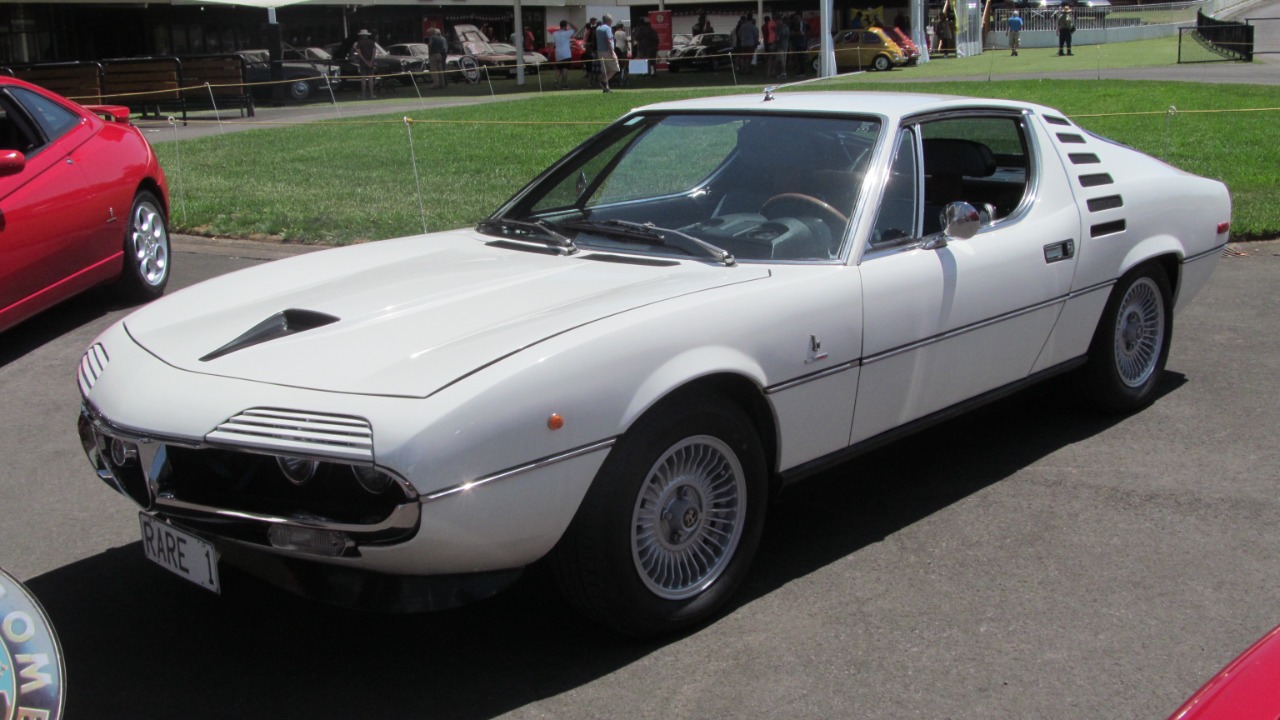
You look at a 1972 Alfa Romeo Montreal and assume it must drive like a junior supercar. The proportions, the slatted headlamp eyelids, the vents carved into the C‑pillars, everything tells you this is a machine built to thrill. Yet when you dig into how it was engineered and how it behaves on the road, you find a car that never quite lives up to its own visual drama, even if it has become one of the most intriguing classics you can buy today.
To understand why the Montreal promised more than it delivered, you have to start with the dream that created it, then follow the compromises that dulled the edge. From its show‑car origins and exotic V8 to its awkward packaging and fussy hardware, every part of the story shows you a car caught between concept fantasy and production reality.
The show car that set expectations sky‑high
You first meet the Montreal not as a showroom model but as a futuristic concept, built to impress visitors at Expo 67 in Canada. Since the concept car was already unofficially known as The Montreal, Alfa Romeo simply kept the name when it decided to build a road version. That decision mattered, because you were no longer buying just another Italian coupe, you were buying a piece of world‑fair theater that had been hyped as a vision of motoring’s future.
When the production Montreal arrived at the Geneva Auto Show, it looked every bit the exotic you had been promised. The Bertone studio, and specifically Marcello Gandini, translated the show car into steel with barely any loss of drama, so the silhouette that had wowed crowds at Expo still stared back at you from the stand. That continuity between fantasy and reality primed you to expect a driving experience just as wild as the styling.
Styling that shouted supercar, hardware that hedged its bets
Walk around a Montreal and you see why your expectations climb so quickly. The Bertone styled body is described as curvy in all the right places, with details like the louvered headlamp covers and those deep side vents that make it look ready to trade punches with mid‑engined rivals, and The Bertone shape still reads as properly exotic today. From a distance you would be forgiven for assuming there is a racing chassis and a stripped‑back cabin hiding underneath.
Look closer and the compromises start to show. Under that dramatic shell you find a front‑engine layout with a relatively conventional rear axle, and Jul notes that a detuned version of the competition engine was paired with a lightweight live axle in back. While that recipe made sense for cost and durability, it meant you were not getting the cutting‑edge mid‑engined hardware that the styling seemed to advertise, so the car’s stance and its underlying engineering were already slightly out of sync.
The exotic V8 that never quite delivered its promise
On paper, the Montreal’s engine should have erased any doubts. You were getting a 2.6‑liter V8 derived from Alfa’s racing program, with SPECIFICATIONS listing it as a 158.3‑cu‑in/2594cc DOHC V‑8 with SPICA mechanical port fuel injection. In period form it produced a quoted 227 hp at 65, figures that sounded suitably racy for a road car wearing such an extroverted suit.
Yet the way that power reached you did not always match the brochure. The SPICA system that fed the engine was sophisticated but also complex, and The SPICA mechanical injection fuelling system is described as a unit that demands regular, expert attention if it is to work properly. When it is out of tune, the crisp response you expect from a race‑bred V8 turns into hesitation and thirst, so the very technology that made the Montreal special also made it temperamental for everyday use.
Weight, packaging and the reality of living with one
Even if you accept the Montreal as a grand tourer rather than an all‑out sports car, you still have to live with its compromises. Company engineers Ozario Puliga and Giuseppe Busso were already worried that the original show car’s 1,600cc engine would not be enough for a 2,800-pound coupe, and Company voices inside Alfa pushed for the V8 to solve that problem. The engine did add muscle, but it also added complexity and did nothing to shrink the car’s mass, so you still feel like you are asking a heavy GT to dance like a lightweight sports car.
Inside, the Montreal can be even more surprising. With rear seats not fit for human habitation and a luggage bay half filled by the spare wheel, accommodating just 3.2cu ft of usable space, one assessment concludes that this packaging “just about says it all,” and Flawed diamond is not an unfair label. You get the sense that the car was designed from the outside in, with practicality and luggage space sacrificed to preserve the show‑car silhouette you fell in love with.
On the road: fast enough, but not the revelation you expect
When you finally drive a Montreal, the gap between appearance and experience becomes clearest. Contemporary testers found plenty to like, with Autocar putting a Montreal through its paces and concluding that it “deserves a high place in our list of desirable machines,” praising its character and a measured top speed of 137 mph, as you can see in the Autocar report. You are not dealing with a slow car, and on a fast, open road the V8’s surge and the long‑legged gearing make sense.
Yet the handling and braking remind you that this is not a thoroughbred racer in disguise. Ven-tilated disc brakes and wider wheels and tires were fitted to cope with the Montreal’s weight and power, but Ven and other period notes point out that the car could still feel thirsty and expensive to run. You get strong straight‑line pace and a charismatic engine note, but the chassis never quite matches the visual promise of those slatted eyelids and muscular haunches.More from Fast Lane Onl

Leave a Reply