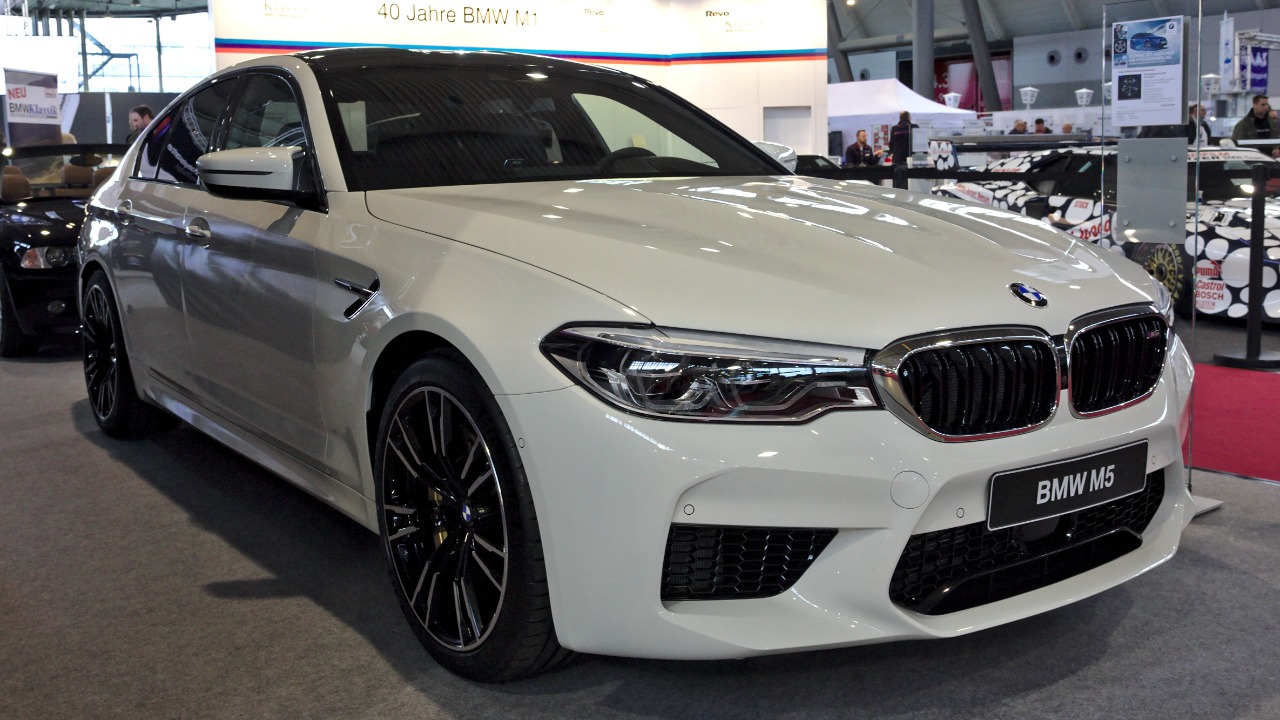
The 2018 BMW M5 arrived with a spec sheet that looked like heresy to traditionalists: a twin-turbo V8 feeding an all-wheel-drive system in a car long defined by rear-drive purity. Yet instead of diluting the formula, it managed to win over drivers who swore they would never accept power going to the front axle. By treating all-wheel drive as a tool for speed and control rather than a compromise, it turned a philosophical battle into a practical advantage for you behind the wheel.
What made this shift work was not just raw performance, but the way the car let you choose how much help you wanted. From its configurable M xDrive system to its track-ready balance, the 2018 M5 showed that you could have security in the rain, outrageous acceleration on a straight, and the playful feel of a classic rear-driver when you were in the mood.
The power that forced a rethink
If you trace the story back to its roots, the move to all-wheel drive starts with power figures that simply outgrew the old template. The F90-generation M5 arrived with a 4.4‑liter twin-turbo V8 officially rated at 600 horsepower, making it the fastest BMW of all time at launch. That kind of output in a large sedan is not just about bragging rights; it is a traction problem waiting to happen if you insist on sending everything to the rear tires.
On paper, you might think you could simply rely on wider rubber and clever stability control, but the numbers tell a different story. Independent testing recorded the 2018 M5 sprinting from a standstill to 60 mph in as little as 3.2 seconds, a figure highlighted when you look at its Drivability and everyday usability. At that level of acceleration, all-wheel drive stops being a luxury-car add-on and becomes the only realistic way to deploy 600 horsepower on real roads without turning every launch into a smoky, sideways event.
M xDrive as a purist’s safety valve
What kept enthusiasts from revolting was the way BMW structured the M xDrive system to feel like an ally rather than a nanny. In its default setting, the car starts in a rear-biased “4WD” mode with DSC (Dynamic Stability Control) active, which gives you secure traction without feeling numb, and you can then step through “4WD Sport” and finally a full “2WD” mode that sends everything to the rear axle once you have disabled DSC. That progression, described in detail when you read how the car behaves According to early drive reports, means you are never locked into a single philosophy about how the car should behave.
On track, that flexibility translates into a car that can feel like a traditional rear-driver when you want to play, yet still claw its way out of slow corners with all four tires when you are chasing lap times. One tester described how, once the front tires bite and you are back on the throttle, the big sedan tends to rotate into gentle oversteer rather than plowing into understeer, especially in the 4WD Sport setting. That is the key to why purists could live with the hardware: the system behaves like a rear-drive car that happens to have extra traction in reserve, not a front-heavy all-weather appliance.
Driver focus first, technology second
Underneath the marketing language, the development brief for the sixth-generation M5 was surprisingly simple: give you more engagement, not just more speed. Enthusiasts wanted sharper steering, more configurable responses, and a sense that the electronics were there to serve the driver rather than the other way around. Internal messaging at BMW framed the car as one that would put the driver first and let you access the M5’s power on your terms, which is exactly what the layered drive modes and customizable M1/M2 buttons on the steering wheel are designed to do.
From the engineering side, the message was equally blunt: bmw M stands for precision and agility in the high performance segment, not for a specific kind of technology. In a technical presentation shared in Aug, the team stressed that they had always said they would only adopt all-wheel drive if it could meet those standards. That philosophy is why the M xDrive system defaults to a strong rear bias, why you can fully decouple the front axle, and why the car still feels eager to change direction rather than locked down by its extra hardware.
On the road and track, skepticism fades
For many long-time fans, the real test was not the spec sheet but how the car felt when you pushed it. Early prototype drives in a 4WD development car showed that the new layout did not sanitize the experience; instead, it made the M5 more enjoyable to drive more of the time. One early review summed it up by saying that Our first taste of the 2018 BMW M5 was enough to calm fears that four-wheel drive would make it dull, because the chassis still felt alive and rear-led.
Once full production cars hit circuits, that impression only deepened. One track tester described settling on shifting manually via paddles because there were only negligible delays up or down the ratios, and then experimenting with the different drive modes until the car could be switched to two-wheel drive. That experience, captured in a detailed Dec drive story, shows you how the M5 invites you to tailor the experience: you can treat it as a brutally effective all-weather weapon or as a tail-happy track toy, often within the same session.
Numbers that back up the feel
Even if you are the kind of driver who trusts your hands more than a stopwatch, the performance data helps explain why the all-wheel-drive decision was inevitable. Instrumented testing recorded the M5 covering the benchmark sprint to 100 kph, or 62 mph, in a hysterically quick 3.4 seconds, a figure that would have been supercar territory not long ago. That kind of pace is only possible because the 4WD capabilities of the 2018 M5 let it put down power with a consistency no rear-drive sedan on street tires could match.
At the same time, the car did not lose its sense of drama. A later evaluation of the M5 as a supersedan contender praised its versatility and rear-biased all-wheel-drive system, noting that it inspired a spark of hope among those who felt recent BMWs had lost some of their edge. That assessment, which highlighted the way the car could still be coaxed into graceful slides by a resident drift whisperer, is captured in a Mar feature that underlines how the numbers and the sensations line up.
More from Fast Lane Only