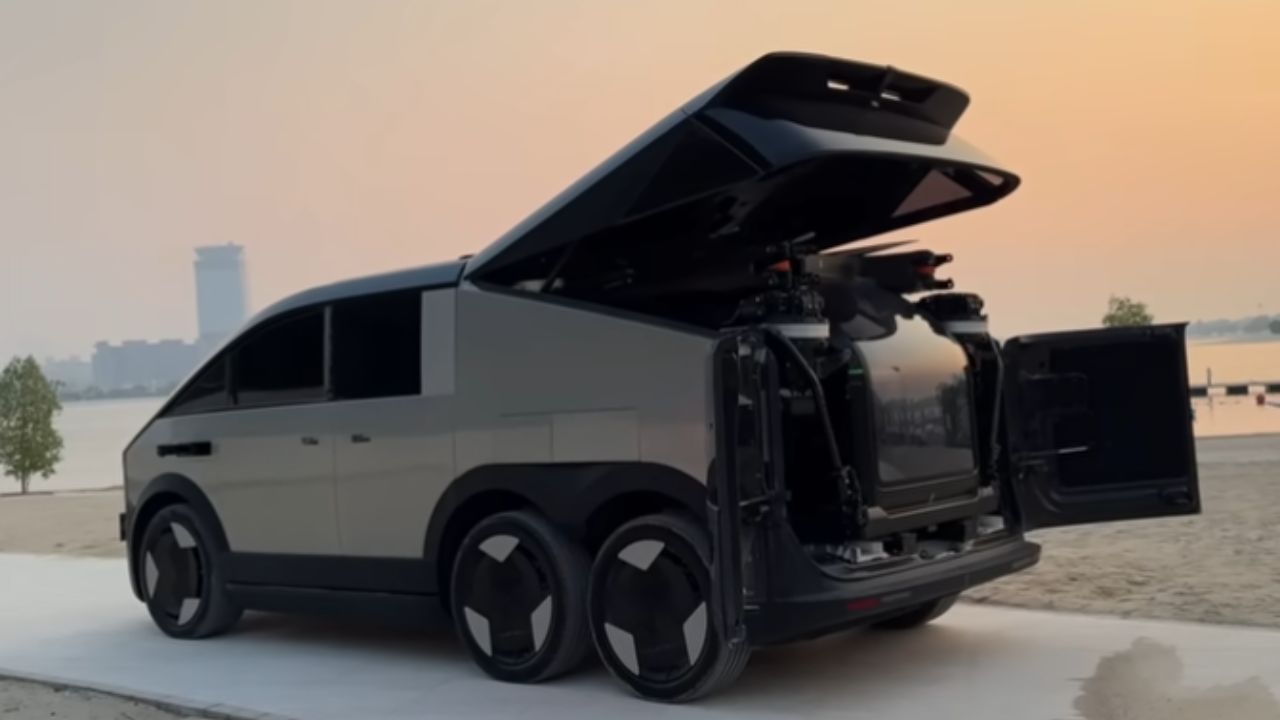
You are about to see a car that treats gridlock as a minor inconvenience rather than a daily sentence. Xpeng is preparing to ship its Land Aircraft Carrier EV van with a built-in personal aircraft module, and 7,000 early buyers are lined up to drive out of traffic and lift off above it instead. This is not just another futuristic concept but a production program that aims to put a detachable electric aircraft in your trunk as deliveries begin in 2026.
How the Land Aircraft Carrier actually works
You start with a ground vehicle that looks closer to a sci-fi utility truck than a family van. Xpeng’s Land Aircraft Carrier is described as a six-wheeled electric vehicle that pairs battery power with an ICE-powered range extender, so you can treat it as an EREV that keeps rolling long after a typical EV would need a charge. The van stretches to about 18 feet, with reports specifying an 18 foot or 5.5-meter footprint, and it rides on a 6×6 layout that gives you both presence and payload capacity. One detailed breakdown notes that the Land Aircraft Carrier is a six-wheeled electric vehicle with an ICE-powered range extender, so perhaps you can call it an EREV, and that context helps explain how the platform can support the extra mass and complexity of an aircraft system in the rear.
The magic for you as a driver sits behind the passenger cabin. The LAC is a modular duo, a 5.5-meter 6×6 mothership van and a detachable two-seat eVTOL (electric Vertical Take Off and landing) aircraft that lives in the rear bay. When you want to fly, you park, open the rear section, and deploy the aircraft module, which can then lift a human occupant vertically and transition to forward flight. Coverage of the 7,000 early customers describes how Xpeng’s Land Aircraft Carrier is a six-wheeled van that can deploy a six-rotor drone capable of ferrying a human occupant out of traffic, and that detail gives you a sense of how integrated the road and air pieces really are.
Inside the personal aircraft in your trunk
From your perspective as a future owner, the aircraft is not a toy drone but a compact air taxi. The detachable module has been described as a Modular Flying Car with space for at least one human, a large front window, and doors that close under a protective roof once it is stowed back in the van. When deployed, the aircraft uses multiple rotors for vertical lift and can be flown either by a pilot on board or via automatic pilot, which means you will interact with it more like a small helicopter than a hobby quadcopter. Demonstrations at events such as CES have shown the aircraft lifting off from static displays and concept platforms, giving you a preview of how the van and eVTOL pair in real use.
If you have followed other flying car concepts, you may recall earlier prototypes where the aircraft folded into the body of a sports car or sedan. Xpeng is taking a different approach by separating the heavy road hardware from the lighter aircraft module, and that means you can treat the van as your daily driver while only deploying the aircraft when you need vertical lift. A detailed walkaround from Jan at CES at the Xpang Aerot booth shows how the van carries the aircraft and how the rear structure opens for deployment, and that kind of demonstration helps you picture loading passengers, sealing doors, and then lifting away from the ground in a controlled sequence.
Price, timelines, and the 7,000-buyer queue
If you are wondering how close you are to being able to buy one, the answer is that the program is moving out of concept territory and into scheduled production. Xpeng Aeroht aims to start delivering this modular flying car in 2026 for less than $280,000, and internal planning materials reference 48 months of development work that feed into that first delivery window. That price target puts the Land Aircraft Carrier in the same financial category as a high-end supercar or small business aircraft, not a mass-market crossover, but it also reflects the fact that you are buying both a 6×6 EREV van and a certified eVTOL aircraft in one package.
Additional reporting on XPeng AeroHT’s modular flying car notes that the same 2026 target applies, with the market launch framed around a price of $280,000 and a production ramp that depends in part on a new factory in Guangzhou, Chi that is described as essential for volume manufacturing. When you read that Xpeng AeroHT’s modular flying car is expected to hit the market in 2026 for under $280,000, you can connect that to the 7,000 preorders referenced in other coverage, which collectively signal that early adopters are willing to commit supercar-level money to avoid traffic and gain personal air mobility.
From CES demos to global interest
Before you see one of these vans in your neighborhood, you are more likely to encounter it on a show floor or in a demonstration video. Xpeng AehoHT announced that it would display the modular flying car called Land Aircraft Carrier at CES 2025 in Las Vegas, a move that brings the hardware in front of U.S. audiences and industry analysts. At the 2025 Consumer Electronic Show, footage from Jan shows Xpang presenting both the flying car and the Land Aircraft Carrier van in a polished booth, with the Chinese company walking viewers through how the aircraft docks, how the doors seal, and how the control systems work.
Interest is not limited to tech tourists and social media viewers. Middle Eastern buyers have already signed for 600 Xpeng electric Land Aircraft Carrier units through agreements with Ali & Sons Group in the UAE, Almana Group of Qatar, Kuwait’s Alsayer Group, and other partners, a sign that you may see these vehicles first in markets that are aggressively courting advanced air mobility. When you combine that regional demand with the 7,000 individual buyers referenced in reports on how 7000 Buyers Will Soon Avoid Traffic by Pulling a Personal Aircraft out of Their Xpeng EV Van, you get a picture of a product that is attracting both fleet and private customers before the first production unit leaves the line.
What it means for your daily commute
If you imagine yourself behind the wheel, the Land Aircraft Carrier changes how you think about a commute or a weekend trip. Instead of planning a route purely around highways and charging stops, you can think in terms of ground segments and air hops, using the van to reach a safe launch site and the aircraft to bypass chokepoints or geographic barriers. The eVTOL is controlled via onboard systems similar to those described in other personal EV aircraft concepts, where the aircraft in your trunk is charged by the host vehicle and designed for short-range hops rather than long-haul flights, which means you will treat it as a way to cross a congested city or a river, not as a substitute for a commercial jet.
Regulation and infrastructure will shape how quickly you can actually fly from your driveway, and those pieces are still evolving, so you should think of early ownership as a partnership with local aviation authorities rather than a free-for-all. Chinese EV maker Xpeng has already signaled its intent to deliver its first flying car in 2026 through its affiliate Xpeng AeroHT, and executives have framed that goal as part of a longer-term strategy to integrate air mobility into the broader Chinese EV ecosystem. As prototypes move through the PT (Prototype Test) stage and Xpeng Land Aircraft Carrier confirms delivery start while the company readies mass delivery, your role as a potential owner shifts from passive observer to someone who may soon decide whether your next vehicle needs a personal aircraft in the back as much as it needs a fast charger on the wall.
More from Fast Lane Only