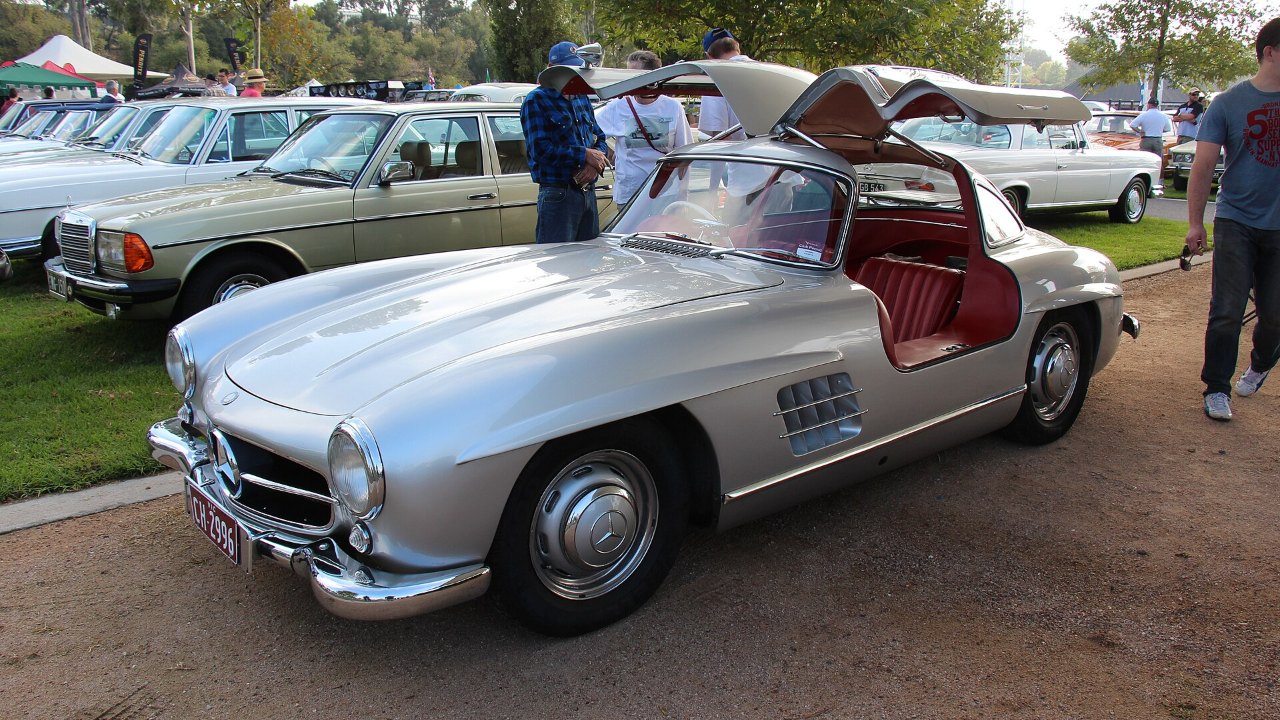
The doors on the Mercedes-Benz 300 SL coupe open upward because the car’s 300 SL tube frame left no room for ordinary ones. Engineers ran a web of thin steel tubes high up both sides of the body. As a result, a normal door would have had nothing to hinge on and nowhere to swing. So the roof opened instead, and those wings became the car’s signature.
It reads like a styling flourish today. In fact, it was a packaging fix that started with a race car. The story runs from a 1952 racing program to a New York show stand and finally to a coupe that now sells for seven figures.
Here is how the frame came first and the famous doors came second.
A race car built around a lightweight 300 SL tube frame
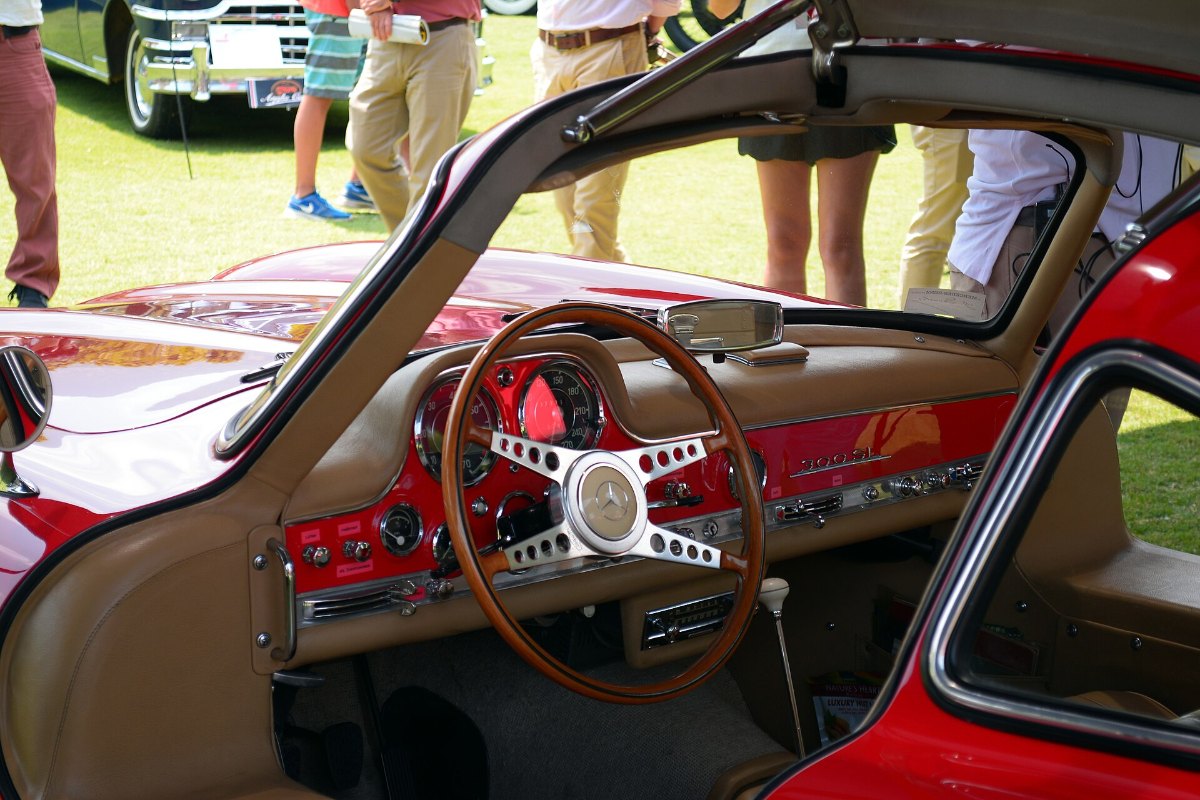
The road car grew out of the W 194 racer that Mercedes-Benz built for the 1952 season. According to the eMercedesBenz history of the car, Rudolf Uhlenhaut designed its tubular frame to cut weight to a minimum while keeping maximum strength. Motor1’s 70th-anniversary feature describes the structure as very thin tubes assembled into triangles. That triangulation made the frame stiff without making it heavy.
The approach worked on the track. The eMercedesBenz history lists a podium sweep at the Bern Grand Prix, a one-two finish at the 24 Hours of Le Mans and victory in the Carrera Panamericana in Mexico. Meanwhile, Motor1 says the cars won four of the five races they entered that season. The racing car made its debut on March 12, 1952, according to the same report.
Why the frame ruled out ordinary doors
The trouble sat along the sides of the car. In its own milestone page on the 300 SL “Gullwing” (W 198), Mercedes-Benz states the problem plainly. Because of “the extra height at the sills,” the spaceframe was incompatible with conventional doors. The company’s engineers then solved it with doors that swing up from the roof.
The eMercedesBenz account adds the reason for that height. For stability, the tubular frame rose much further up the sides than usual. That left no room to fit a normal door. Motor1 puts it more bluntly, calling the doors “more a necessity than an intention.” Instead of a cut in the side of the body, the openings ran deep into the roof.
The fix created its own problem, though. Columnist Bill Vance, writing in the Victoria Times Colonist, notes that the high, wide sills made getting in and out awkward. For that reason, the designers fitted a steering wheel that tilted down to help the driver slide past it. Hagerty adds that the original owner’s manual called the openings “trap doors” rather than gullwings.
Keeping the hood low with a tilted six
The frame also shaped what went under the hood. The 300 SL used a water-cooled 3.0-liter overhead-cam straight-six, according to Hagerty’s 70th-anniversary history. Because the six was a tall engine, it would not fit under the low hood standing upright. Uhlenhaut therefore laid it over steeply to the left and used dry-sump lubrication to cut its height, Motor1 reports.
Sources differ on the exact tilt angle, so we have left the number out. On output, however, they agree. Mercedes-Benz rates the production engine at 215 hp (158 kW). The company also says the 300 SL was the world’s first four-stroke production passenger car with direct fuel injection. Later, in December 1999, a jury of trade journalists voted it Sports Car of the Century, according to the same Mercedes-Benz page.
From New York show car to seven-figure coupe
An importer pushed the race car onto the street. Max Hoffman, who sold Mercedes-Benz cars in America, urged the company to build a road version. Motor1 says he promised both new sports cars for the 1954 New York show before they existed. The W 198 coupe then made its debut at the International Motor Sports Show in New York in February 1954, Mercedes-Benz says. Hagerty dates the unveiling to February 6.
Series production began in Sindelfingen in August 1954, according to eMercedesBenz. The same history puts the price at 29,000 Marks, while Hagerty lists $6,820 in the United States. Mercedes built about 1,400 coupes through 1957. Of those, roughly 1,100 went to the United States, eMercedesBenz says.
After that, the 300 SL Roadster followed in 1957. Without a fixed roof, that car no longer needed doors that hinged from above. Motor1 and the Times Colonist both put roadster output at 1,858 cars through 1963.
Today, Hagerty says the 1954–57 coupe averages seven figures even in #4 (Fair) condition. A 1956 300 SL coupe sold at Barrett-Jackson in 2024 for $3.41 million. That was the highest price ever paid for a steel-bodied 300 SL coupe, according to Hagerty.
More from Fast Lane Only
- Unboxing the WWII Jeep in a Crate
- 15 rare Chevys collectors are quietly buying
- 10 underrated V8s still worth hunting down
- Police notice this before you even roll window down
This article was created with the help of AI and was reviewed and edited by Fast Lane Only editors before publication.