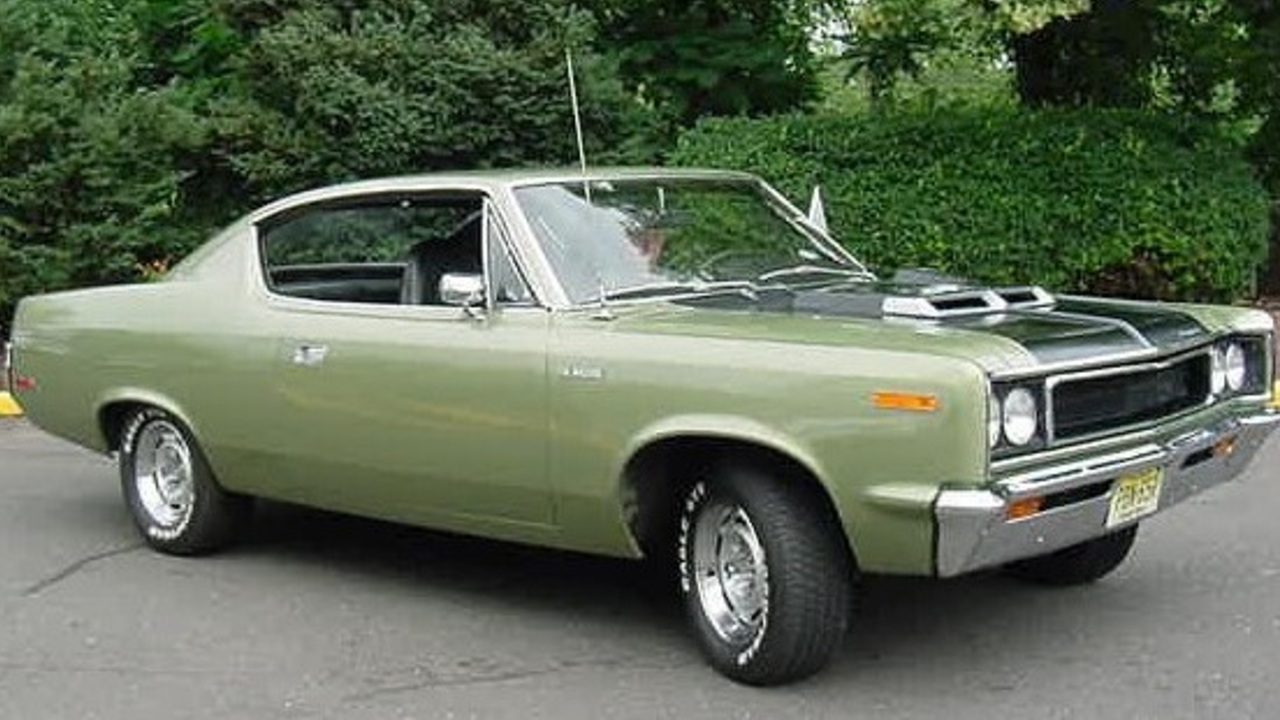
American Motors Corporation spent most of its life building sensible compact cars, yet it briefly chased the muscle car crowd with a mid-size brute that arrived fully formed and then vanished almost immediately. The 1970 Rebel Machine was conceived as a bargain performance statement, but its short production run and modest sales ensured it would become one of AMC’s most elusive efforts. Today, that fleeting experiment looks less like a misstep and more like a revealing snapshot of how a small independent tried, and largely failed, to muscle into Detroit’s horsepower wars.
Although AMC found its greatest commercial stability in practical models, the company’s decision to create a high profile Rebel variant showed how far it was willing to stretch its limited resources to gain credibility with enthusiasts. The Machine’s brief life, and the tiny number of buyers it attracted, underline both the ambition and the structural limits that defined American Motors at the dawn of the 1970s.
AMC’s late arrival to the muscle car party
AMC had built its reputation on compact, economical cars, a strategy that positioned the company well as the industry moved into smaller pony cars and performance compacts. That focus helped AMC carve out a niche against the Big Three, but it also meant the company arrived late to the full-bore muscle car segment that Chevrolet, Ford, and Chrysler had already saturated. Even as AMC found success with smaller models, its leadership understood that image mattered, and that a serious performance car could lift the entire brand in the eyes of younger buyers.
Instead of abandoning its core strengths, AMC tried to leverage them, using its experience with compact platforms to create performance variants that could stand beside more famous rivals. The company’s broader muscle portfolio included cars like the AMX, which offered buyers a two seat layout and a choice of V8 engines, including a 360 cubic inch V8 rated at 290 horsepower and a 390 cubic inch V8 rated at 325 horsepower. Those figures showed that AMC could match the raw numbers of better funded competitors, even if its marketing budget and dealer network could not.
The Rebel Machine’s brief production and tiny audience
Within that context, the Rebel Machine emerged as a bold attempt to turn a mid-size family car into a headline grabbing performance model. Built off the existing Rebel, the Machine was intended as a low priced muscle car version of a semi popular mid-size platform, a way to attract attention without the cost of an all new design. The Rebel itself had been a workhorse in AMC’s lineup, but the Machine transformed it into something far more aggressive, pairing a big engine with visual cues that left little doubt about its intent.
Despite that ambition, the numbers tell a stark story. The 1970 Rebel Machine was the last hurrah for the Rebel name, and it found just 2,326 buyers at $3,450. The Machine was only produced in that single model year, which meant that AMC’s mid-size performance experiment effectively began and ended in one season. For a company that needed every sale, a run of 2,326 units underscored how limited the audience was for an AMC muscle car, especially when buyers could walk into rival showrooms and choose from a long list of better known alternatives.
Styling, image, and the Teague factor
Styling was central to AMC’s performance push, and few figures loomed larger than designer Teague, whose work shaped much of the company’s late 1960s and early 1970s output. His approach could be daring, but it also drew criticism for borrowing too heavily from competitors. Even the Chevrolet two bullet taillights, an iconic cue on rival models, were not immune, with Teague placing a similar treatment on the 1973 Javeli. That willingness to echo other brands may have helped AMC cars look contemporary, yet it also risked making them seem derivative at the very moment the company needed a distinct identity.
The Rebel Machine sat within that tension. Its graphics and stance were anything but subtle, and the car projected a level of bravado that contrasted sharply with AMC’s sensible image. However, without the deep marketing resources of larger automakers, the Machine’s extroverted styling could not fully overcome lingering perceptions of AMC as a builder of practical transportation. The company’s design language, shaped by Teague across multiple models, sometimes blurred the line between inspiration and imitation, which may have further complicated efforts to sell a premium priced performance car under the same badge that also adorned economy minded sedans.
Engineering muscle on a budget
Under the surface, AMC’s performance cars reflected a careful balance between engineering ambition and financial constraint. The AMX, for example, gave buyers serious hardware, including the 360 cubic inch V8 with 290 horsepower and the 390 cubic inch V8 with 325 horsepower, figures that placed it squarely in the muscle conversation. Those engines, and the robust blocks behind them, earned a reputation among enthusiasts for durability, with owners recalling how a V8 originally run in a Dad’s old 65 could later be transplanted into a factory performance car without ever needing to be bored. That kind of longevity reinforced the sense that AMC’s mechanicals were tougher than its modest image suggested.
The Rebel Machine drew on the same parts bin logic, using existing components to keep costs in check while still delivering credible straight line performance. Enthusiasts who have studied AMC’s product decisions note that the company often relied on the normal sharing of parts across models, a necessity for a smaller manufacturer trying to compete in a capital intensive segment. That approach extended into the mid 1970s, when the Pacer eventually replaced the Javelin and AMX line, signaling a pivot away from traditional muscle toward more unconventional offerings. In hindsight, the Machine’s single year run looks like the high water mark of AMC’s attempt to package serious power and distinctive styling within the tight financial boundaries it faced.
From sales disappointment to cult status
What the Rebel Machine lacked in showroom success, it has gradually gained in rarity and mystique. With only 2,326 examples built, surviving cars now occupy a small but coveted corner of the collector market, where the combination of low production and period correct performance gives them a distinct appeal. The Machine’s status as the final flourish for the Rebel name adds another layer of significance, marking the end of a line that had carried AMC through much of the 1960s as a dependable mid-size option. When one appears at major auctions, its limited numbers and unique place in American Motors history tend to draw close attention.
The broader AMC performance story has also been burnished by discoveries that highlight just how scarce some of these cars have become. Enthusiast channels have documented finds such as a “1 of 52” example pulled from a barn near Ann Arbor, with hosts from Backyard Barn Finds and traveling to Ann locations to unearth long dormant machines. At the same time, creative projects like a modern fastback interpretation of the Rebel Machine show that designers and fans still see potential in the basic idea, imagining how a contemporary version of the car could compete with today’s performance coupes. Those efforts, along with speculative builds like a 1974 two seater AMX described as “one of none ever built,” keep AMC’s brief muscle era alive in the enthusiast imagination.
Viewed against the sweep of Detroit history, the Rebel Machine’s short life and limited sales might suggest failure, yet the car’s legacy tells a more nuanced story. It encapsulates the risks a smaller automaker took to challenge giants, the compromises required to engineer speed on a budget, and the way scarcity can eventually transform a commercial disappointment into a coveted artifact. AMC’s shortest lived performance car barely found buyers when new, but in the decades since, it has secured something more enduring: a place in the small but passionate canon of American muscle that dared to be different, even if only for a single model year.
More from Fast Lane Only