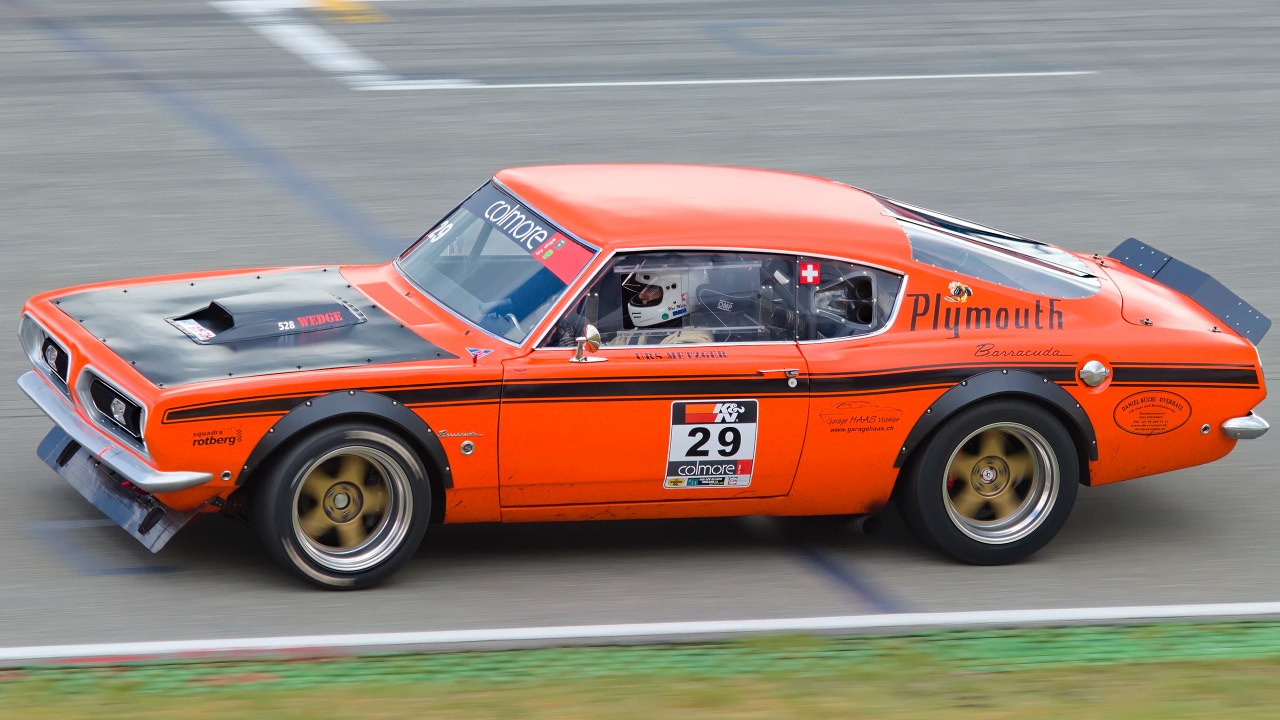
The 1968 Plymouth Barracuda arrived in showrooms with strong engines, fresh styling, and a respected Mopar badge, yet it never matched the Ford Mustang’s sales or cultural impact. Its struggle was not a matter of raw potential so much as timing, positioning, and execution in a market the Mustang had already defined. Understanding why the Barracuda lagged behind reveals how product planning and brand perception can outweigh even impressive hardware.
By 1968, the pony car segment was crowded, and the Mustang had become the default choice for American buyers who wanted affordable style and performance. The Barracuda, which had actually beaten the Mustang to market earlier in the decade, was still fighting to escape the shadow of its compact-car roots. The result was a capable but conflicted contender that never quite convinced mainstream shoppers it was the obvious alternative.
First to market, but not first in minds
Plymouth did not lose the calendar race. The Early Days of the model show that the Plymouth Barracuda was Introduced on April 1, 1964, beating the Ford Mustang to dealerships by roughly two weeks. That early launch, however, came with a catch: the original Barracuda was essentially a Plymouth Valiant fastback with a large wraparound rear window, marketed as a sporty variant of an existing compact rather than a clean-sheet image car. Contemporary histories note that if someone is asked to name an American sporty car of the late sixties, Plymouth Barracuda is rarely the first answer, unless the person is already a dedicated Mopar fan, which underscores how little that head start translated into lasting mindshare.
Ford, by contrast, framed the Mustang as an entirely new idea, even though it also shared humble underpinnings. The Mustang’s launch was treated as a major event, with aggressive promotion that instantly embedded the car in popular culture. Later retrospectives on the Barracuda’s origins describe how it was conceived specifically to counter Ford’s upcoming sporty compact, yet Plymouth’s more conservative presentation meant the car never shook the perception that it was simply a Valiant with a fastback roof. Even when later generations added notchback coupe and convertible body styles, Like Ford’s Mustang had done, the Barracuda still carried the baggage of that first, understated debut.
A stronger 1967–1968 redesign that still felt derivative
By 1967, Plymouth attempted to reset the narrative. The second generation Barracuda arrived with its own body, separate from the Valiant, and with three distinct body styles: a notchback coupe, a fastback, and a convertible, mirroring the variety that Like Ford’s Mustang already offered. The proportions were cleaner and more muscular, and the car finally looked like a dedicated pony car rather than a modified compact. Yet even in this improved form, period and modern assessments often describe the Barracuda as overlooked, suggesting that the redesign, while competent, did not create a visual identity as instantly recognizable as the Mustang’s.
The 1968 model year built on that 1967 foundation, but the basic silhouette and interior layout remained relatively conservative. One detailed model history notes that the Barracuda’s cabin and detailing lacked some of the sporty flair that buyers found in rivals, and that its connection to Plymouth’s economy-car lineup still lingered in the public imagination. When enthusiasts compare the 1967–1968 Barracuda to its contemporaries, they often praise its clean lines and practicality, yet they also acknowledge that the Mustang’s styling and branding felt more aspirational. In a segment driven by image as much as performance, that subtle gap in perceived excitement mattered.
Performance potential versus real-world execution
On paper, the 1968 Barracuda could be ordered with serious power. By that point, the car had moved far beyond its modest early engines and could be specified with big-block V8s, including the legendary Hemi in limited, race-focused configurations. Enthusiast discussions and factory-backed builds highlight 1968 Plymouth Barracuda 426 HEMI cars that were equipped with the fire-breathing 426 HEMI V8, demonstrating that Plymouth was willing to turn its compact pony car into a straight-line weapon. Later accounts of the Barracuda’s evolution emphasize that, although the Barracuda would later go on to become an icon of muscle car design and performance, its origins were humbler than those of some rivals, and its most extreme versions were rare and specialized.
In everyday form, the story was more complicated. A 1968 muscle car comparison test that evaluated multiple pony cars reported that The Barracuda lacked much of the sporty appeal of its competitors in the passenger compartment and in handling. Testers noted that every Barracuda they evaluated had a tendency toward front-end float and less precise road manners than some rivals, even when the powertrains were competitive. Another retrospective on the Barracuda’s development points out that the new Barracuda was fitted with a more restrictive exhaust, limiting power to 300 hp as a means to prevent the Barracuda from overshadowing other models in the corporate hierarchy. That decision blunted the car’s performance edge in showroom trim, just as buyers were becoming more sensitive to published horsepower figures.
Marketing muscle and the Mustang’s cultural lock
Even where the Barracuda matched or exceeded the Mustang technically, it struggled to compete with Ford’s marketing machine. Commentators who revisit the early pony car years often note that, although the Ford Mustang is often credited as the original pony car, the Barracuda actually beat it to market by two weeks, a fact highlighted in discussions labeled Three Unknown Facts About the model and in other historical summaries. Yet that trivia has not altered the broader narrative, because Ford’s promotion of the Mustang was so pervasive that it effectively rewrote public memory. The Mustang became shorthand for the entire segment, while the Barracuda remained a specialist’s choice.
Later comparisons of the Ford Mustang and Plymouth Barracuda describe both as iconic American muscle cars, but they also underline how the Mustang’s image was more accessible and widely understood. The Barracuda was available in both coupe and convertible body styles and was known for its powerful Hemi engine options, yet those strengths were not consistently foregrounded in mass-market advertising. Instead, Plymouth’s broader lineup and its positioning within the Chrysler Corporation diluted the focus on a single halo car. When enthusiasts debate the two today, some argue that the Barracuda was a Valiant that had been made a lot more sporty looking, while the Mustang felt purpose-built from the outset, even if the engineering reality was more nuanced.
Interior appeal, everyday livability, and buyer priorities
For many 1968 buyers, the decision between a Mustang and a Barracuda came down to how the car felt to live with, not just how it performed on a drag strip. Contemporary tests of the 1968 pony car field, which included the Mustang, Camaro, Firebird, Javelin, Barracuda, and Cougar, observed that The Mustang had some rough edges built in, but not enough to take away any of the glamour. The same evaluations were less forgiving of the Barracuda’s interior and ride, noting that it lacked some of the sporty appeal and polish that made competitors feel special. That difference in perceived refinement and glamour, even if subtle, could sway buyers who were cross-shopping multiple models at similar price points.
Enthusiast recollections and later lifestyle pieces on the 1967–1968 Barracuda acknowledge that the car offered practical advantages, such as usable rear seating and cargo space, especially in fastback form. However, they also concede that practicality was not the primary driver in the pony car market. The Mustang’s cabin design, option packages, and image-building trims, such as later Mach 1 variants, reinforced the idea that buyers were purchasing a statement as much as transportation. By contrast, the Barracuda’s more restrained interior and its lingering association with the Valiant meant that, for many shoppers, it felt like a sensible choice rather than an aspirational one, even when equipped with strong engines.
More from Fast Lane Only