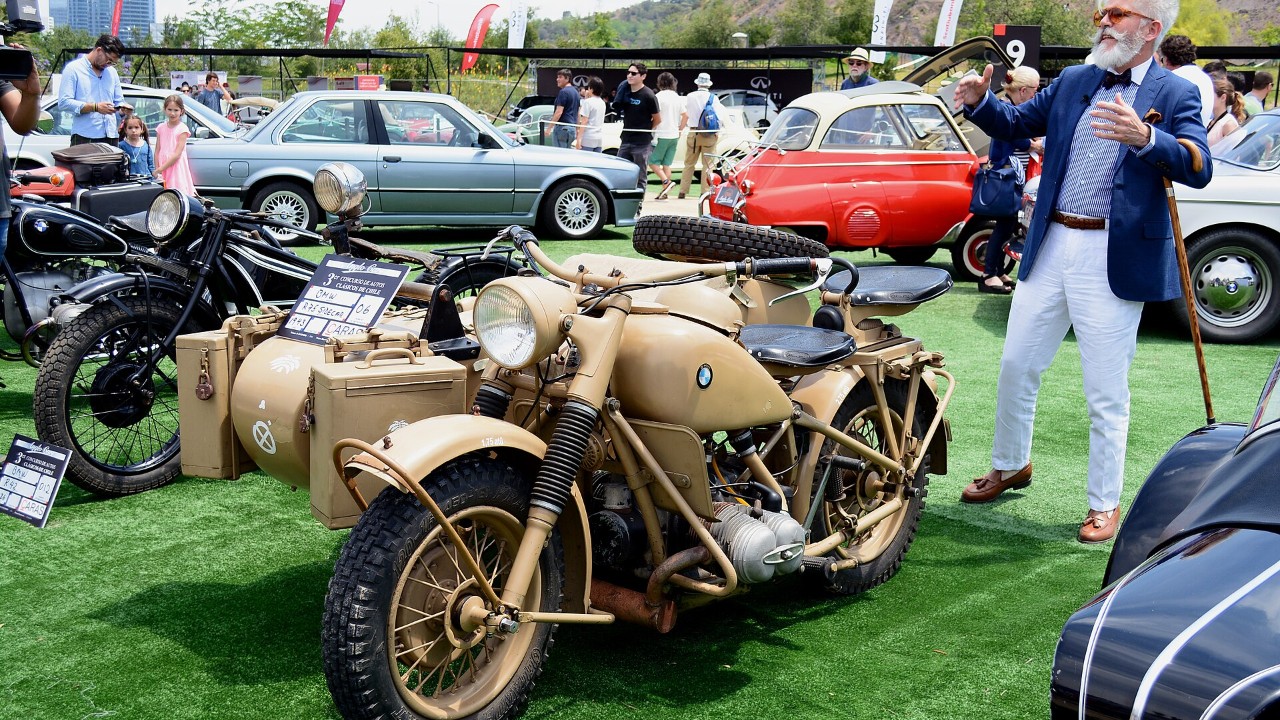
The BMW R75 sidecar outfit drove its third wheel, and that one idea let a motorcycle go where many trucks could not. During World War II, German, Soviet and British forces all leaned on sidecar rigs for scouting and for carrying people. Several of those designs never really went away.
A sidecar outfit asks a lot of a motorcycle. It has to haul a passenger and gear, often far from paved roads. Yet a handful of these rigs proved so useful that people kept copying them, riding them and restoring them for decades.
These four are our picks for the sidecar motorcycles that became legends without much fanfare. Two of them descend from the same prewar BMW, and one is still sold new today. The verdicts are our opinion, and the figures come from the records.
1. 1941–1944 BMW R75 sidecar outfit
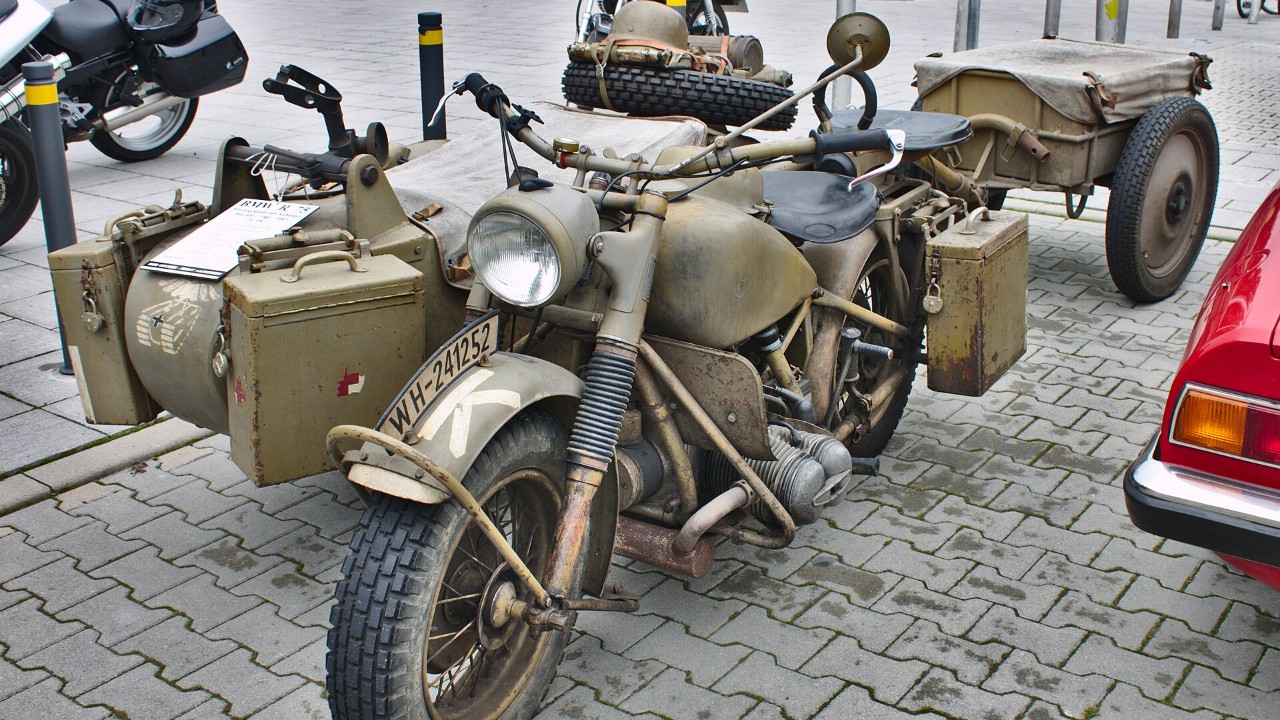
BMW built the R75 as a purpose-made military sidecar machine. It used a 745-cc flat-twin making 26 horsepower at 4,000 rpm, and it topped out at 95 km/h, or about 58 mph. BMW Group Classic says around 18,000 were produced between 1941 and 1944.
The clever part sat under the sidecar. Shafts from a locking differential drove both the rear wheel and the sidecar wheel. A transfer case added road and off-road ratios, and it also gave the rider reverse gears. As a result, BMW says the R75 was easy to ride on any surface. The Wehrmacht used it widely in Russia and North Africa. BMW also designed the machine to be low-maintenance, its heritage arm says.
Allied bombing badly damaged BMW’s Eisenach factory, and production stopped in 1944. Our take: the R75 set the template for every two-wheel-drive sidecar rig that followed. If you love the later boxer twins, see our list of vintage motorcycles that were built to outlast everything else. If you shop for an original R75, insist on documented frame and engine numbers before you buy.
2. 1941–1944 Zündapp KS 750
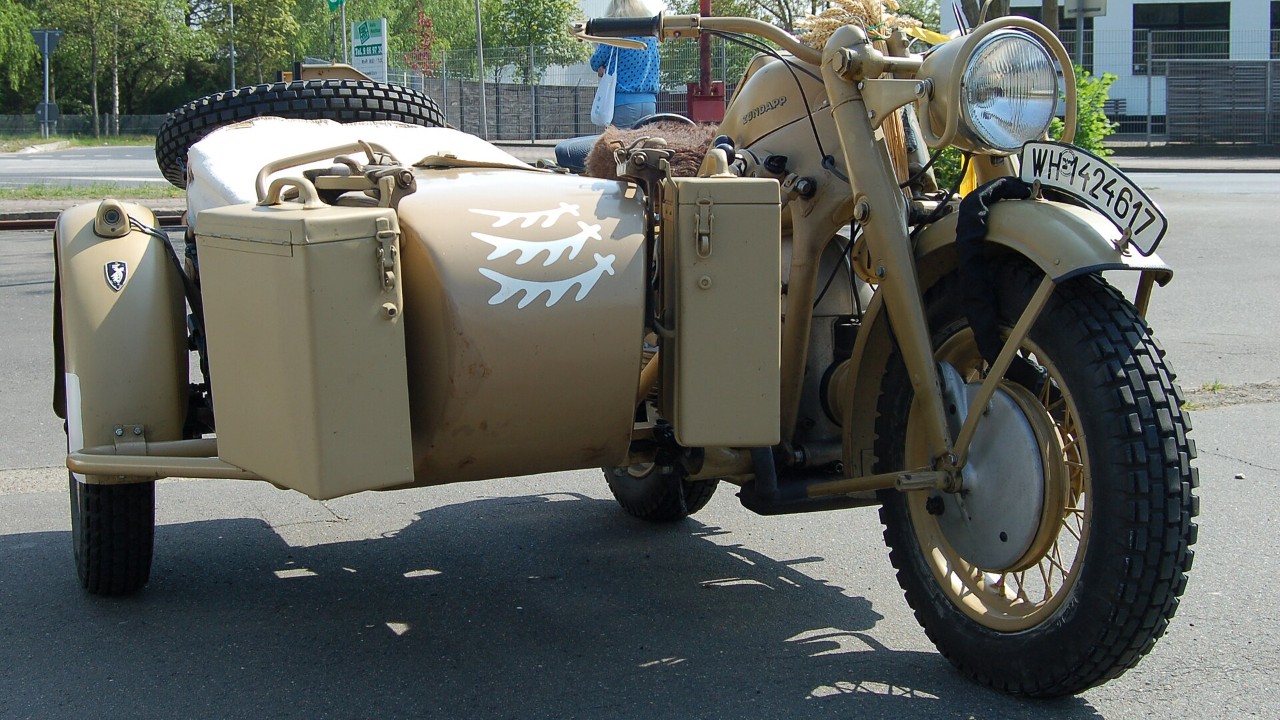
Zündapp built its KS 750 for the same army job as the R75. In fact, military testers judged the Zündapp the better machine, and the two makers later shared about 70% of their parts. The KS 750 used a 750-cc flat-twin and drove its sidecar wheel too. A limited-slip differential split the power, and the rider could lock it for tough ground.
The army’s brief called for a payload of 500 kg, the weight of three fully equipped soldiers. It also wanted the outfit to work anywhere. Rider magazine notes that Zündapp designed the outfit for desert heat, Russian winters and Balkan mountains. A switchable device warmed the intake air in cold weather. The 23-liter fuel tank gave a range of more than 200 miles, and a fully loaded rig weighed about half a ton.
Zündapp built some 18,000 of them before bombing put the factory out of business in late 1944. However, the story did not stop there. Many KS 750s stayed in Eastern Europe as basic transport until 1989, Rider reports. Our take: a war machine that turned into everyday transport for decades is a legend by any measure. Check for a matching sidecar if you shop for one. For more hardy machines from that era, see eight military vehicles built like tanks that you can buy.
3. 2023 Ural Gear Up Expedition

Ural’s roots go back to five BMW R71s that Soviet engineers took apart and copied in detail. The result, the M-72, went into production in August 1941. Later that year the plant moved east to Irbit, and the Red Army received 9,799 M-72s during the war for scouting and mobile troops.
The modern Gear Up keeps the same layout. It uses a 749-cc air-cooled boxer twin rated at 41 horsepower at 5,500 rpm and 42 lb-ft at 4,300 rpm. Its on-demand two-wheel drive powers the sidecar wheel, and the gearbox has four forward speeds plus reverse, according to Ural’s own specifications. Since August 2022, Ural has built new bikes in Kazakhstan.
The Expedition model added upgraded suspension, handguards, extra luggage space and better protection. It also comes with a spare wheel, a jerry can and a folding shovel. ADVpulse reported an MSRP of $31,440 when Ural announced it in 2023. By comparison, the standard Gear Up lists at $21,999, so the Expedition costs about $9,400 more. Our take: few motorcycle designs from 1941 are still on sale new, and that alone makes the Gear Up special.
4. 1978 Chang Jiang CJ750 sidecar outfit

The Chang Jiang 750 carries one of the longest family trees in motorcycling. It began with the 1938 BMW R71, which the Soviets turned into the M-72. In the mid-1950s, the Soviets sold the M-72 tooling to China, and the Chang Jiang 750 appeared a few years later, Bike EXIF explains.
China built the CJ750 for its military at first. The China Nanchang Aircraft Manufacturing Company was among its makers. It used an air-cooled opposed twin of 746 cc, and it kept the classic sidecar format of its ancestors. Sources disagree on the exact start date, but production began in the late 1950s or early 1960s. Production finished in the 1990s, when China opened its market to foreign motorcycle makers.
The CJ750 then found a second career. Foreign hobbyists keep the marque alive, and in Shanghai, the touring firm Shanghai Sideways has used the bikes to take visitors around the city. Travel guides including Lonely Planet have recommended those tours. Our take: a 1930s German design that became a Chinese army bike and then a tourist ride is the definition of an unlikely legend. If you want one, buy from a known specialist.
More from Fast Lane Only