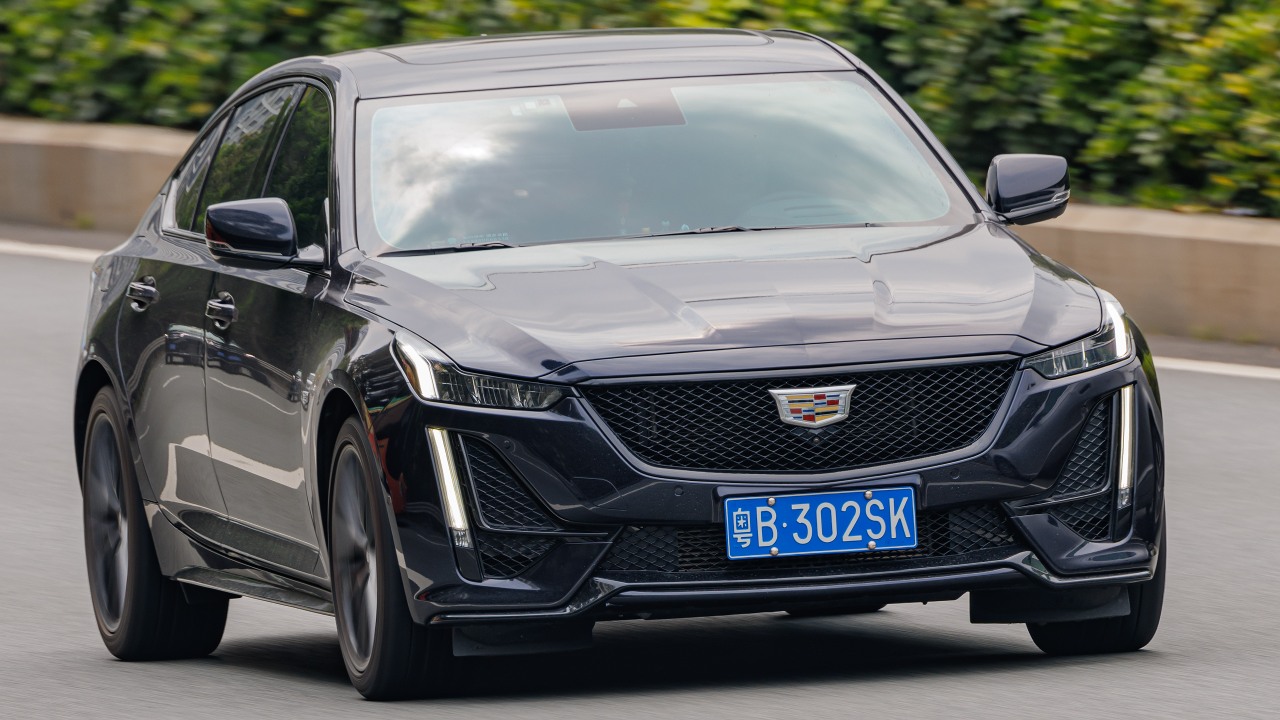
Cadillac’s midsize CT5 is quietly rewriting the narrative around American sedans. While crossovers dominate showroom floors, this three-box four-door has delivered a genuine sales surge, proving that a well-executed sedan can still command attention and volume in the United States.
I see the CT5’s momentum as more than a quirky outlier. It reflects a stubborn core of drivers who still care about driving dynamics, design, and value in a package that sits lower to the ground, even as the broader industry pivots toward electric crossovers and SUVs.
CT5’s sales surge defies the crossover script
The clearest signal that the CT5 is resonating comes from the numbers. Cadillac sedan sales climbed 5.3% last year, a rare uptick for a body style many executives have already written off, and reporting credits the facelifted CT5 as the primary driver of that growth. Internal tallies for the CT5 itself show a steady cadence of monthly volumes, with figures such as 70, 85, 91, and 73 units adding up to an annual total of 957 in one recent Year, a pattern that underscores consistent demand rather than a one-off spike. In a market where sedans are supposed to be in retreat, that kind of stability is its own quiet rebuttal.
What stands out to me is that this performance is arriving at a time when the broader company is already celebrating strong overall Sales, including its Best retail results since 2007 and a 69% jump in luxury EV deliveries. Against that backdrop, the CT5 is not being carried by a weak comparison, it is contributing to a portfolio that is already performing well. The fact that a conventional, gasoline-powered sedan can still carve out meaningful growth inside a lineup increasingly defined by crossovers and electric models suggests that the American appetite for this format has been overstated in its decline.
A sedan that still anchors Cadillac’s identity
Cadillac’s own leadership has been explicit about how central this car has become. John Roth, vice president of Global Cadillac, has said that CT5’s importance in Cadillac’s portfolio cannot be overstated and that, Globally, CT5 is a key part of the brand’s strategy. I read that as an acknowledgment that the sedan is doing double duty, serving as both a volume player in the United States and a brand ambassador in markets where traditional three-box luxury cars still define status. In other words, the CT5 is not a nostalgic indulgence, it is a strategic pillar.
That role is reinforced by the way Cadillac has equipped the latest version. The 2025 CT5 integrates Google Automotive Services, including Maps, Assistant and the Play store, alongside familiar smartphone mirroring such as Apple CarPlay and Android Auto, both with wireless connectivity. By pairing a classic sedan silhouette with a modern digital cockpit and advanced driver assistance, Cadillac is using the CT5 to bridge its heritage as the Standard of the World in luxury sedans with the expectations of a connected, software-centric era. For buyers who still prefer a sedan but do not want to feel left behind by technology, that combination is a compelling proposition.
Performance variants keep the enthusiast flame alive
Beyond its role as a mainstream luxury sedan, the CT5 has also become a standard-bearer for enthusiasts who still care deeply about how a car feels on a back road. The CT5-V and CT5-V Blackwing variants, with their focus on power, chassis tuning, and track-capable hardware, have helped deliver the brand’s Best-ever V-series sales. Reporting notes that the CT5 managed a double-digit year-over-year gain even late in the year, a period when demand typically softens, which suggests that interest in these performance versions is not just loud on social media but real at the dealership level.
I see that as a crucial counterweight to the narrative that performance sedans are a dying breed. When a reviewer can look at the 2026 Cadillac CT5 and remark that it is only a matter of time before beautiful sedans are coming back, that sentiment is grounded in the way the CT5-V Blackwing in particular has captured a specific and still attentive audience. The car’s ability to attract drivers who might otherwise drift toward German rivals or high-performance crossovers helps Cadillac maintain credibility among enthusiasts, which in turn supports the broader brand as it leans further into electrification and utility vehicles.
Product refinement, not reinvention, is paying off
What strikes me about the CT5 story is how incremental improvements, rather than radical reinvention, have delivered tangible results. The recent refresh sharpened the styling, updated the cabin technology, and added features such as new Driver Attention Assist, but the underlying formula remained intact: rear-drive-based architecture, balanced proportions, and a focus on driving feel. Instead of chasing every passing trend, Cadillac chose to refine what already worked, and the sales response suggests that many buyers appreciate that restraint.
The integration of services like Google Automotive Services, with native Maps, Assistant and the Play store, is a good example of this philosophy. Rather than building a proprietary ecosystem that risks frustrating users, Cadillac leaned on familiar platforms while still offering wireless smartphone integration for those who prefer their own apps. That approach keeps the CT5 competitive with newer electric models that tout big screens and app stores, yet it does so in a package that remains relatively light, efficient, and engaging to drive. In a market saturated with tall, heavy crossovers, that kind of thoughtful evolution gives the CT5 a distinct identity.
A future caught between discontinuation and renewal
For all its recent success, the CT5 sits in a complicated strategic position. Cadillac has confirmed that the CT4 and CT5 sedans are set to exit its lineup after the 2026 model year, a decision that would mark the end of an era for the brand’s current generation of internal combustion four-doors. At the same time, General Motors has confirmed that the next generation Cadillac CT5 midsize sedan will be assembled at the Lansing Grand River Assembly Plant, following investments to begin electrifying the facility. Taken together, those facts paint a picture of a nameplate that is being retired in its current form but prepared for a new chapter.
I interpret that tension as a sign that the CT5’s recent popularity spike may have arrived slightly out of sync with Cadillac’s long-term product cadence. One analysis has already described the surge in interest as coming a moment too late, given how far the company has moved toward crossovers and electric vehicles. Yet the decision to commit a plant like the Lansing Grand River Assembly Plant to a future CT5 suggests that General Motors still sees value in keeping a midsize sedan in the portfolio, potentially with a different powertrain mix or market focus. In that context, the current CT5’s sales boom is not just a nostalgic last hurrah, it is a data point that will shape how Cadillac balances sedans and utility vehicles in the years ahead.
There is also a global dimension that cannot be ignored. General Motors has already pulled many sedans from its North American showrooms, while continuing to evolve similar formats in markets such as China, where demand for three-box luxury cars remains stronger. Reporting on how America’s failed luxury cars are still evolving in China underscores that the company is willing to let certain body styles fade in one region while nurturing them in another. The CT5’s performance in the United States complicates that calculus, showing that even in a crossover-heavy market, a well-executed sedan can still find nearly one thousand buyers in a single Year and lift Cadillac sedan sales by 5.3%. As I see it, that is enough to prove that the American sedan is not dead, just waiting for the right product and timing to remind drivers what they have been missing.
More from Fast Lane Only