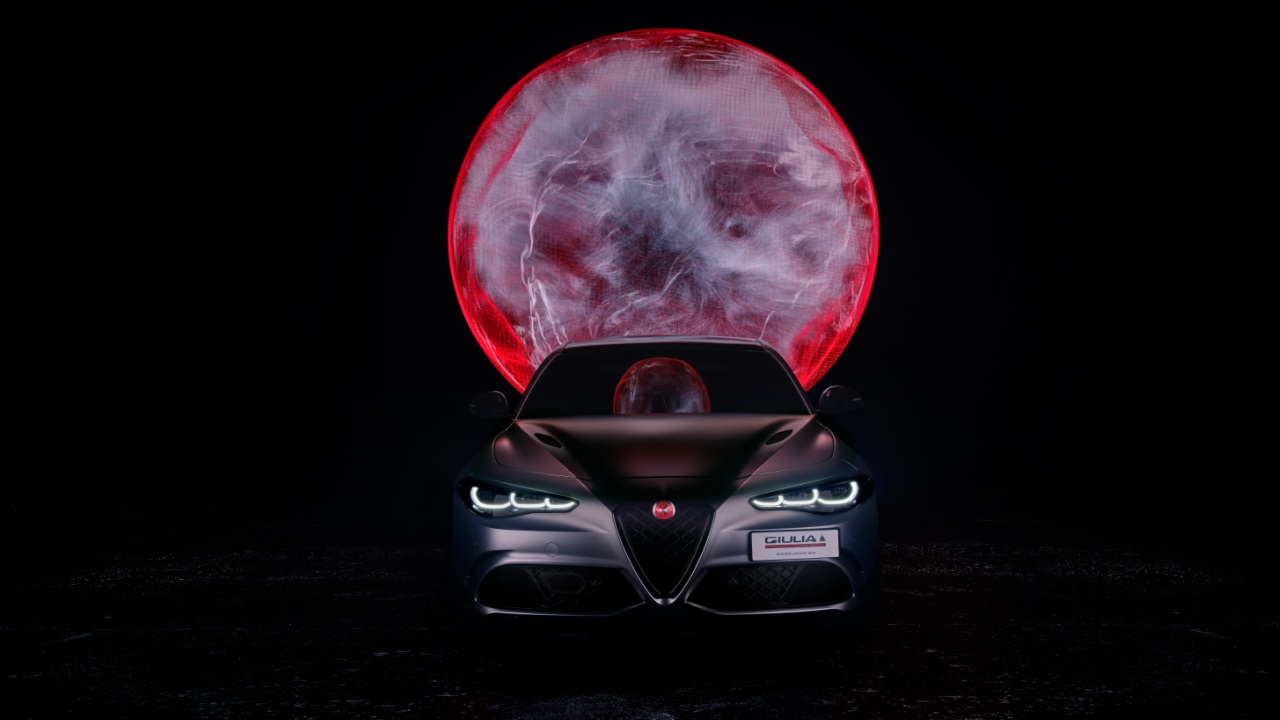
Alfa Romeo has never been shy about drama, but with the Giulia Luna Rossa it has turned the volume up through aerodynamics rather than sheer power. The new limited series takes the familiar Quadrifoglio super saloon and layers on a competition-inspired aero package that is far more than cosmetic, reshaping how the car slices the air at speed.
By drawing directly from the Luna Rossa Prada Pirelli America’s Cup campaign, Alfa Romeo has created a Giulia that treats airflow as a design material in its own right. I see this car less as a special paint and badge exercise and more as a rolling demonstration of how race-bred aero can transform a road-going four door.
A road car shaped by a racing yacht
What sets the Giulia Quadrifoglio Luna Rossa apart is the way its entire brief is anchored in the world of high performance sailing rather than traditional motorsport. Alfa Romeo created the car to celebrate the 38th America’s Cup campaign of Luna Rossa Prada Pirelli, and only ten units will be built, all reportedly reserved for team members and partners. That extreme scarcity turns the car into a kind of road legal trophy, but the more interesting story, in my view, is how the design team has translated the language of foiling yachts into the bodywork of a super saloon.
According to Alfa Romeo’s own description, the Giulia Quadrifoglio Luna Rossa is presented as the most Extreme Quadrifoglio yet, with a focus on carbon fiber aerodynamics that echo the foil sections used to lift the Luna Rossa yacht out of the water. The brand has reinterpreted that foil profile in the car’s add-on surfaces, using sculpted carbon elements to manage airflow with extraordinary efficiency and to make the driving dynamics even more precise. Inside, the cabin incorporates authentic material from the yacht’s history, turning the link between car and boat into something tangible rather than a marketing metaphor.
Serious aero: from canards to twin wings
From a technical standpoint, the Luna Rossa package is defined by a full carbon aero kit that goes far beyond the standard Giulia Quadrifoglio. The front end gains prominent canards, or dive planes, that sit ahead of the wheels to generate extra downforce and stabilize the nose at high speed. Along the flanks, deep side skirts and additional appendages help seal the underbody from turbulent air, while reworked underfloor profiles smooth the flow beneath the car to reduce lift and drag. It is a comprehensive approach that treats every surface as an opportunity to extract more grip.
At the rear, the visual centerpiece is a dramatic twin element wing that sits above the bootlid and works in concert with a lower spoiler. Reporting on the car’s development notes that Its front dive planes, side skirt appendages and those twin rear wings combine to offer five times the downforce of the regular Giulia Quadrifoglio at speed, a staggering gain that moves the car into territory usually reserved for track specials. Alfa has also fitted a dedicated carbon package that includes a reshaped diffuser, further improving stability when the car is approaching its 186 mph top speed. In effect, the Luna Rossa treatment gives the Giulia wings, but in a way that is grounded in measurable aerodynamic benefit rather than theatrics alone.
Performance that matches the aero promise
All of this aerodynamic effort would ring hollow if the underlying powertrain could not exploit it, but Alfa Romeo has kept the Giulia Quadrifoglio’s core mechanicals suitably potent. The car continues to use the twin turbo 2.9 litre V6, a unit that has already proven itself as the heart of the brand’s modern performance lineup. With the Luna Rossa specification, the focus is not on chasing headline horsepower increases, but on allowing the existing output to be deployed more effectively and more consistently, particularly at very high speeds where lift and instability can sap confidence.
Alfa has stated that at 186 mph, which is the Giulia super saloon’s top speed, the enhanced aero package keeps the car planted in a way that the standard configuration cannot match. By generating significantly more downforce without a corresponding spike in drag, the Luna Rossa kit allows the chassis to work in a more predictable window, especially during fast direction changes or heavy braking from high velocity. I read this as a deliberate choice to prioritize usable performance over spec sheet inflation, a philosophy that aligns with the America’s Cup inspiration, where efficiency and control often matter more than raw power.
Design cues that speak fluent Italian performance
Visually, the Giulia Luna Rossa walks a fine line between motorsport aggression and the kind of elegance that enthusiasts expect from an Italian four door. The additional carbon elements, from the front canards to the deep side skirts, are integrated with a level of care that keeps the overall silhouette cohesive rather than cluttered. Alfa has long understood that proportion is its secret weapon, and here the designers have used the aero addenda to emphasize the Giulia’s existing stance, lowering it visually and stretching its profile without resorting to cartoonish flares.
There is also a playful self awareness in how the brand frames this car within its broader culture. One report wryly filed the Luna Rossa under “Things That Sound Better In Italian, Part 39,” a nod to the way names like Giulia and Quadrifoglio carry a certain musicality that amplifies the car’s appeal. Inside, the use of materials linked directly to the Luna Rossa yacht, including dashboard elements that incorporate authentic components, reinforces the sense that this is a curated object rather than a mass produced variant. For someone like me who values narrative in design, those touches matter as much as the raw numbers.
A collector’s piece with a competitive edge
From a market perspective, the decision to limit the Giulia Quadrifoglio Luna Rossa to just ten units transforms it into an instant collectible. Created to celebrate the 38th America’s Cup campaign, the car is positioned as a reward for those closest to the project rather than a conventional showroom offering. That scarcity, combined with the direct tie to one of the most technologically advanced sailing competitions in the world, ensures that each example will be treated as a piece of rolling memorabilia as much as a performance tool.
Yet I find it significant that Alfa Romeo has not allowed the collector narrative to dilute the engineering ambition. The company describes the Luna Rossa as the most Extreme Quadrifoglio ever, and the data on downforce and aero efficiency support that claim. By reinterpreting the foil section of the Luna Rossa yacht into carbon fiber surfaces that deliver extraordinary efficiency, Alfa has created a Giulia that is both a tribute and a test bed. Even if only ten people will experience it firsthand, the lessons learned in shaping this car’s airflow are likely to inform future performance models, ensuring that the serious aero upgrades do more than simply decorate a limited edition.
More from Fast Lane Only