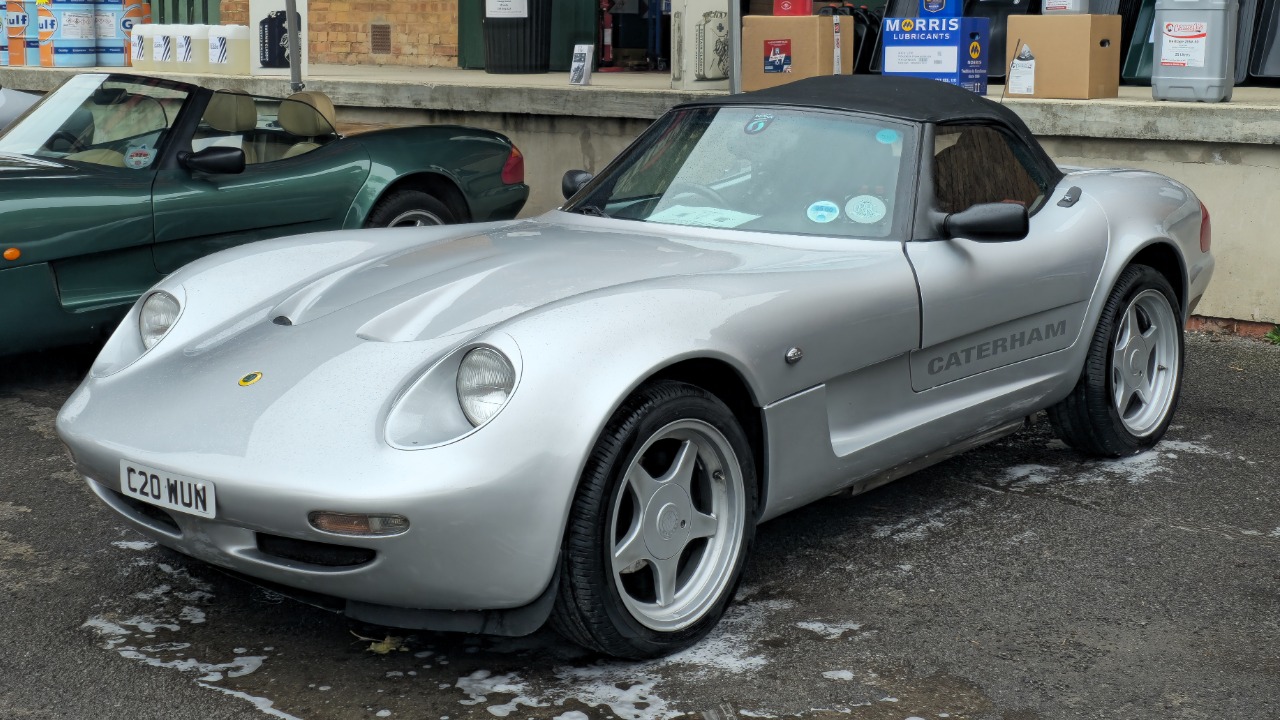
You meet the Caterham 21 at the exact crossroads where driving purity and everyday usability collide. It is a car that tried to give you the Mazda Miata’s friendly, live-with-it-every-day charm while keeping the raw, go-kart feel that made the Caterham Seven legendary. It did not quite manage the sales success, but when you look closely, you see how close it came to out-Miata-ing the Miata on the road that really matters to you: the one filled with corners.
To understand why the 21 almost worked, you have to see it as a bold experiment. Caterham tried to wrap its featherweight track toy in a more civilised shape, add a hint of comfort, and sell you a British two-seater that could handle a commute as happily as a track day. The fact that fewer than 50 cars were built does not change how ambitious that idea was or how much it still speaks to anyone who loves small sports cars.
How you get from Seven to 21
You start with the Caterham Seven because everything about the 21 flows from that car. The Seven traces its roots back to the Lotus 7, and if you count the initial production under Lotus as the Lotus 7, the Katerum 7 has been in continuous production for an astonishing span of decades, a run that has turned it into one of the purest driver’s cars you can buy. Modern versions like the Caterham 170 stick to an “everything you need and nothing you don’t” philosophy, which helps the 170 weigh just 970 lbs and shows you how serious Caterham is about lightness, as you see in the compact figures for the Caterham 170.
By the mid 1990s, that purity had a downside for you if you wanted to use a Caterham every day. Climbing into a Seven required agility, weather protection was basic, and the styling looked like a throwback even in period. Caterham knew that if you were cross-shopping a Seven with more modern rivals, you might love the handling but still walk away. The 21 was the answer to that problem, a car that kept the Seven’s mechanicals but tried to present them in a package that would not look out of place in your driveway or office car park.
The Miata benchmark you already know
To see what Caterham was aiming at, you only have to think about a first-generation Mazda MX-5 Miata. You get a front-engine, rear-drive layout, friendly handling and a soft top you can raise or lower with one hand, all wrapped in a car that feels eager rather than intimidating. Period impressions of the 1991 Mazda MX-5 Miata praised its light controls, slick gearbox and approachable performance, the kind of traits that made the little Mazda a benchmark for accessible fun, as reflected in early Miata reviews.
What really matters for you is that the Miata made this experience incredibly easy to live with. You could drive it to work, take it on a long trip, or just enjoy a back road without worrying about leaking roofs or cramped cabins. That blend of reliability, usability and joy is what Caterham wanted to match, and if possible, to surpass. The 21 was built to give you the same daily-friendly two-seat formula, but with even more focus on lightness and feel.
Designing a civilised Caterham
From the outside, the 21 tried to reassure you that this was a proper sports car, not just a track toy with fenders. Styled by Iain Robertson and a small team, it wore a curvy body with enclosed wheels, a low nose and a tail that nodded to classic Brit sports car shapes. Underneath, it was almost mechanically identical to the Seven, which meant you still got that race-car-like chassis, but the main difference sat in the way the bodywork wrapped around you, as described in coverage of how the 21’s mechanicals mirrored the Seven.
Inside, the 21 aimed to make your life easier than a Seven ever could. You no longer had to step over a high sill and drop into a bare tub; instead, you got doors, a more conventional dashboard and a cabin that at least gestured toward comfort. The idea was that you could climb in without gymnastics, take a partner along without apologising for the noise and drafts, and still enjoy the direct steering and feedback that made Caterham famous. On paper, it looked like the perfect halfway house between a hard-edged kit car and a friendly roadster.
The mish-mash that tripped you up
Once you start looking at the details, you see where the 21 began to lose you. To keep costs down, Caterham used a mish-mash of parts from different suppliers instead of engineering everything from scratch. The 21 had a mish-mash of parts on it thanks to the redesigned body, and rather than engineer new pieces for every panel and fitting, the company borrowed parts from other companies, which meant even the rear lights and some trim came from outside sources, as described in analysis of how Mish of borrowed components.
That approach made sense for a tiny manufacturer, but it left you with a car that felt less cohesive than the Miata. You could see the compromises in the cabin, where ergonomics were not as carefully tuned, and in the way the narrow body made entry and exit awkward despite the more conventional shape. Reports describe how you needed the agility of a gymnast to get in and out, and how the car still felt unusually narrow, even after adding three inches to the Seven’s width, a combination that made it less friendly than the spec sheet suggested, as detailed in accounts of the great motoring disaster that the 21 became.
Why the Miata still won your driveway
Even if you loved the idea of a Caterham with a roof, the market around you was shifting fast. At the same time that the 21 appeared, you already had the Mazda MX-5 setting the standard for how a front-engine, rear-drive lightweight should behave, with a level of polish that made it easy to recommend to anyone. A video analysis of the period argues that, never mind the Elise as competition, the car that really guaranteed the 21’s failure was the Mazda MX, with its front-engine, rear-drive layout delivering the same core ingredients in a more refined package, as discussed in commentary that compares the Mazda MX and layout directly to the 21.
The 21 also struggled to justify its price and practicality when you looked at alternatives. You could buy a Miata that started every morning, shrugged off rain and road salt, and offered dealer support that a small British maker could not match. Meanwhile, the 21 remained rare, with a total of under 50 cars built, which made it a veritable curiosity rather than a common sight, as noted in summaries that point out that only 50 examples ever reached customers. For you as a buyer, that meant higher risk and less support, even if the driving experience promised something special.
More from Fast Lane Only