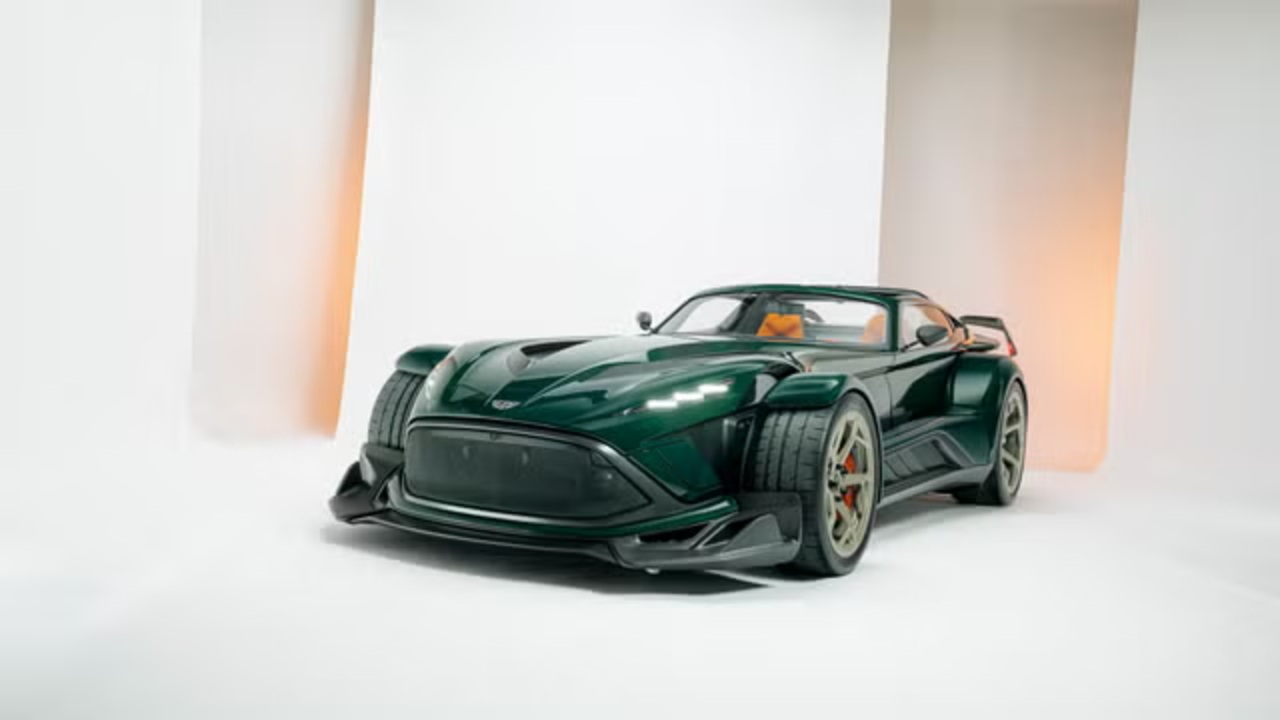
The Donkervoort P24 RS arrives as a pointed rebuttal to the heavy, insulated supercar, a machine built to thrill drivers rather than coddle them. Now that it is coming to America in limited numbers, this ultra-light, twin-turbo V6 two-seater is poised to test how much appetite remains for a purist’s car in a market saturated with electronics and excess. With extreme power, a weight figure that undercuts a Mazda Miata, and a production run capped in the low hundreds, it is engineered to impress both on paper and on the road.
A featherweight with hypercar punch
At the core of the P24 RS story is a simple equation: big power, very little mass. Donkervoort has replaced its familiar Audi five-cylinder with a twin-turbo V6 that delivers up to 591 horsepower, while keeping the car’s weight under 1,900 pounds. That combination pushes the P24 RS into territory usually reserved for full-bore track specials, yet it remains a road-legal two-seater with recognizable Donkervoort styling and exposed front wheels. The company’s own description of the car as “More emotional, more engaging, technologically pioneering and the most Dutch supercar ever created” underlines how central this power-to-weight focus is to its identity.
The result is a car that several observers have described as lighter than a Miata, but with output that edges into the 600 horsepower conversation. One report notes that the P24 RS has 591 horsepower and emphasizes that it is “lighter than a Miata,” while another describes it as a “blistering 600HP featherweight” and a “purist’s revolution” in how performance is defined. That slight discrepancy in quoted output reflects rounding and rhetoric rather than a fundamental disagreement, but both perspectives converge on the same point: the P24 RS offers hypercar-level thrust in a package that weighs less than many compact hatchbacks.
Designing for the driver, not the computer
Where many modern exotics lean on layers of software, the P24 RS is framed explicitly as a driver’s car that does not isolate its pilot from the experience. Donkervoort describes it as “more emotional” and “more engaging,” and stresses that the car is about what “driving pleasure means” to its customers. That philosophy shows up in details such as an interior designed to accommodate a wide range of drivers while keeping them closely connected to the chassis, and in the decision to prioritize mechanical feel over digital filters. The company positions the P24 RS as a response to “Some Supercars” that “feel like they’re apologizing for letting you drive them,” weighed down by “too many computers” and “too many safety nets.”
Instead of apologizing, the P24 RS leans into analog sensation, then layers in technology where it enhances control rather than diluting it. Reports highlight an adjustable power dial that lets drivers rein in the full punch of the twin-turbo V6 if they find the constant surge intimidating, a nod to usability that still respects the driver’s judgment. Braking is handled by “Four-piston front and rear calipers” from AP Racing, paired with a carefully tuned chassis and optional carbon-ceramic hardware to keep that acceleration in check. The car also offers an optional removable aero kit for track work and “industry-first swing-out headlights” that add both drama and functional downforce management, underscoring that the engineering focus is on feedback and precision rather than digital spectacle.
Limited numbers, global ambitions
Exclusivity is baked into the P24 RS program. Donkervoort has committed to building only 150 examples of the car, a figure repeated across multiple reports that describe the run as “Limited to Just 150 Units Worldwide” and “Only 150 units” in total. One account notes that “more than 50” of those 150 units have already been sold to customers, while another specifies that the first 50 build slots are spoken for, indicating strong early demand. A separate report on the company’s plans reiterates that it “only plans to build 150 examples of the P24 RS,” reinforcing that this is not a flexible target but a hard cap on production.
That scarcity is matched by pricing that firmly plants the P24 RS in supercar territory. The company has indicated a starting price of 298,000 for the car, a figure that reflects both its bespoke construction and its positioning as a halo product for the brand. Donkervoort, founded in 1978, has long specialized in ultra-light, driver-focused machines, but the P24 RS is being presented as a step change in ambition, with the company describing it as “technologically pioneering” and offering “extreme customer service and personalisation.” The ordering process is correspondingly personal, with official materials explaining that “Reserving your P24-RS build slot is straightforward” but requires a signed sales agreement and a structured deposit, underscoring that each car is effectively a commissioned piece rather than a mass-produced commodity.
Coming to America, and beyond
For American enthusiasts, the most striking development is that this once-obscure Dutch supercar will not remain a distant curiosity. One detailed report makes the point bluntly: “Don’t think this is just some forbidden fruit, either. The Donkervoort P24 RS is being sold in America,” framing the car as a “wonderful antidote to supercar fatigue” in a market crowded with heavy, electronically filtered performance cars. Another account, focused on the brand’s broader expansion, describes a “blistering 600HP featherweight” that “is coming to the US,” confirming that Donkervoort has structured the P24 RS program with North American customers in mind from the outset.
The company is also looking beyond the United States to build a North American footprint. In Canada, Donkervoort’s plan to get some of those 150 cars across the border involves partnering with a Canadian company to complete “partial” builds, a strategy that can help navigate local regulations while keeping the cars closely aligned with their Dutch specification. A separate report on the Canadian rollout notes that the P24 RS headed there is a “591-hp” car, aligning with the 591 horsepower figure cited elsewhere and reinforcing that the same core specification will be shared across markets. Together, these moves signal that Donkervoort is no longer content to be a niche European name, but is instead using the P24 RS as a calling card in some of the world’s most competitive performance-car arenas.
A different answer to the modern supercar
What sets the P24 RS apart is not only its numbers, but its stance on what a modern supercar should be. In an era when “Some Supercars” are criticized because “They have too many computers, too many safety nets,” Donkervoort is explicit that the P24 RS “does not isolate” its driver. Company messaging describes it as “More emotional, more engaging” and “the most Dutch supercar ever created,” language that emphasizes character and national identity as much as raw performance. A video presentation of the car goes further, declaring that “the purist’s revolution begins today” and that the automotive world has witnessed “a seismic shift in the definition of performance,” positioning the P24 RS as a standard-bearer for a different philosophy.
That philosophy is reflected in the car’s details and in the way Donkervoort talks about its customers. One executive is quoted as saying, “It’s about what driving pleasure means to them, because this is everything to us,” a line that captures the company’s willingness to prioritize feel over convenience. The P24 RS is described as “a lightweight, driver-focused supercar,” with exposed front wheels that keep the classic Donkervoort look while sharpening the lines, and with an interior that is tailored to the driver rather than dominated by screens. The brand’s own Q&A materials, framed under “YOUR QUESTIONS. OUR ANSWERS.”, emphasize direct communication and “extreme customer service and personalisation,” reinforcing that the P24 RS is intended as a deeply personal machine for those “who dare” to choose engagement over insulation.
More from Fast Lane Only