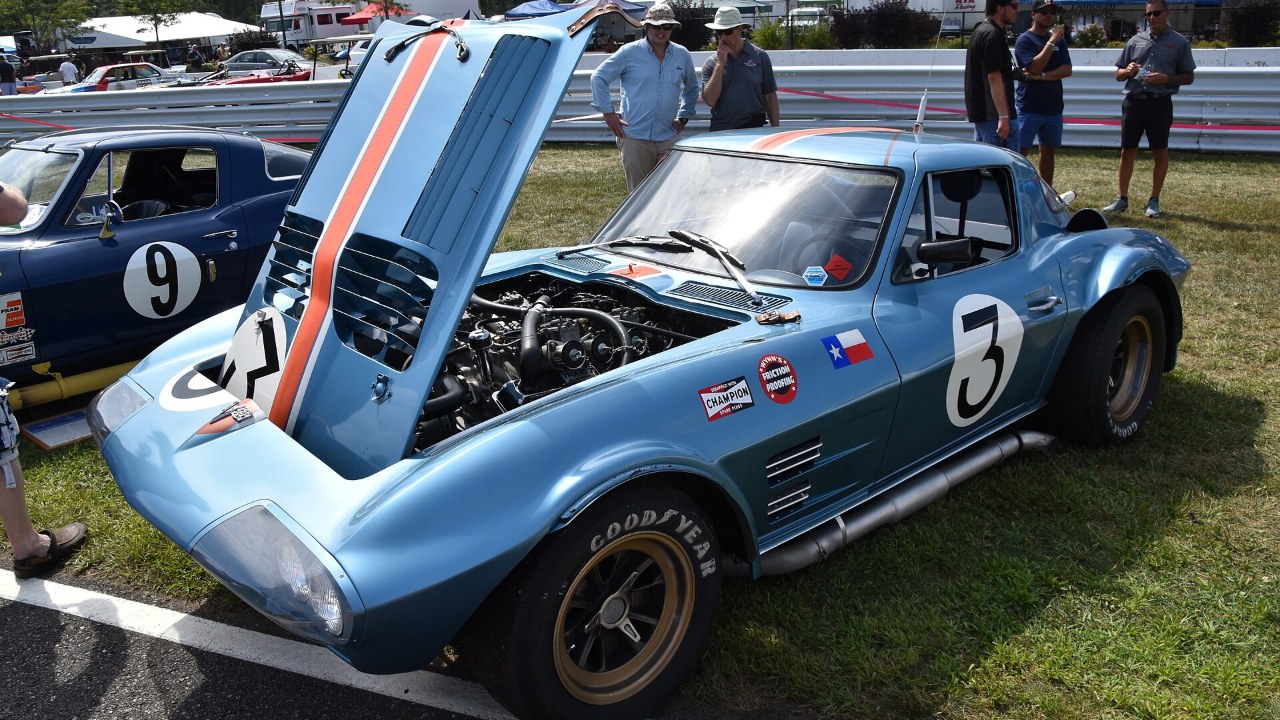
Chevrolet set out in 1963 to build 125 lightweight Corvette Grand Sport race cars. That number would have qualified the car for international GT racing. Instead, Chevrolet finished five. General Motors’ top management never let the other 120 happen, because it shut the project down once it learned how far things had gone.
The reason had nothing to do with speed. Instead, it came down to a gentleman’s agreement among American automakers and a corporation nervous about government attention. It also came down to one engineer. He had been working on something his bosses had told the industry they were not doing.
That engineer was Zora Arkus-Duntov. He had already led Chevrolet’s 1957 Corvette SS racing project. With the Grand Sport, he meant to take the new Sting Ray body and turn it into a real contender. The goal was a car that could run with Carroll Shelby’s Cobras and the European GT cars at Sebring and Le Mans.
A race car built around a road car’s silhouette
The plan called for a car that looked like a production Corvette but shared very little with one under the skin. According to RM Sotheby’s catalogue announcement for chassis 003, a Grand Sport weighed roughly 1,900 pounds. By the auction house’s math, that put it nearly 1,300 pounds below a production Corvette of the day.
However, GM Authority gives a smaller gap of nearly 1,000 pounds. That figure comes from its report on the car shown at New York’s Saratoga Automobile Museum. So the exact saving depends on which production car you compare it with. Either way, the Corvette Grand Sport weighed a fraction of what a showroom Sting Ray did.
Homologation explains the 125-car target. International GT rules required a minimum production run before a car could race in the class. In fact, GM Authority’s museum report states that Chevrolet planned 125 examples to meet that requirement. A five-car run could never qualify. As a result, the finished cars ended up in prototype and sports-racing classes instead.
The ban that ended the program
In 1957 the members of the Automobile Manufacturers Association agreed to stop supporting motorsport. Everyone expected GM, the largest member, to honor it publicly. The Revs Institute, which owns Grand Sport chassis 004, explains that Duntov developed the race car outside the view of corporate management. Then Chevrolet executives found out. They cancelled the program and ordered the five finished cars sold or crushed.
GM Authority adds a second pressure point: the company’s size. In its report on the 2026 sale, the outlet says executives had two worries. First, they feared breaking the AMA agreement. Second, they feared scrutiny from federal regulators over GM’s dominant market position. A corporate racing program, even an unofficial one, was exactly the kind of headline GM wanted to avoid.
Still, nobody crushed the cars. Revs says all five survive and are accounted for today. Two became open roadsters, while three stayed coupes.
What five cars did on track
Freed from homologation, the Grand Sports went racing in private hands. RM Sotheby’s credits chassis 003 with three SCCA class wins in 1963 with Dick Doane. He also led the Road America 500 for 93 laps before the engine failed. Later in 1963, the car went to Bahamas Speed Week, where Jim Hall and Augie Pabst drove it.
Chassis 003 then earned a second-in-class finish at the 1964 12 Hours of Sebring, according to the GM Authority sale report. A year later, it took third in class at the same race. RM’s announcement names A.J. Foyt and John Cannon as the 1964 Sebring drivers. Meanwhile, Corvette Blogger’s live auction coverage says Foyt started that race from 62nd. He then passed roughly 50 cars on the opening lap. Today the car wears its blue No. 2 Sebring colors.
The engines changed as the cars developed. GM Authority writes that the Grand Sports began with an iron-block 327 engine. Later, they ran an all-aluminum 377-cubic-inch small-block fed by four Weber side-draft carburetors. But published horsepower figures for that later engine differ from source to source. None applies to the cars as first built in 1963, so this story gives no single rating.
Corvette Grand Sport chassis 003 and its $18.7 million sale
On August 15, 2026, chassis 003 crossed the block as Lot 341 at RM Sotheby’s Monterey sale. RM’s pre-sale estimate was $11 million to $13 million. Corvette Blogger reported a hammer price of $17 million, or $18,705,000 once buyer’s fees came in. The seller had owned the car for 23 years. RM also describes it as the first of the three Grand Sport coupes.
Motor1 reported that the result is the highest price anyone has paid for a Corvette at auction. By comparison, the previous Corvette mark was $7.7 million, according to Corvette Blogger. A buyer paid that in 2025 for the 1957 Corvette SS, the earlier race car the Revs Institute credits to Duntov.
In the end, Chevrolet planned 125 Grand Sports and finished five. All five still exist, and chassis 004 belongs to the Revs Institute in Naples, Florida. Meanwhile, the Corvette Grand Sport that sold in Monterey set a new Corvette auction record at $18,705,000.
More from Fast Lane Only
- Unboxing the WWII Jeep in a Crate
- 15 rare Chevys collectors are quietly buying
- 10 underrated V8s still worth hunting down
- Police notice this before you even roll window down
This article was created with the help of AI and was reviewed and edited by Fast Lane Only editors before publication.