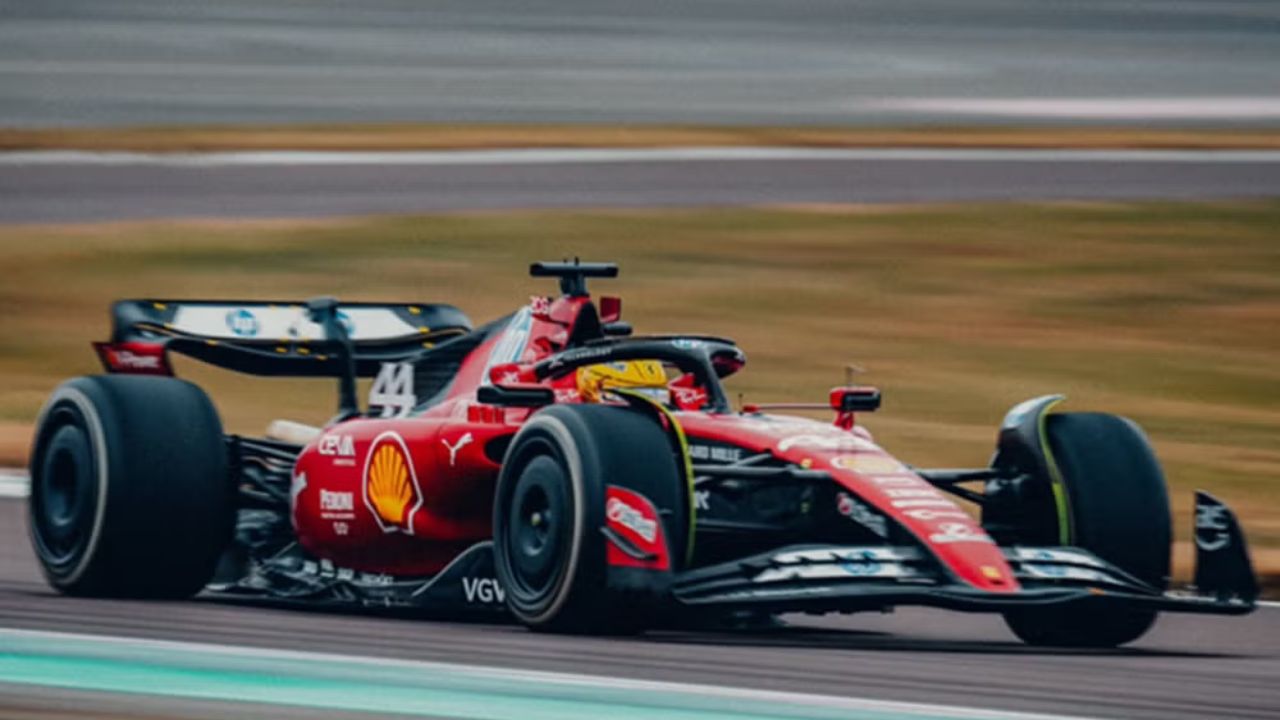
You are watching a rare alignment in Formula 1. A resurgent Ferrari, a sweeping reset of the regulations and the most decorated driver in history are converging to create a realistic new path back to the front. If you care about Lewis Hamilton’s legacy, a genuine Ferrari revival could be the moment that turns fading hope into a serious late‑career title push.
Recent seasons have shown how quickly narratives can swing in this sport. A nightmare first year in red for the 40-year-old British driver made some of you wonder if the move had come too late. Now, with Ferrari’s SF‑26 impressing in testing and Hamilton talking like a man who has rediscovered himself, you are entitled to think that F1 glory might be back on the table.
From nightmare debut to renewed belief
You probably remember how brutal Hamilton’s first season with Ferrari looked from the outside. Reports from PARIS described how Lewis Hamilton’s dream turned into a nightmare as the 40-year-old British driver struggled in a car that never matched his ambition. That context matters for you now, because it frames just how significant the current shift in mood at Maranello feels. When you see Ferrari speak of a reset and hear Hamilton describe the 2026 Formula 1 season as “a huge challenge” while calling work on the new car “fascinating,” you sense that both sides understand how little margin for error remains.
Hamilton is not just another name on the grid. When you search his record, you find Lewis Hamilton defined by seven world titles and a career built on thriving when the rules change. That history underpins why Ferrari’s internal optimism resonates. Earlier this year Hamilton spoke about a “winning mentality” at Ferrari, saying every single person felt more driven than ever, a sentiment that tells you the culture around him is finally catching up with his standards.
Ferrari’s technical reset meets 2026’s new rules
You are entering a season where the rulebook itself invites disruption. The FIA has unveiled new Formula 1 regulations for 2026 that promise more agile cars, active aerodynamics and a different balance between internal combustion and hybrid power. The official outline of the FIA framework describes active aero elements that replace traditional DRS and a new generation of power units that reward efficiency as much as outright grunt. For a team like Ferrari, which has already been working on intricate aero concepts, that is an invitation to innovate rather than copy.
You can see how far Ferrari is willing to push that envelope in the radical rear concept that has had engineers talking in Bahrain. Technical analysis of the SF‑26 explains how the faster the air flows over the rear wing underside, the lower the air pressure becomes, which increases downforce and makes the design both powerful and difficult to copy. Combined with a broader 2026 tech picture that includes shorter wheelbases and narrower tracks, as detailed in specialist breakdowns of the F1 2026 rules, you start to understand why Ferrari sees this as a clean slate. In that environment, Hamilton’s experience in interpreting new aero and tyre behaviour becomes a competitive asset rather than a nostalgic talking point.
Hamilton’s mindset shift and the hunger that remains
You have heard Hamilton speak candidly about how hard the last few years have been. In one frank reflection he admitted he “forgot who he was” during his recent struggles in F1, a confession that made you question whether the fire still burned as brightly. That same conversation highlighted how Christian Horner described his own engine project as being “70 years behind Ferrari,” a line that underlined how far ahead Ferrari’s power unit expertise is perceived to be. For you, that contrast between Hamilton’s vulnerability and Ferrari’s technical confidence sets the emotional stakes for 2026.
You have also watched Hamilton push back against any suggestion that his motivation has faded. In another interview he contrasted himself with rivals by saying, “Because they are nothing like me. I’m hungry, driven, don’t have a wife and kids. I’m focused on one thing, and that’s winning. I want it.” Those words, captured in a post that framed how nothing like me sums up his attitude, matter to you because they show a driver who sees his age not as a limit but as proof of endurance. When he then talks about feeling “in the best place I have been in for a long time” and more connected to the new Ferrari than to its predecessor, you are looking at a mindset that aligns with a team on the rise rather than one in denial.
Testing hints, rivals’ worries and the title‑hope whiplash
You have seen preseason stories swing wildly between pessimism and optimism around Hamilton’s 2026 prospects. One report even suggested that Lewis Hamilton’s hopes of winning the 2026 Formula 1 world title may have ended after a letter from the sport’s governing body, a reminder of how regulatory interpretations and political currents can shape your expectations before a wheel is turned. Yet as the new cars finally ran together in Bahrain, the tone shifted. Observers noted that Ferrari’s fast starts were being linked to a belief that it was running a smaller turbo than rivals, which could be masking full performance now while paying off later when the 2026 engine and car package is fully unleashed.
You also heard that one other Ferrari advantage not fully captured in lap‑time data was the team’s race starts, with Lewis Hamilton and both looking sharp off the line. That detail matters for you because in tightly matched fields, consistent launches from the front two rows can swing entire championships. When McLaren CEO Zak Brown describes “the red and silver guys” as looking very strong and places Ferrari and Mercedes at the top of his early pecking order, you see rivals bracing for a season where Ferrari is no longer a plucky outsider but a benchmark. At the same time, Sky Sports presenter Anthony Davidson warns you not to “give them the trophy yet,” a fair reminder that testing form can flatter and that reliability, strategy and development will decide whether this revival translates into a genuine title shot.
Why the new Ferrari gives you permission to dream
You are not just reacting to lap charts, you are reading the body language of a driver and team that have consciously hit reset. Hamilton has spoken about being involved in developing the SF‑26 on the simulator for around ten months, describing it as a car that carries his “DNA” and that he is excited to race. That level of input, detailed in coverage of Lewis Hamilton, Ferrari, gives you confidence that this is not a case of a star driver simply inheriting what the factory builds. Instead, you are seeing a partnership where Hamilton and Charles Leclerc have pushed Ferrari into a full reset for F1 2026, redesigning the SF‑26 to address tyre behaviour, grip issues and unpredictable handling that ruined 2025. After a brutal campaign, that joint pressure from Lewis and Charles has turned the new car into a statement of intent.
More from Fast Lane Only