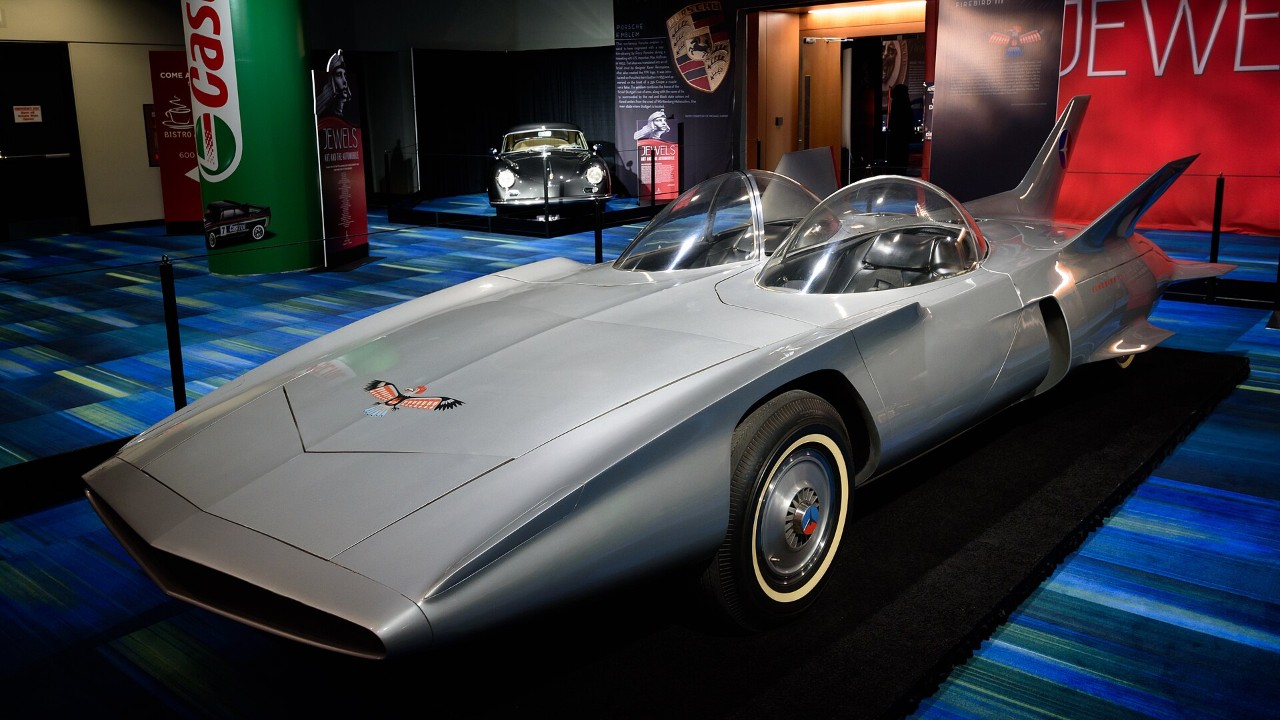
GM’s Firebird III had two engines, and only one of them moved the car. A 225-horsepower Whirlfire GT-305 gas turbine did the driving. Meanwhile, a tiny two-cylinder gasoline engine rated at just 10 horsepower had one job: running the accessories. GM showed the two-seat dream car at its 1959 Motorama.
That little engine tells you a lot about the jet age at General Motors. The company was happy to put a turbine in a car. Even so, it packed a conventional piston engine aboard as well, purely to power everything else.
The Firebird III was also the last of a trio. GM built its Firebird concepts for the 1953, 1956 and 1959 Motorama shows, and the third car was the wildest of the three.
Two engines in one Firebird III

First, the numbers. Greg Wapling’s prototype history lists the main powerplant as a “225 hp (168 kW) Whirlfire GT-305 gas turbine engine.” The same page describes “a two cylinder 10 hp gasoline engine to run all the accessories.” In other words, the second engine never turned the wheels.
Conceptcarz gives the same pair of figures. It also credits Emmett Conklin with leading GM’s gas turbine work, which began in the early 1950s. So by the time the Firebird III arrived, GM’s engineers had spent years on turbine power.
Why carry a second engine at all? The sources we read don’t spell out GM’s reasoning, and we won’t guess at it. What they do agree on is the split. The turbine drove the car, while the little twin handled the rest. Curbside’s history of the car puts it plainly: a small internal combustion engine ran “all the car’s accessories.”
In our view, that split is the most honest detail on the whole car. The turbine was the glamorous part of the story. Still, somebody at GM decided the accessories deserved a power source of their own, separate from the jet in the tail.
A cockpit full of jet-age gadgets
The Firebird III gave an accessory engine plenty to look after. However, the sources don’t say exactly which systems hung off the twin. Greg Wapling’s page lists cruise control, air conditioning and an “ultra-sonic” key that signaled the doors to open. It also describes anti-lock brakes and an automated guidance system meant to help avoid accidents.
Steering was just as strange. Instead of a wheel, the car used a joystick between the seats. Conceptcarz calls the control the Unicontrol. According to that page, either the driver or the passenger could steer, accelerate and brake “with a twist of the wrist.”
Curbside adds that the stick sat on the center console and handled steering, braking and acceleration. Then there were the air brakes. Greg Wapling describes flat body panels that rose up to slow the car, on top of its anti-lock system. Curbside also lists these air drag brakes, along with an automatic self-guidance system tied to cruise control.
For a 1959 audience, that list must have sounded like science fiction. Today, cruise control, anti-lock brakes and accident-avoidance systems are ordinary features on a family car.
The shape of the Firebird III
The body looked like a fighter jet that had lost its wings and grown seven small ones instead. Greg Wapling describes a two-seater with a double-bubble canopy. He also notes seven short wings and tail fins, all tested in a wind tunnel.
Better yet, the car was long and low. The same page lists a 119-inch wheelbase and an overall length of 248.2 inches. Height was just 44.8 inches at the top of the canopy, and ground clearance was 5.3 inches.
Harley Earl designed the Firebird series, according to Greg Wapling. The sources disagree on the skin, though. That page says titanium, while Curbside says fiberglass, so we won’t pick a side. Dates vary a little, too. Greg Wapling says GM built the car in 1958 and first showed it at Motorama in 1959.
Where the Firebird III went next
The car kept working after its debut. Curbside calls it a star of GM’s 1959 and 1961 Motoramas. It also says the Firebird III went on display at the 1962 Seattle World’s Fair.
Along the way, it spent time in a museum. Greg Wapling’s page notes that the car was displayed at the Henry Ford Museum in Dearborn, Michigan. It adds that Hemmings reports the car’s return to GM’s Heritage Collection.
That second engine is still the detail we’d point to first. Turbine power was the headline, yet the car openly admitted that its jet needed help with the chores. The Firebird III carried that helper in plain sight, with numbers attached: 225 horsepower to drive, 10 horsepower to run the accessories.
Finally, the car survived its show career. Curbside’s 2018 profile says the Firebird III rests at GM’s Heritage Center in suburban Detroit, kept in operating condition and often lent to shows and museums.
More from Fast Lane Only