
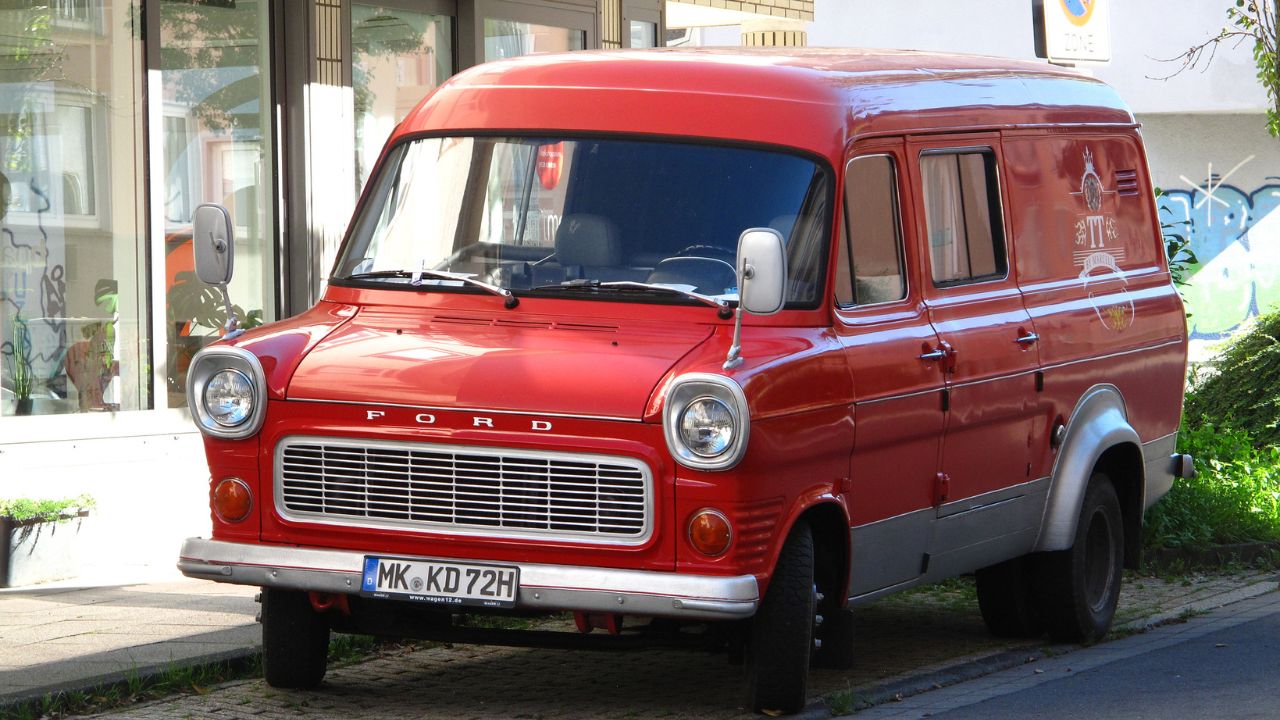
Ford launched the Transit in October 1965, and by 2015 it had sold 8 million of them. That’s a lot of vans, and most of them earned their keep. Still, not every Ford Transit is a smart buy today. Some are now so old that rust and missing parts rule the deal. Meanwhile, some newer ones carry recall history worth checking first. These seven are our picks to avoid before buying one, and the verdicts are our own.
1. 1973 Ford Transit 130 Mk1

The first Transit used Essex V4 petrol engines of 1.7 and 2.0 liters, plus an optional 43-bhp Perkins diesel. A Mk1 is lovely to look at. However, Car & Classic found no body panels for one project van apart from the front valance. As a result, any repair meant fabricating metal. Lights, handles and dash trim can be hard to find, too. Meanwhile, rust hides in the door bottoms, A-pillars, screen surrounds, wings and headlight bowls. Unless you want a restoration project, we’d pass.
2. Ford Transit Mk2 Minibus

The 1978 Mk2 facelift made the Pinto four the Transit’s main engine. Meanwhile, a 3.0-liter Essex V6 stayed on for high-performance vans. As a minibus, it carried passengers rather than cargo. The trouble is age. Even the newest Mk2 is now about 40 years old. Also, Car & Classic notes that owners usually wore work vans out and replaced them. In our view, a decades-old people carrier needs a careful inspection. So we’d skip it unless the history is spotless.
3. 1994 Ford Transit 2.5 D GL Automatic

This generation offered a 2.5-liter direct-injection diesel, a redesign of Ford’s York diesel from 1984. In our view, the automatic suited a gentle working life. Today, though, emissions rules are the bigger problem. Parkers notes that even the 2000-2006 Transit diesels miss Euro 4. As a result, they may face limits in ultra-low emission zones. A 1994 diesel is older still. For that reason, we’d avoid this one if you plan to drive in a city with those rules.
4. 2000 Ford Transit 80 SWB

The 2000 Transit was the first offered with front-wheel drive, alongside rear-wheel drive. Parkers calls it “a generally reliable van.” However, it says “Neither are to be recommended” about the 2.3-liter petrol and the automated gearbox. Also, ABS and a passenger airbag were only options. Commercial Motor told buyers to feel for clutch vibration and listen for a rattle. Either one may mean a new flywheel. So we’d check the spec sheet and the clutch before handing over any cash.
5. 2014 Ford Transit Connect Titanium

The Transit Connect first arrived in 2002 as a smaller van based on the Focus platform. In 2014, Ford recalled 25,238 Transit Connects from that model year. The reason? Their fuel and vapor lines may have gone in incorrectly. According to the NHTSA filing, the lines could rub and leak fuel, which raises the risk of a fire. A separate recall covered sliding-door panels on 19,825 cargo vans. Before buying, we’d insist on proof that a dealer did the recall work.
6. 2023 Ford Transit Custom

The new-generation Transit Custom had a rocky start in Australia. In May 2024, Ford recalled 1,117 vans there. A power steering software fault could stop Lane Change Warning Assist from working. Then, in September 2026, another Australian recall covered 777 diesel double-cab vans over a possible fuel leak. Honest John also flags theft trouble with earlier Customs because of a locking fault. In our view, any new Custom needs a full recall check first.
7. Ford E-Transit

Ford announced the E-Transit in November 2020, and U.S. deliveries began in February 2022. Early vans had 68 kWh of usable battery, and the EPA rated the low-roof model at up to 126 miles. In December 2025, Ford also recalled 2022 to 2025 E-Transits. The left rear half shaft could partly disengage and cut drive power. Battery capacity rose to 89 kWh in 2024, so we’d skip the early, short-range vans unless your routes are short.
More from Fast Lane Only


