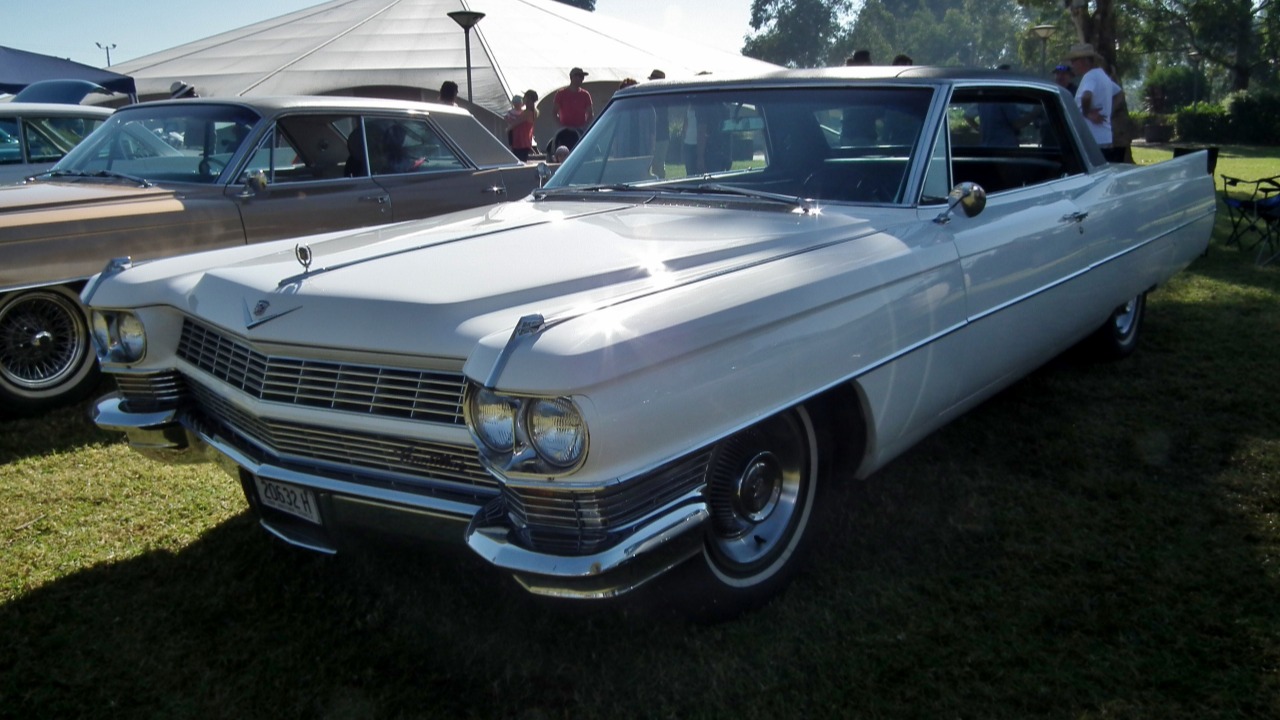
You can measure the 1964 Cadillac DeVille in feet, inches, and pounds, but that only tells half the story. On paper it was a vast American luxury car, yet on the road it moved with a composure that made its size feel like an asset rather than a burden. When you look closely at its proportions, its powertrain, and its cabin, you see how grace and size were engineered to work together instead of fighting for attention.
To understand why this particular model still captivates enthusiasts, you have to start with its sheer physical presence and then follow the trail inward to the details. From the long hood that hid a 429 cubic inch V8 to the nearly 19‑foot footprint that still managed to glide down the road, the 1964 DeVille was built to make you feel unhurried, confident, and unmistakably at the top of the automotive food chain.
Big numbers, balanced proportions
When you first walk up to a 1964 DeVille, the dimensions hit you before anything else. Owners describe the sedan as “nearly 19 feet long and over 4,600 pounds,” a scale that would dwarf most modern crossovers yet still reads as elegant rather than bloated. That length is not just trivia, it is what gives the car its stretched, almost formal stance, with a hood that seems to run on forever and a trunk that looks ready to swallow luggage for an entire family. Even the convertible version is described as Measuring over 18 feet in length, which means that even with the top down you are piloting something closer to a rolling terrace than a simple two‑door.
The width and weight figures reinforce that impression of deliberate scale. The second‑generation DeVille, which ran through 1964, spanned 79.5 inches across, or 2,019 m in metric terms, and carried a Curb weight between 4,700 and 4,900 pounds, equivalent to 2,100 to 2,200 kg. Those numbers, documented for the second generation, show you just how much metal you are guiding down the road. Yet the body lines are clean and restrained, with subtle fins and a low beltline that keep the car from looking top‑heavy. The result is a footprint that should feel unwieldy, but instead reads as stately and surprisingly well balanced.
The 429 that made it float
Size alone would have made the DeVille memorable, but what really allowed it to move with poise was the engineering under the hood. For 1964, Cadillac increased its engine displacement to 429 cubic inches, a change that applied across models like the Series 62 sedan and the DeVille. That 429 was not just big, it was carefully tuned, with a bore of 4.13 inches and a 4.0 inch stroke, figures that appear again in the broader Cadillac V8 family. The company’s own literature described the 1964 Cadillac engine as having a displacement of 429 cubic inches and delivering a record 340 horsepower, while still being the lightest engine in its class, a combination that helped this large car feel unexpectedly responsive.
Those same specifications show up in period brochures that list the ENGINE as an Eight cylinder, 340 HP unit, with a 90 degree V‑type layout, a bore of 4.13, and a displacement of 429 cubic inches, backed by a Max torque rating of 480 ft‑lbs. When you translate those figures from the page to the pavement, you get a car that can surge forward with a gentle squeeze of your right foot instead of a dramatic stomp. Enthusiasts still talk about the 429 cubic‑inch V8 and its 340 horsepower in reverent tones, describing how the big Cadillac would gather speed without drama, the drivetrain and the ENGINE working together to make acceleration feel like a smooth, continuous wave rather than a sudden shove.
Transmissions that turned mass into smoothness
Power is only graceful if you can deliver it without fuss, and that is where the DeVille’s transmissions come in. For 1964, Cadillac introduced a new Turbo‑Hydramatic automatic transmission on models like the Series 62 sedan, pairing it with the 429 cubic inch engine to create a drivetrain that shifted almost imperceptibly. That combination is documented as Cadillac’s engine displacement being increased to 429 cubic inches and a new Turbo‑Hydramatic transmission being added, a pairing that helped the car pull away from a stop with the kind of calm you expect from a luxury flagship. The same basic hardware appears in descriptions of the 1964 Cadillac Sedan DeVille, where additional advancements for 1964 included the Turbo Hydramatic automatic transmission, which further refined how the car translated torque into motion.
Owners remember this setup in vivid terms, describing how at the heart of the car was a massive 429 cubic‑inch V8 delivering 340 horsepower through a Turbo Hydra‑Matic automatic transmission, and how that large car handled with grace despite its bulk. When you read those accounts, you see how the transmission’s smooth shifts and the engine’s broad torque curve worked together to make the DeVille feel lighter on its feet than its curb weight suggested. The same spirit shows up in restoration notes that highlight the Turbo, Hydramatic unit and the way it complements the Comfort Control systems, reinforcing that Cadillac was not just chasing raw numbers but a cohesive driving experience. In each case, the drivetrain is remembered not as a collection of parts, but as the reason this big car could glide, a point echoed in period prestige material that celebrated the Cadillac powertrain as both powerful and refined.
Comfort tech that matched the scale
Inside the DeVille, the cabin had to live up to the exterior’s promise of effortless travel, and Cadillac leaned on technology to make that happen. Additional advancements for 1964 included Comfort Control fully automatic heating and air conditioning, a system that let you set a preferred temperature and then forget about it as the car adjusted fan speed and airflow on its own. That same list of features mentions Twilight Sentinel headlamp delay, which kept the lights on briefly after you parked so you could walk away in safety, and it sits alongside references to the Turbo, Hydramatic transmission and Twili‑branded conveniences that underlined how thoroughly Cadillac was thinking about daily use. When you combine those systems with the car’s long wheelbase and soft suspension tuning, you get a ride that feels more like a moving living room than a conventional sedan, especially when you are seated on broad bench seats with room to stretch.
The sense of comfort extended beyond climate and lighting into the way the car isolated you from the outside world. Owners who describe the DeVille as nearly 19 feet long and over 4,600 pounds also emphasize how it glided down the road with grace, a direct result of the suspension and sound insulation working in concert with the drivetrain. That impression is echoed in accounts of the convertible, which, despite its open roof, is said to make highway cruising feel effortless, helped by intuitive controls and carefully placed accents that keep the driver relaxed. When you read those recollections alongside the technical notes on Comfort Control and the other amenities documented for the 1964 Cadillac Sedan DeVille, you see a consistent theme: the car’s size was not just for show, it created the space and stability needed to deliver a genuinely serene experience, one that modern luxury cars still chase in their own way.
Why this “last of the big ones” still resonates
More from Fast Lane Only