You did not buy a 1973 Cadillac Sedan de Ville to slip quietly through traffic. You bought it so the world would see you arrive, then feel you glide past in a rolling living room of chrome, vinyl, and V8 rumble. Presence was the point, and everything about the car, from its vast sheet metal to its hushed ride, was engineered to make you feel like the road belonged to you.
Even today, when you look back at that long hood and formal roofline, you are not just seeing a big old sedan. You are seeing a moment when American luxury still meant size, softness, and a kind of confident excess that did not apologize for itself. The 1973 Cadillac Sedan de Ville invited you to take up space, literally and socially, and it did so with a calm authority that modern crossovers can only hint at.
The look that filled a lane
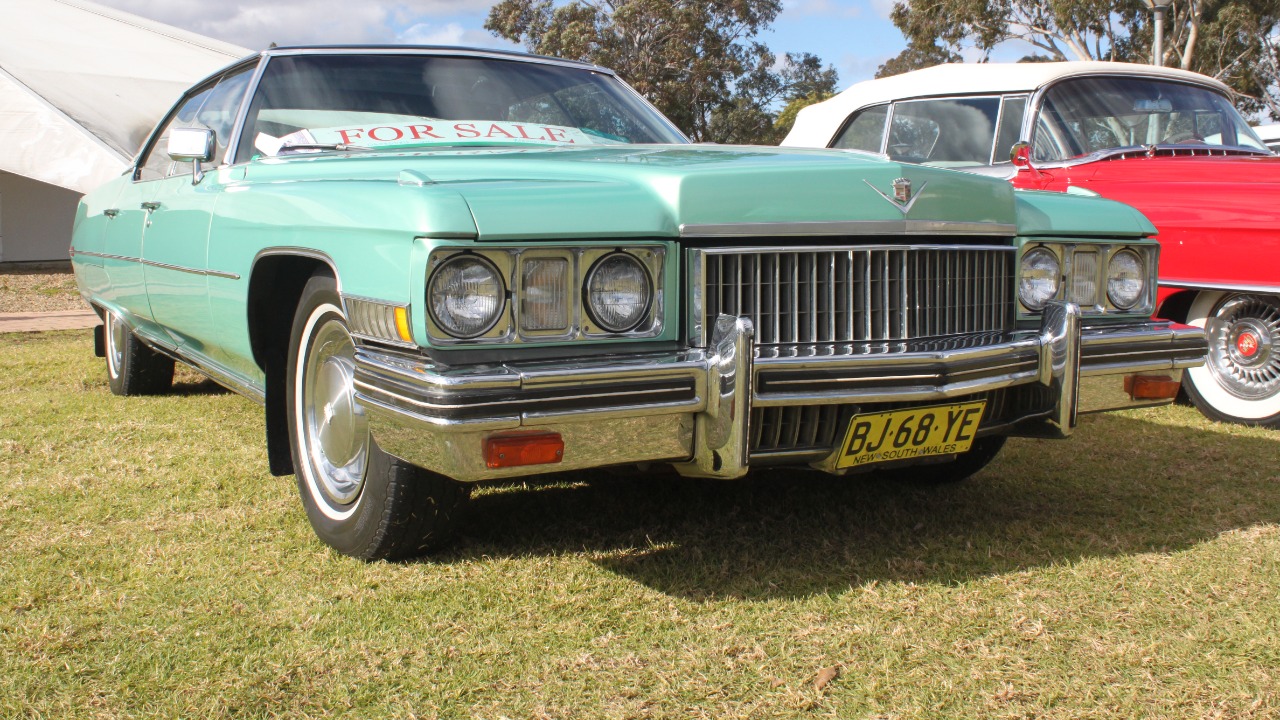
Before you ever turned the key, the Sedan de Ville worked its magic with scale. You felt it in the way the front fenders stretched out in front of you like a runway and in how the rear quarters seemed to go on for an extra parking space. Contemporary accounts describe the 1973 Cadillacs as the epitome of American luxury, style, and presence, with bold chrome accents, massive bodies, and a smooth, almost floating demeanor, and that description fits the four‑door de Ville perfectly when you picture it filling an entire lane of your memory as well as the road in front of your house. Those long, flat surfaces and sharp creases were not subtle, but they were disciplined, giving you a car that looked expensive without needing a badge to explain it.
Walk around a well‑kept example today and you notice how the details reinforce that first impression. The grille is wide and upright, the bumpers are heavy enough to look structural, and the side profile is a single, unbroken line that makes the car seem even longer than it is, a visual trick that designers of early 1970s American luxury sedans leaned into. When you see enthusiasts talk about these cars as the epitome of early 1970s American luxury, they are responding to that combination of scale and restraint, the way the brightwork frames the body rather than drowning it, and how the car’s sheer size becomes part of its quiet confidence rather than a gimmick.
Power you felt more than you heard
Once you settled into the driver’s seat, presence shifted from what others saw to what you felt through your right foot. Under the hood, the 1973 de Ville shared its heart with its two‑door sibling, a massive 472-cubic-inch, 7.7-liter V8 that delivered its strength in a smooth, almost lazy way. You did not buy this car to chase redlines, you bought it so the engine could move several thousand pounds of steel with the kind of effortlessness that made you feel insulated from the work of driving. The big V8’s broad torque curve meant you could ease away from a light with barely a whisper from the exhaust, yet still surge past slower traffic with a gentle squeeze of the pedal.
Period descriptions of the related Cadillac Coupe talk about performance that was rated as strong enough to keep this full‑size luxury car at the front of the pack while still using a traditional front engine rear‑wheel drive layout, and that same mechanical formula underpinned your Sedan de Ville. One detailed account notes that the car was performance rated while remaining composed, which is exactly how the four‑door felt when you merged onto the highway and watched the speedometer climb without any drama. The engine’s quiet authority, more than any spec sheet number, is what made you feel like you were piloting something important.
A cabin built to impress your passengers
Open the long door and you stepped into a space that was as much social lounge as automobile interior. The Sedan de Ville’s mission was to carry you, your family, and your friends in comfort that felt a step above anything else on the block, and owners of earlier cars like the 1965 Cadillac Sedan remember how that formula created a top‑tier driving experience when a strong engine was coupled with a plush, carefully finished cabin. In the 1973 car, that meant broad bench seats, deep carpeting, and a dashboard that wrapped gently around you, signaling that you were in something more considered than a basic sedan.
What made the interior feel special was not just the materials, but the way they were arranged to flatter everyone on board. The rear seat was genuinely adult‑sized, the door panels carried the same patterns and trim as the front, and the overall effect was of a rolling living room where every passenger mattered. Enthusiasts who look back on the Cadillac Sedan as a prime example of mid‑60s and early‑70s American luxury often point to how this kind of interior, paired with a strong engine, delivered top-tier driving experience that made long trips feel shorter and everyday errands feel like small occasions.
On the road, the car did the talking
Out on real pavement, the Sedan de Ville’s presence turned into something you could feel in your spine and your fingertips. Owners and period testers describe these full‑size Cadillacs as best‑selling luxury sedans that offered an unbeatable combination of style, comfort, and performance, and that mix came alive once you were rolling. The steering was light, the suspension was soft, and the car’s long wheelbase smoothed out expansion joints and potholes until they felt like distant suggestions rather than sharp impacts.
One evocative description of a similar Cadillac notes that once the ride was under way, boulevard travel intrusion was negligible and that the car managed the roughest pavement with ease, a reminder that the brand’s reputation as the standard of the world was built on how it felt to cover real miles. That same account emphasizes that its eminence never went unnoticed, which is exactly how your Sedan de Ville behaved when you glided through town, the car doing the social signaling for you while you relaxed behind the wheel. In that sense, the car’s presence was not just visual, it was experiential, a combination of isolation and authority that modern luxury cars still chase but rarely match in quite the same way, a point underscored when you watch a detailed walkaround of a surviving 1973 Cadillac Se at Hudson Autoworks in Greensboro North Carolina and see how serenely it still idles and moves.
Why the Sedan de Ville still lingers in memory
Decades later, you can see how deeply this car imprinted itself on people by the way they still talk about it. Enthusiast groups share photos of a 1973 Cadillac Sedan Deville that has 000 miles on it and still belongs to the original family that bought it brand new at Don Mas, treating the car almost like a member of the household rather than a depreciating asset. That kind of loyalty is not just about nostalgia, it is about how the car made its owners feel important, whether they were pulling up to a restaurant or loading luggage for a cross‑country trip.
Broader histories of the brand point out that by the early 1970s, the Coupe De Ville had vaulted ahead of the Sedan De Ville in sales, with the Cadillac Coupe De Ville and its two‑door glamour becoming the face of Cadilla’s luxury image. Yet the four‑door quietly remained the full‑size luxury sedan that anchored the lineup, the car that families and business owners chose when they wanted space and stature in equal measure. When you look at how these cars are described as full‑size luxury sedans that were Cadillac’s best‑selling models, or how later commentators talk about the timeless elegance of the 1973 Cadillac Coupe and its influence on design in the early 70s, you start to see the Sedan de Ville as the practical backbone of that story, the car that translated all that design work into everyday life.
More from Fast Lane Only